
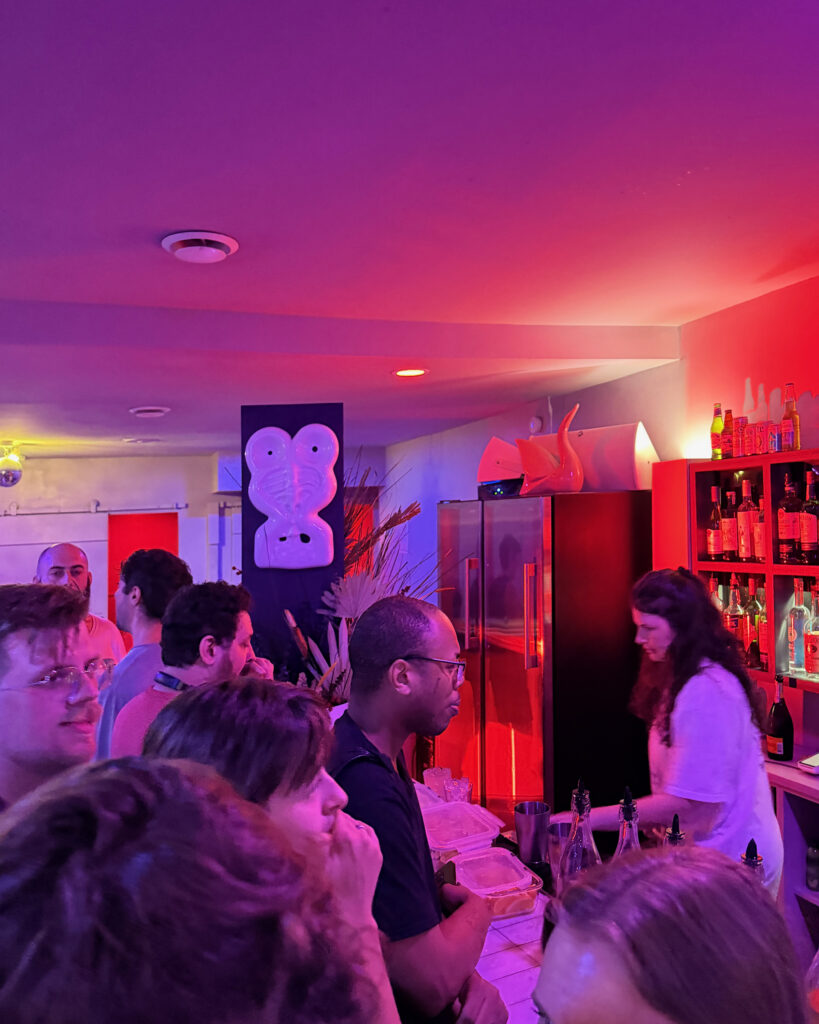
They say Vegas is dying. In the face of endless beige organic wine, padded listening rooms that drip-drop a smug sense of performed connoisseurship, while we “quiet quit” in “quiet luxury” – Las Vegas and what it embodies just might save us from ourselves.
Do we really not want to see The Sphinx, visit the Temple at Luxor, or feel the mist of the Trevi Fountain for 50% off? Why is a simulacra of a farmstead dining experience in the middle of Nolita more enticing than a simulacra of the ancient city of Venice in the middle of the desert?
Do the wildly colorful theaters of Vegas shine too bright of a spotlight on the nature-toned preachers of the commercialized self-care pulpit? Las Vegas, and all its aesthetic American grandiosity, is a synthetic environment that speaks human truths. It’s a story of American hope, optical illusion, aesthetic density, and the belief that one glimmering moment might change our lives forever. It’s a city made from the same impulse that brought us all to NYC, to try our luck. Like New York, like Venice, like South Beach, like Hollywood, like all of us artists working through the night – if your lights are on, you are alive.
VENETIAN BELLAGIO PALACE is up through early November at BEVERLY’S, 297 GRAND STREET, NYC
ARTIST STATEMENTS
Eric Santoscoy-McKillip – site – Instagram
Formerly, my work in Venetian Bellagio Palace consists of the intersections of forms, planes, and symbols. The three paintings currently at Beverlys are a break or rupture of the traditional Western pictorial orientations. Stepped shapes cut into and inlaid into rust and stuccoed covered rectangles. Stuccoed buildings are ubiquitous in the US desert Southwest; the material is an inexpensive material to cover all types of structures both commercially and domestically. In making these, I was reacting to a recent trip driving into Las Vegas and seeing a glittering oasis in a rusted landscape. The pieces themselves become tableaux, facades, and placeholders for something real, much like in the way Las Vegas has a tradition of recreating or, better yet, mimicking sights, cities, and attractions that inevitably ask questions of authenticity and ownership. The masks that I have in the show act in the same way, what we see in something, in a symbol, a game, is what we see within ourselves or society.
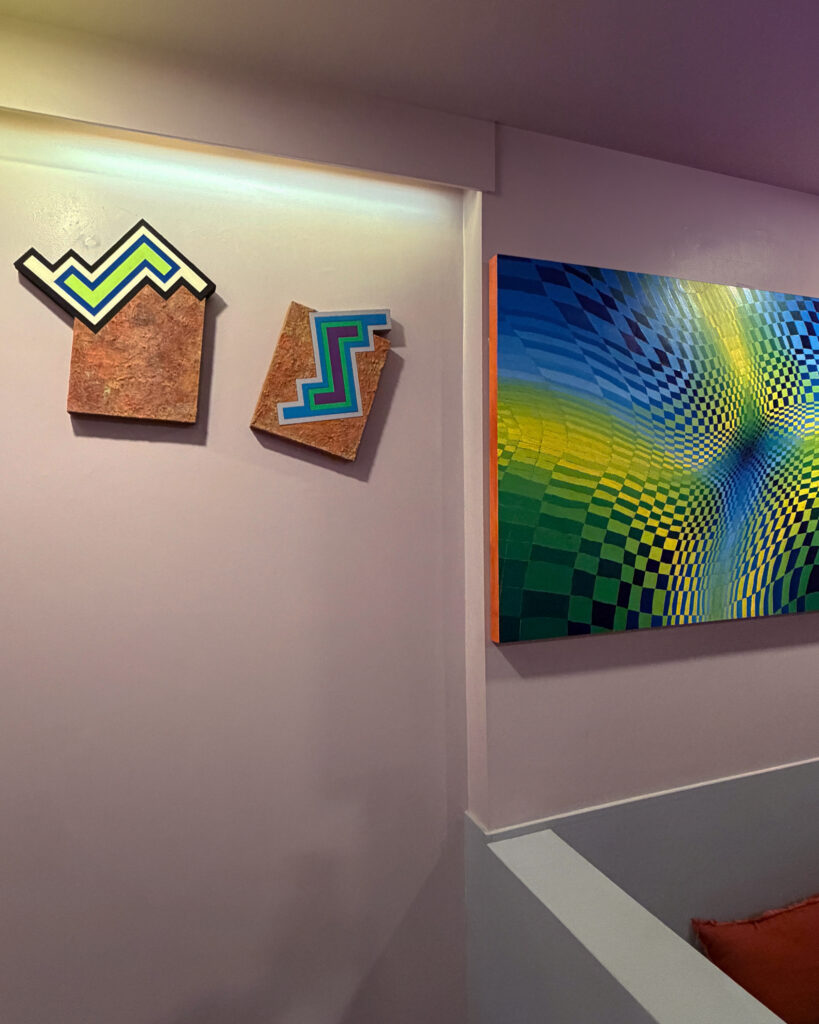
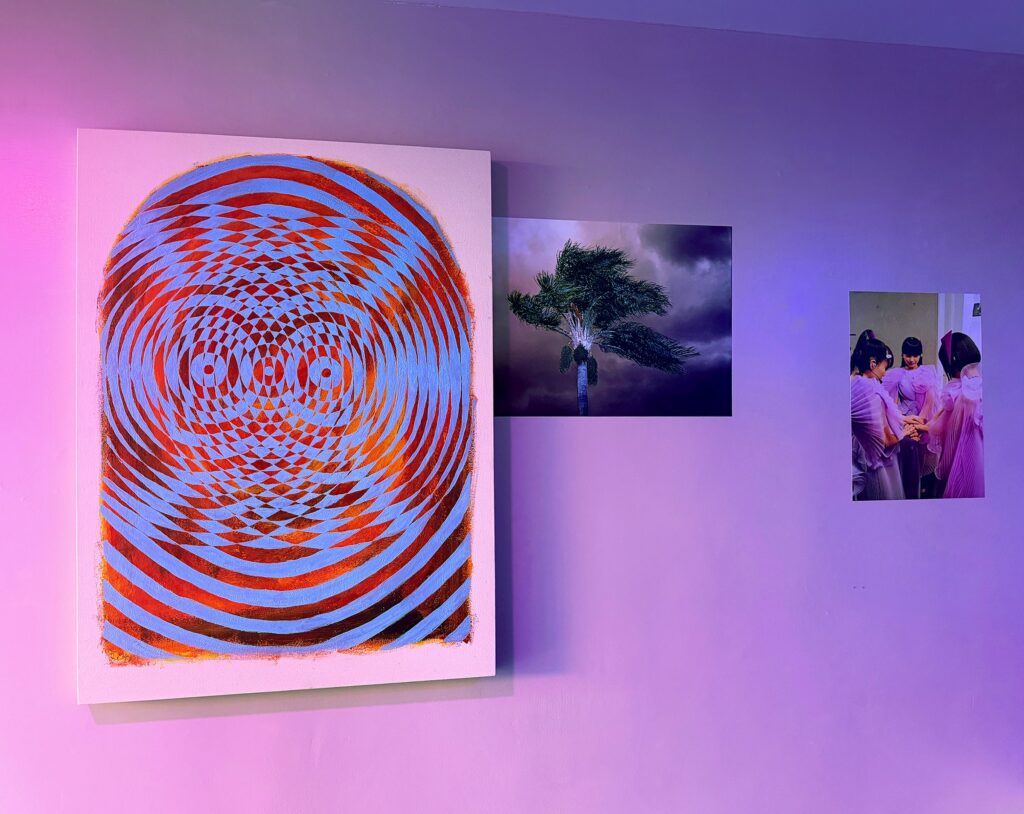
When I’m at work in the studio, I think about my painting as a building process. There is a distinct order in assembling these images. First, I lay down an expressive ground with palette knives to open the space of the painting. Next, I delineate that ground with finely brushed grids or interfering circles. The line-work acts as a foundational structure that I finally fill with more color, often in gradient steps. While I’m aiming for precision in this process, my human wobble is a valuable, essential element.
In the context of VENETIAN BELLAGIO PALACE and the aesthetic grandiosity of Las Vegas, my paintings share a highly constructed character. Mine are images of a synthetic space – but one that is deeply personal and true.
I’m thrilled to be included in this show of wonderful artists. All of our work together is energized with the neon glow on Beverly’s walls.
Charles Caesar – site – Instagram
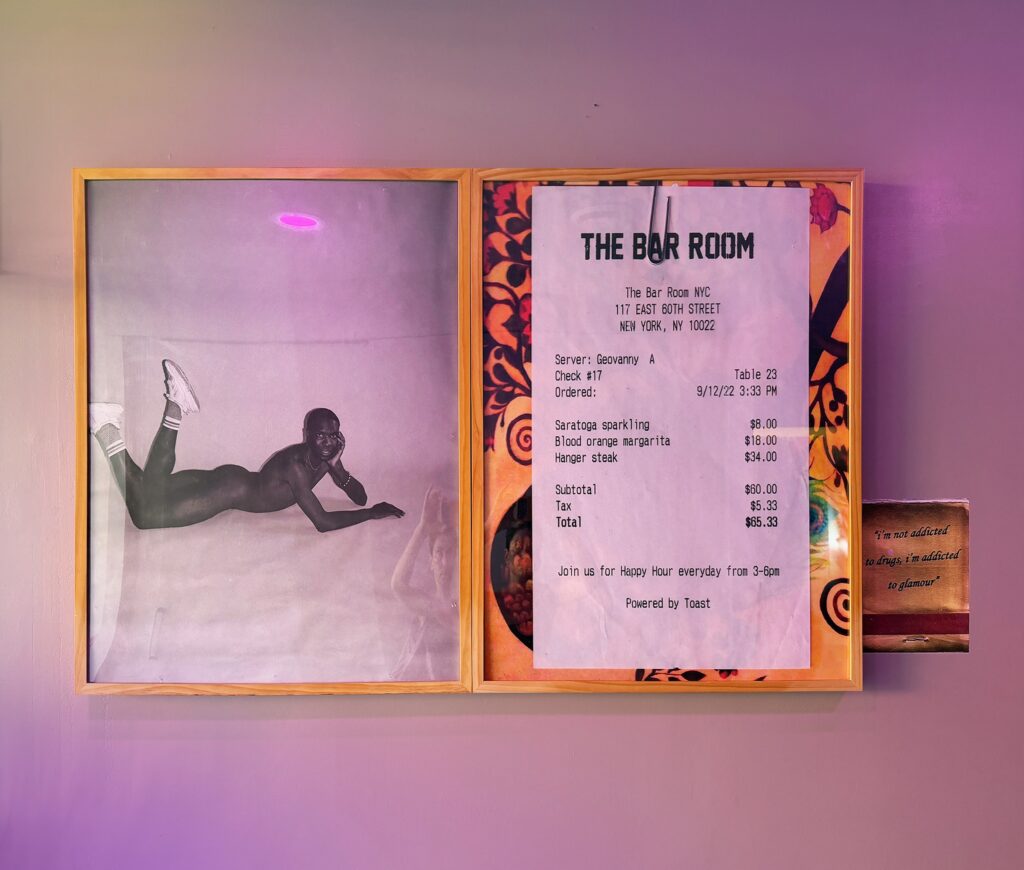
There’s a self-portrait that relates to taking control over one’s own image, like a proud stage performer on Broadway or the Strip. There are scans of matchbooks. We love good design and a good smoke in NYC. Vegas can relate. There’s a rare portrait of the pop music trio Perfume, performing their pre-show “huddle” before taking the stage at Shibuya Public Hall. The band formed when the trio was friends in high school, just as I began my art practice in high school; years later, our creative drives and good fortunes overlapped. Luck is only part of the story. WE WORK FOR OUR ART. My practice is my priority, yet I’m having my precious time wasted by systems that only serve the greed of a very few. They say the house always wins, but many of the current houses are built on sand. Earth will heal.
Caroline Anderson – site – Instagram
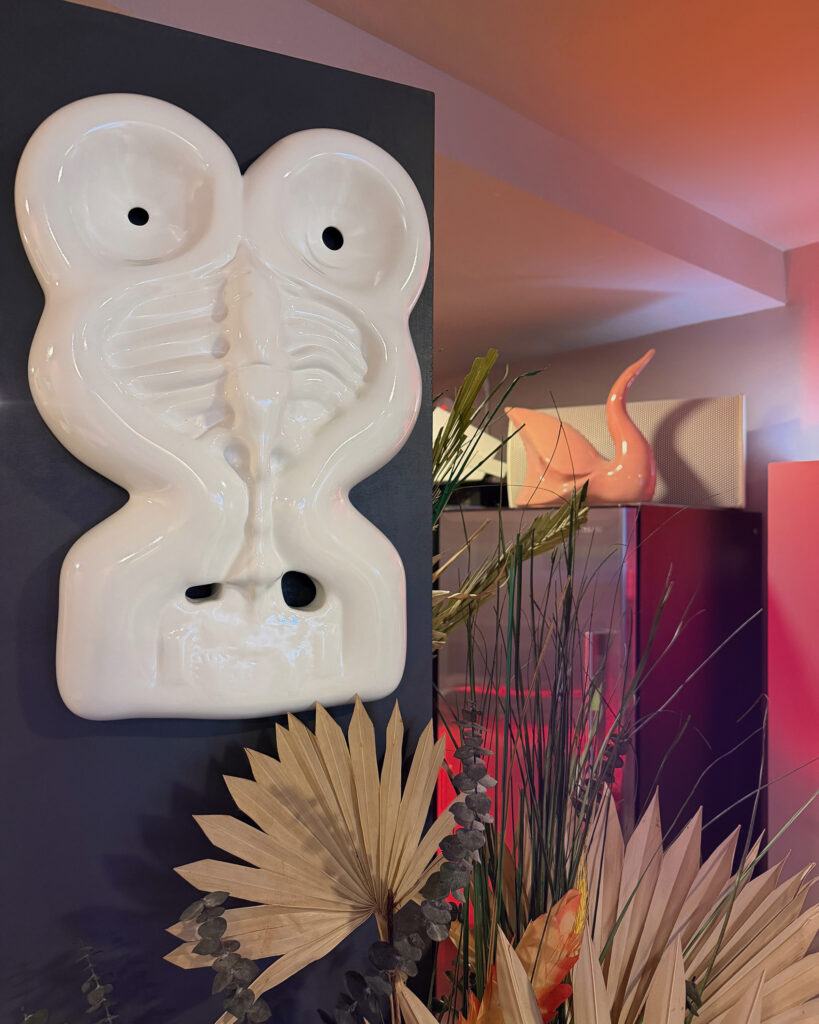
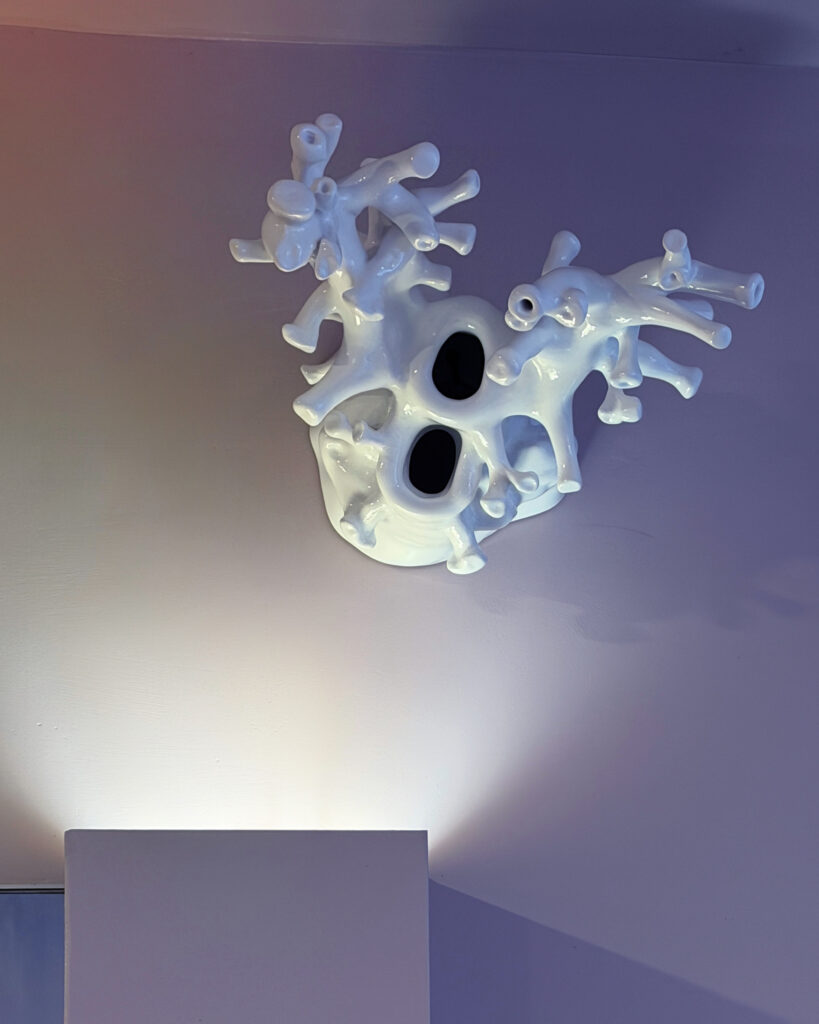
Having never personally visited Las Vegas or lived in NYC, I was nevertheless immediately drawn to the conversations Leah and I had as she was planning this exhibition. We both responded to the indulgence, maximalism, and lushness of Las Vegas as a metaphor for more vital experiences, and to the idea that such an artificial environment can produce something genuinely felt. In my work, I’m always trying to create forms and experiences that sit ambiguously between the biological, technological, ancient, alien, and speculative, things that are difficult to categorize through language alone. They become ciphers for all kinds of possible origins, suggesting unfamiliar organisms or artifacts from histories that have never existed. Friends have cheekily described them better than I can as “a spatchcock alien” or “my sensuality,” and I love how they seem to take on a life of their own beyond my attempts to describe them. I’m interested in how readily we project meaning and a sense of life onto things we don’t entirely recognize.
The way I make my work involves pulling from a visual archive I’ve been building for years, collecting images of everything from tree roots, coral, and fungi to computer hardware, industrial machinery, and microscopic structures. I use these images to develop digital sculpting brushes that extrude geometry, which I then spend a lot of time manipulating and refining into the forms you see in VENETIAN BELLAGIO PALACE. For this exhibition, I 3D printed each sculpture and meticulously finished the surfaces through a process much closer to automotive bodywork than traditional sculpture. I intentionally left them a glossy white so they could take on the particular lighting and atmosphere of Beverly’s. I love how dramatically their appearance changes in the space, and how the environment becomes part of the experience of looking at them.
I’ve always had a deep appreciation for artist-run spaces and galleries that both play into and break the conventions of the traditional white cube. About ten years ago, I started IRL Gallery, which was interested in blurring the experience of seeing art in real life and encountering it through documentation online. More recently, I founded Solar Noon in Cincinnati to highlight experimental practices through solo exhibitions that are responsive to the contemporary conditions of the Midwest. Beverly’s, for me, is one of the most potent expressions of the artist-run mentality, and the fact that it’s also a bar activates the work in a way that couldn’t really be replicated elsewhere. People are encountering the sculptures while having drinks, talking with friends, or just going about their night. I think there’s something wonderful about that, and it gets at the premise of the exhibition in a very real way. All of the artifice and theatricality of the space becomes part of an experience that is entirely authentic.
Victoria Reshetnikov – site – Instagram
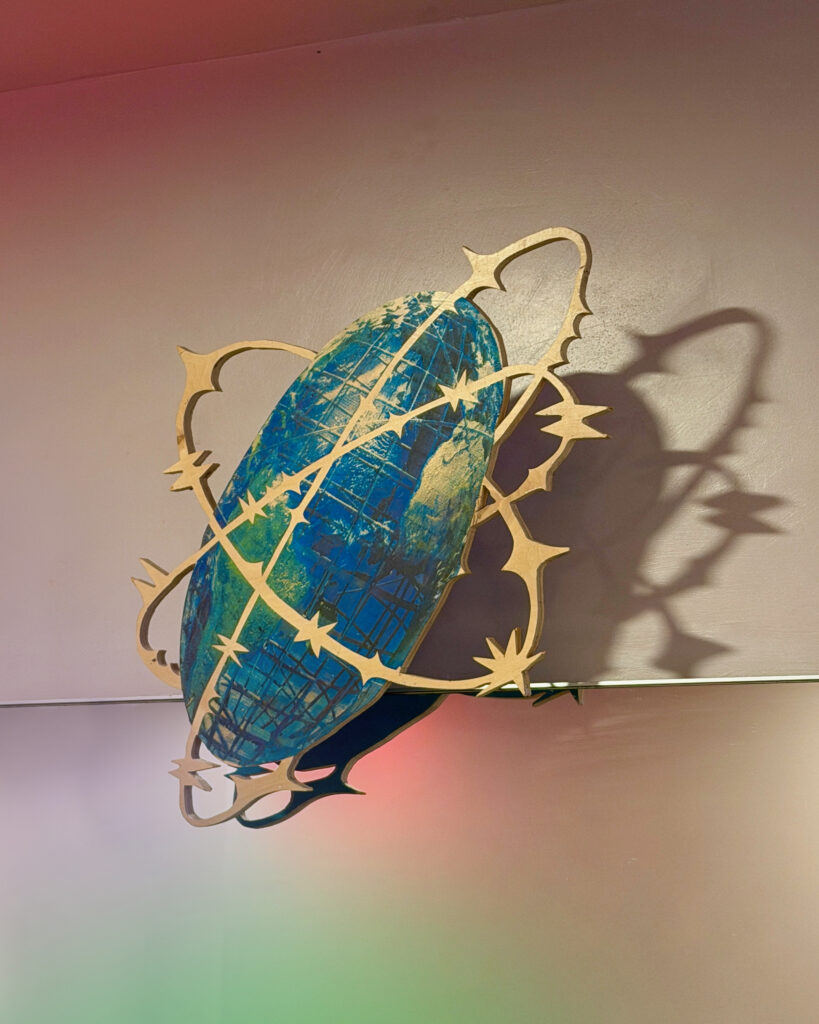
I’ve had a years-long interest in world’s fairs, as architectural projects, political tools, and symbols. World’s fairs are first and foremost concerned with empire and how to present that empire. In order to be digestible, the historic tactic has been miniaturizing and producing replicas, displacing cultural objects and people. This results in a site of pilgrimage, where people travel to see the “real” fake thing, or the real thing in an entirely different context. This has always felt relevant to New York City for me, not only because there’ve been three world’s fairs here, but also the sheer mass of people that move through the city carry artifacts with them from other places; and often, they take root. We are surrounded by nods to other places, on people’s front yards as statues and shrines, as gardening techniques and produce, as songs and languages. Their recontextualization also blends and transforms these artifacts into new things and experiences, into new sites of pilgrimage. I think about this evolution in the work I make, looking at stratifications of time and history through the collection, construction, and distribution of culture and monuments, and how they’re allowed to take on new use values.
We understand Las Vegas, like world’s fairs, and like New York, to be a site of pilgrimage. Like a world’s fair, the city is highly fabricated, capturing monuments for their ability to be consumed by the public: in the middle of a desert, the Statue of Liberty shines as bright as its real counterpart. This obsession with capturing, creating a navigable version of the entire world, is a kitschy residue of imperial desires for control. My work “the world has always been yours (after Unisphere)” (2024) echoes this obsession using a representation of a globe, an image that is always doomed to be a miniature. We can never experience the real thing, but there exists a prolonged impulse to capture the earth for our viewing.
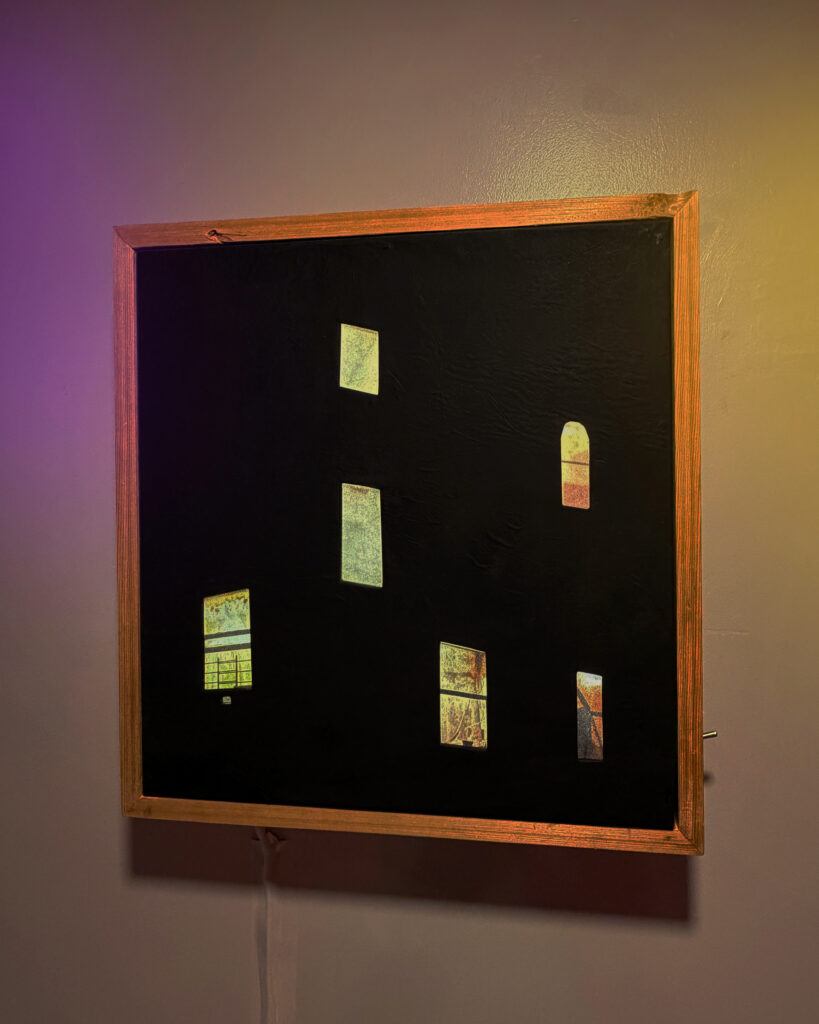
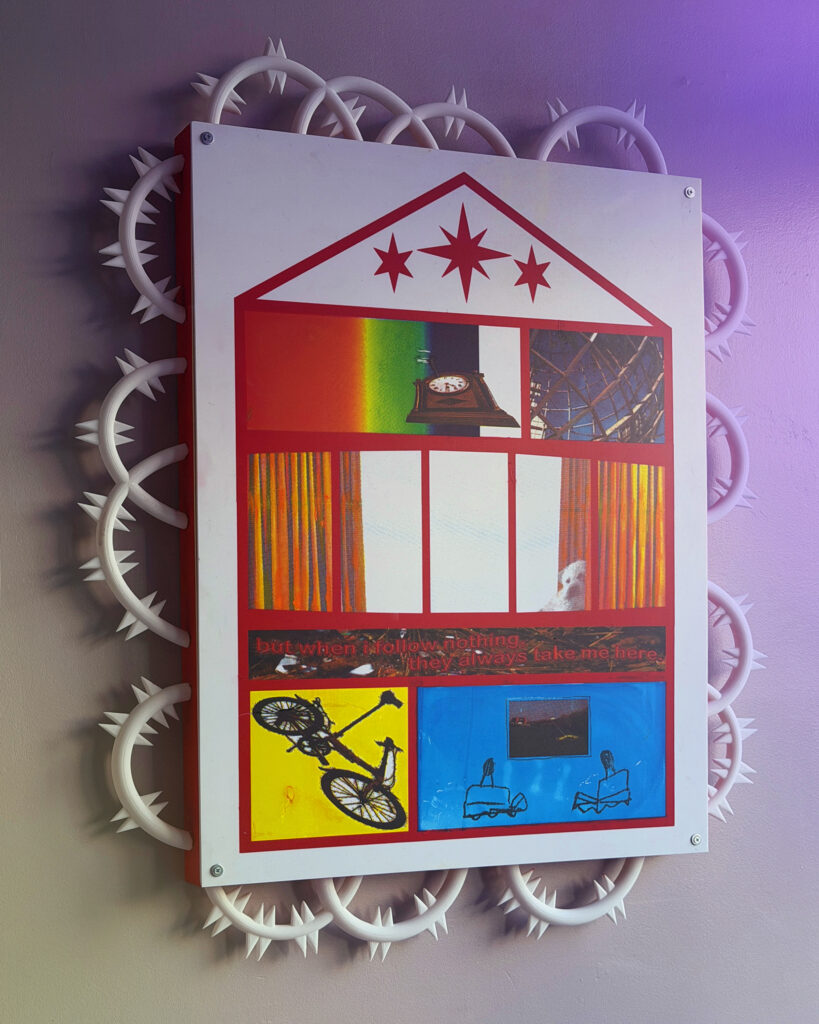
When I got the opportunity to exhibit some work at BEVERLY’S, I knew I wanted to create a lamp. Artwork in the space requires high contrast, so I wanted to incorporate lighting to draw the eye and create new visual interest. “Night Light #2” (2026) is an artwork that I’d already had in my mind for a few months, so I appreciated the final push to get it done for this show. It comes out of a prolonged interest in windows, which I’ve been interested in since my collaboration with artist Meinzer on our two-person show Hush Lobby. I have an archive of photographs of lit windows at night that I’ve been capturing on bike rides for the last few years. I’ve become concerned with photography for all the usual reasons– its voyeurism, its violence, and its capacity to capture time and narrativize reality. These photos and the resulting compositions are a poetic investigation of urban living, a practice of constructing architecture out of its openings. It felt relevant to the site of BEVERLY’S in New York, as well as the general feeling of living in urban centers: there are small openings in space that wandering street eyes can still pass through, if they look hard enough.
Tommy Schell – Instagram
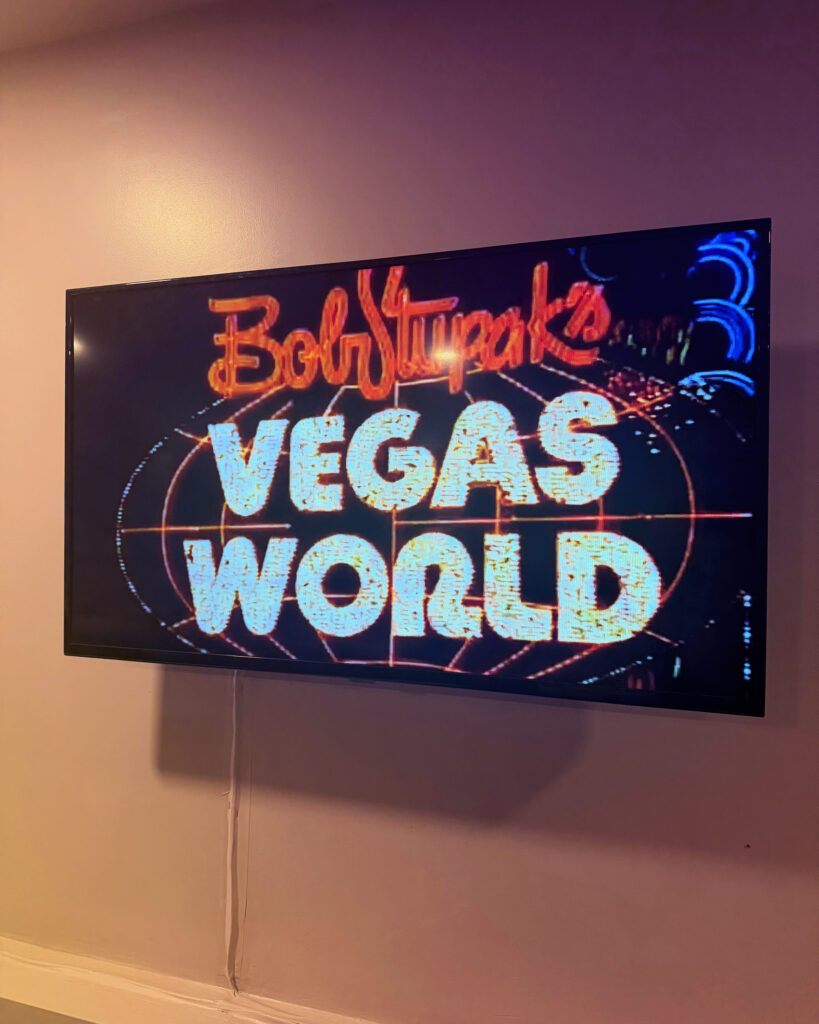
There are some funny connections between Beverly’s and the video I made for the Venetian Bellagio Palace show. The video is probably the most obvious representation of Las Vegas – it’s a compilation of incandescent lighted signs of the old strip interspersed with footage of the Sirens of TI (a massive defunct spectacle that took place outside of the Treasure Island casino). The show was a Frankenstein creation of the different trends that altered Las Vegas over 30 years and created a nostalgia for those things that were lost along the way. I’ve always admired that Beverly’s doesn’t get caught up in the trends that proliferate through New York, and this lineage to the past of art and nightlife spaces in NYC is actually one of the things that makes it so cutting edge and relevant today.
The Sirens of TI show was originally a massive pirate show that was built in the 90s when Las Vegas rebranded as a family-friendly destination. It ran for nearly 20 years – every day a 100’ British ship would sail out into the bay and sink below the waterline. It was the largest moving piece of scenery ever built. However, by the 2000s it was obvious that families weren’t spending a lot of time gambling in casinos. So, Vegas stopped trying to brand itself as something that it’s not, and just tried to make it sexy. Make the pirates Pussy-Cat Doll “Sirens” and swap the British military for jacked beefcakes who are wooed into the sin-filled cove. Ultimately, the Disney-inspired spectacle wasn’t more than a fad, and Las Vegas was left trying to recapture the hedonistic things that made it so interesting to people in the first place.
I think this is a fun lens inside of Beverly’s, a place that is clearly drawing on a long history of bars and nightclubs in NYC. It’s from a lineage that’s much more dialed-up and bacchanal than the calculating and buttoned up world of mixology that took over in the 2010s. It’s focused on getting people and ideas together and less about narrowing in on the trends of the thing that you’re individually consuming. When we, as New Yorkers, are standing in line to get the best loaf of bread for $60 or spending entire Saturdays in line for the most TikTok’d pile of dumplings for $5, it feels like we’ve lost the plot. The best parts of New York are not about the individual’s experience, it’s arguably one of the most inhospitable places to live, it’s about sharing that experience with others. Bev’s has always embodied that ethos and continues to provide a place that honors and cultivates the real-life experience of being together. A lot of us took a risk moving to NYC, an often less comfortable place to live, from other parts of the world to connect with people on a more profound level. In that sense, Venetian Bellagio Palace couldn’t be in a better location than Beverly’s – a spot that is always welcoming people into the continued conversation.
Intro copy and all photographs courtesy of BEVERLY’S
Be the first to comment