
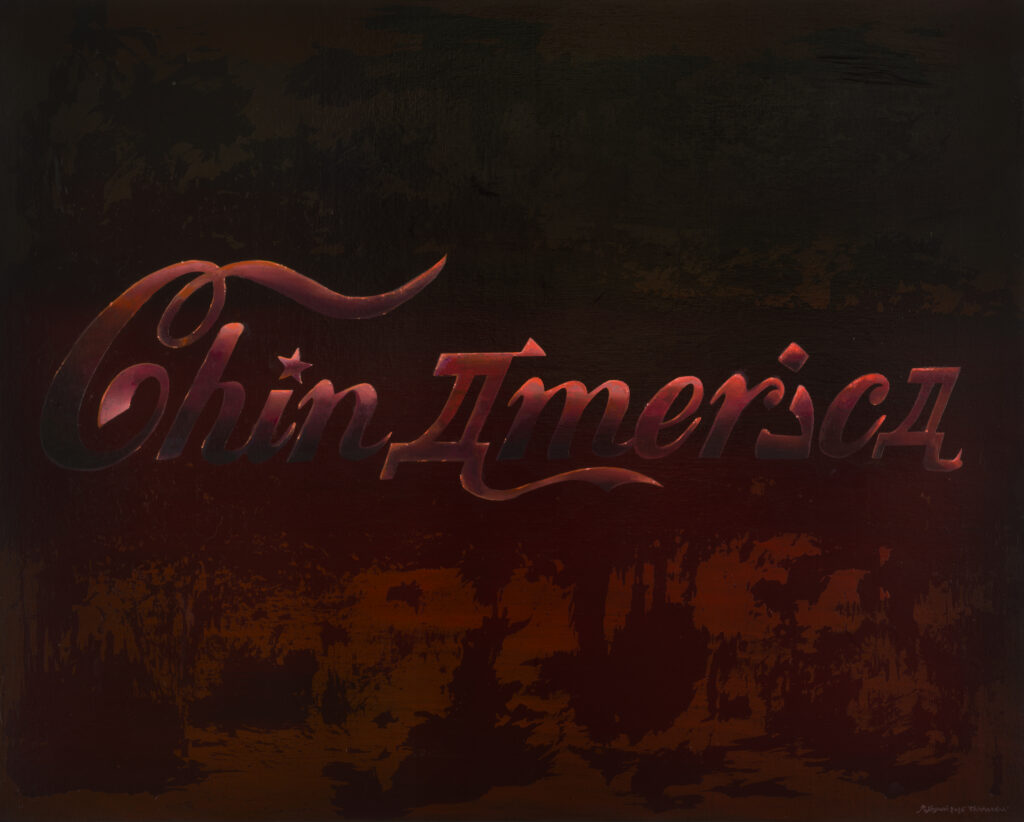
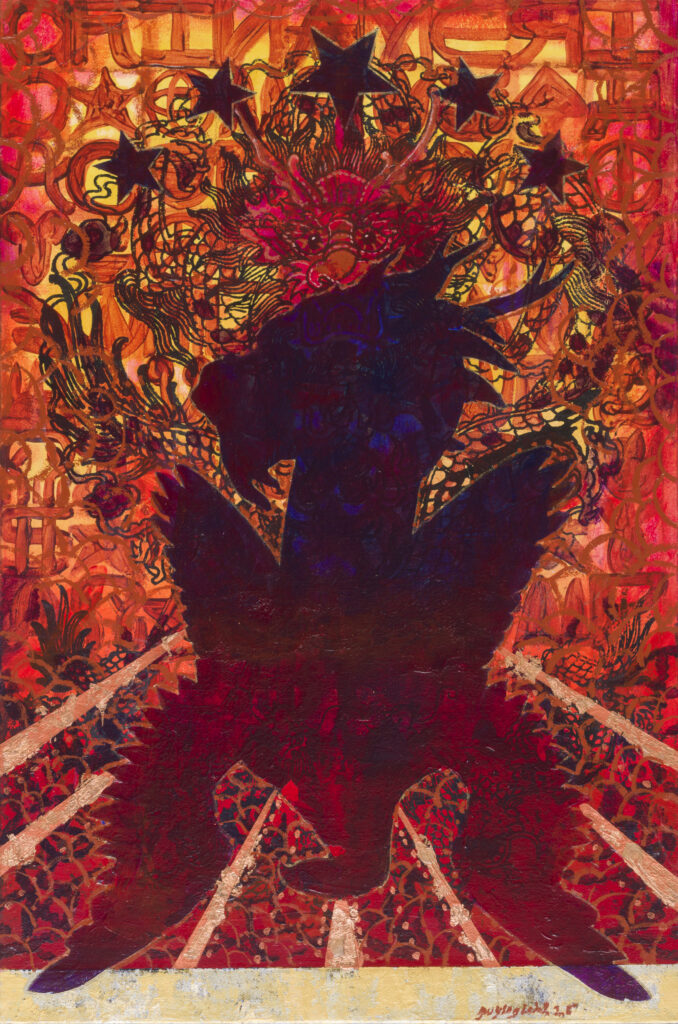
31.5 x 39.37 in
Pu Yingwei (b. 1989) lives and works in Beijing, China. As an active contributor to the new generation of political conceptual art in China, he critically engages with socialist art genealogy. Pu Yingwei dedicates his work to articulating the changes in China’s identity amid globalization and exploring the deeper impact of China’s modernization and development model on global patterns through cross-cultural narratives.
His practice employs various media, including painting, video, design, writing, and lecturing. He has developed a “new internationalist” artistic language based on his perception of Eastern civilization. In recent years, Pu Yingwei has deepened his global engagement, traveling to Eastern Europe, Africa, Central Asia, Southeast Asia, the Americas, and the Caribbean, including regions like the Balkan Peninsula and Ukraine, which are currently in conflict.
Yingwei recently made his U.S. debut at Independent Art Fair New York with Paris-based Galerie Sator. His solo booth was a critical success and one of the standout presentations of the Fair.
You’ve described ChinAmerica as approached from “Chinese subjectivity” rather than nationalism; that is, lived experience rather than ideology. In a New York room, in front of American collectors, how do you hold that distinction?
To me, Chinese subjectivity represents an open, ever-evolving sense of identity. Along this ongoing journey, I continually ponder fundamental questions: What defines China today? What does contemporary China truly stand for? What lies ahead for its future, and what implications will that future hold for the wider world? These are questions we must confront mindfully, yet they carry no definitive answers.
Unlike nationalism, Chinese subjectivity is far more nuanced, intangible, and layered. And it is this very complexity that lends it raw authenticity and intimate humanity. It is inextricably woven into the minutiae of my daily life, shifting and evolving with each passing day. Your observation about navigating this distinction in a New York setting is incredibly astute. It rightly acknowledges that American audiences often reduce “Chineseness” to simplistic symbols.
Needless to say, conveying the multifaceted reality of China cannot be achieved in a single gesture—which is exactly why conversations like this matter. For this exhibition, I have chosen to intentionally soften the dividing line between the two concepts. While ChinAmerica carries a distinct sharpness and edge, its core goal is to make American viewers keenly perceive the vitality of contemporary China. This is the foremost aim of my artistic practice. Only when this tangible presence is fully acknowledged can the stories behind the work unfold and strike a genuine chord with the audience.
I previously staged an exhibition in China titled Obscure Adventure. I believe that for a long time to come, my artistic portrayals of China, my creative stance, and the values embodied in my work will continue to exist in a state of ambiguity and subtle obscurity. This inherent complexity and duality run parallel to the trajectory of modern China’s development.
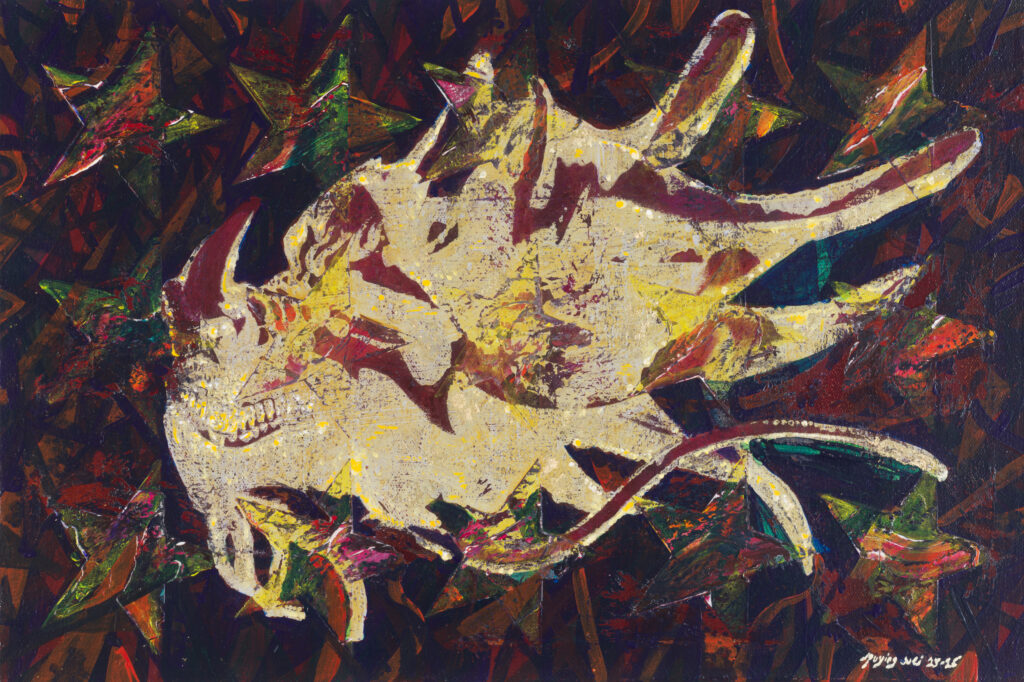
The concept “ChinAmerica” was first proposed in a sociological context around 2010. Why do you think it took the art world so long to engage with it, and what has changed now that made this the right moment for the visual manifesto?
To this day, this concept remains largely under explored across the art scene, with few artworks created around it. From what I have observed, the contemporary art world appears inherently wary of grand narratives—such as China-U.S. relations or post-communism. Most practitioners choose to turn toward micro-narratives and uphold the value of diversity, and this is undoubtedly a noble ethical pursuit.
Yet I sense a striking shift: grand narratives have permeated every facet of private life, merging seamlessly into our personal stories. They tug at our emotions and steer our choices, exerting a profound influence on how we live and act. For this very reason, I hold that we ought to revisit the grand narratives around us with sincere and rigorous reflection.
Take the notion of “ChinAmerica” in particular. In little more than a decade, it has transformed from a speculative idea into an undeniable reality. While my exhibition was underway, the heads of China and the United States held a meeting in Beijing. This event alone stands as the most compelling testament to the validity of this concept. Unlike abstract philosophical theories, visual artworks are far more layered entities. They exist simultaneously as intellectual expressions and commercial pieces, bridging the spiritual and the tangible. This dual identity is where art’s inherent political dimension resides. At this defining juncture of global history, creating a solo exhibition and a full body of work to document this pivotal moment is, to my mind, an indispensable act—both for myself and for the world as I perceive it.
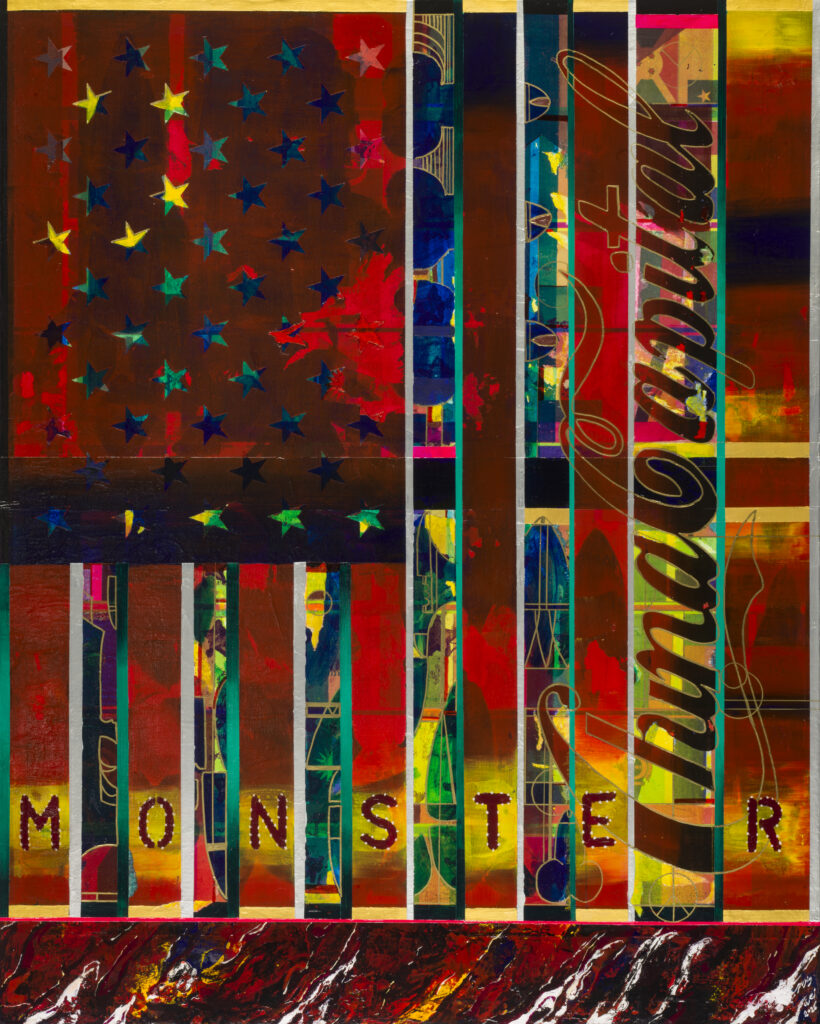
You’ve described ChinAmerica as a condition shaping everyone. Yet Independent New York’s framing positioned it alongside other Asian artists examining post-empire America. Does that contextualization feel accurate?
This interpretation misses the mark. What I adopt is merely a stylistic framework; at its heart, this is a deliberate conceptual choice rooted in political thinking. To put it plainly: the aesthetics may appear alike, yet our core intentions stand worlds apart.
I am reminded of Xu Beihong, one of China’s pioneering artists who studied in France. Upon arriving there, he did not bring the prevailing Impressionist style back home. Instead, he embraced Realism, convinced it could resonate more widely and carry greater social weight in the China of his time.
Similarly, I have revisited the Political Pop aesthetic that defined Chinese contemporary art in the 1990s, reinterpreting it through my own painterly vocabulary. But beneath the surface, my creative motivations, real-life references and ultimate goals diverge entirely from the artists of that period. Art history is a polyphonic tapestry. For a time, critics and audiences may categorize you under a particular artistic trend — and this is not without merit, as it helps others recognize your work and step into your creative vision. Still, my artistic practice has never been confined to such labels. I have never chased prevailing styles nor aligned myself with established movements. To circle back to the notion of the “China Model”: China’s current development and societal structure are unparalleled in human history. As an artist, it follows that my creative journey must also forge an entirely new path, one with no prior precedent.
The Intelligent Capital paintings are split into a fictional magazine header above and painterly imagery below. What are those two registers doing differently? Why does the work need both simultaneously?
I have long been captivated by the art of magazine covers. Even now, conversations still revolve around who graces the cover of Time and the deeper meaning behind such features. To my mind, a magazine weaves together iconography, visual language and media storytelling as a cohesive whole. This unique fusion endows it with profound historical significance — and it is precisely for this reason that I aim to create a bespoke “magazine” to anchor my own artistic world.
Meanwhile, the concept of Intelligent Capital is my artistic response to the era of artificial intelligence. Nowadays, humanity and culture alike are being reduced to data, all feeding into commercial production. Everything is converted into big data and turned into business opportunities, with underlying risks to data security and national security looming large at every turn.
Intelligent Capital captures this subtle yet overwhelmingly pervasive infiltration. The upper section, designed as a magazine masthead, features a hybrid typeface that fuses Chinese, Cyrillic and Latin characters. The lower section serves as a convergence point, where Eastern and Western themes, painting styles, and media intersect and blend seamlessly. This two-part composition, as a whole, envisions a future society in which politics, economy, technology, and culture are no longer separate realms but are tightly interwoven into a single, integrated system.
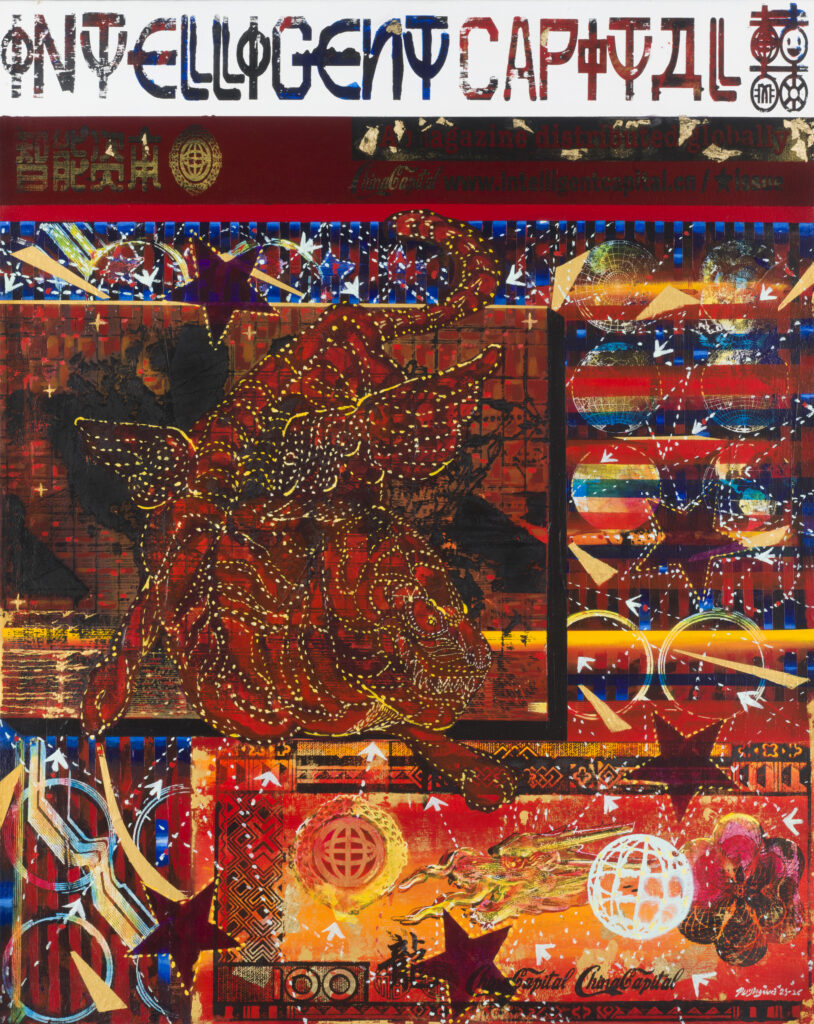
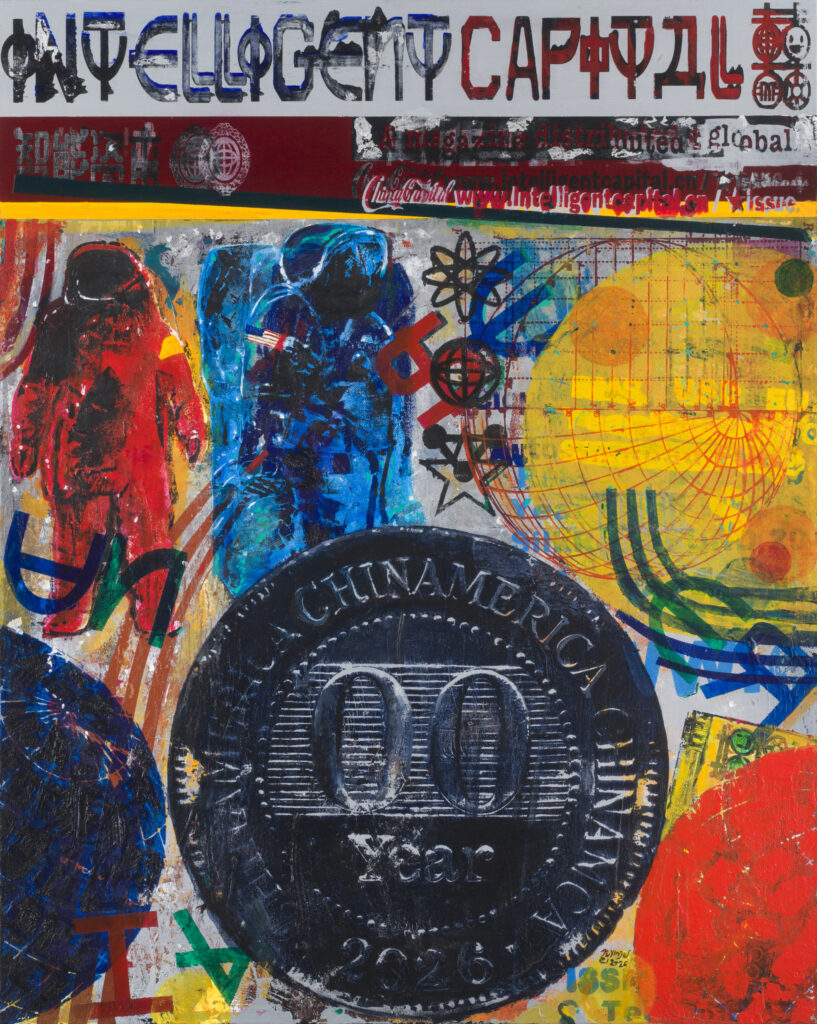
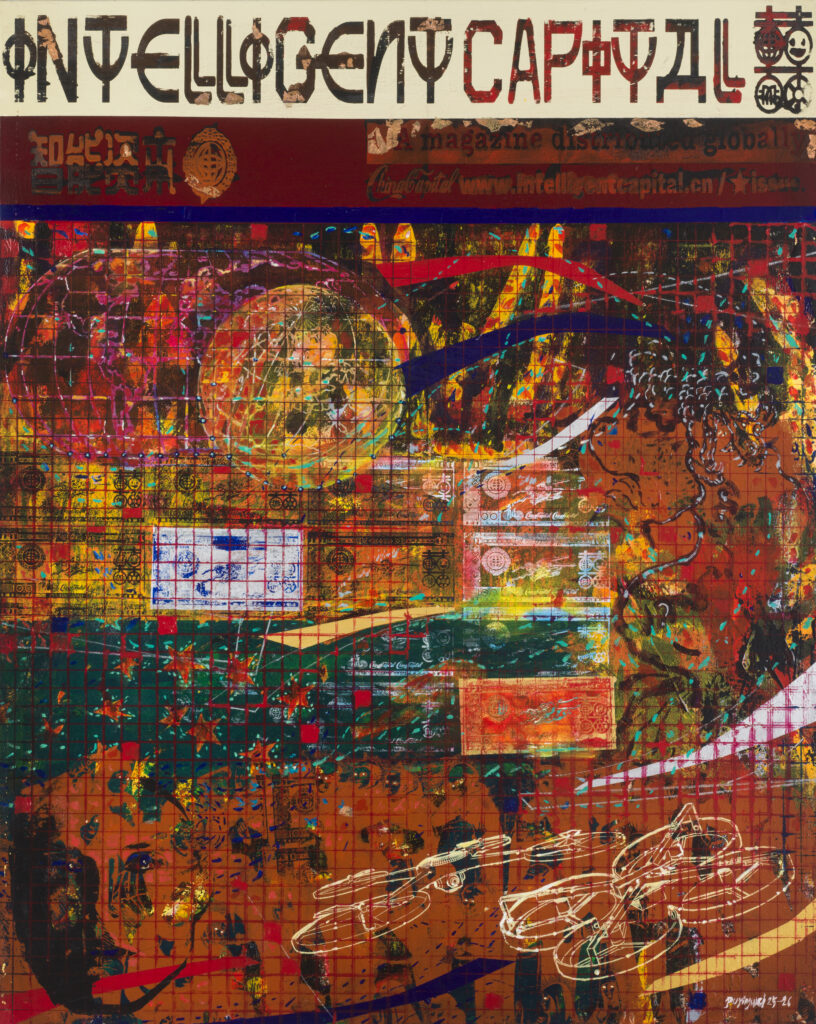
What does this hybrid typeface communicate to a viewer?
I name this custom typeface Empire Font. It ranks among my earliest major conceptual creations after I returned to China. The Cyrillic, Latin, and Chinese characters here are far more than mere stylistic elements. They stand for three powerful cultural currents that define contemporary China: Cyrillic carries the legacy of socialist tradition, Latin represents the global order shaped by the English language, and Chinese characters embody the nation’s age-old heritage. Interwoven together, they compose the cultural landscape of present-day China.
In today’s geopolitical climate, this fusion also mirrors the nuanced dynamic of competition and partnership between three major global powers: China, the United States and Russia. Audience engagement does not rely on intellectual decipherment. Often, simply perceiving this abstract, blended aura is enough to grasp the core concept. Even among familiar audiences in mainland China who follow my work closely, many do not realize these paintings feature a typeface of my own design. Yet this never stops people from sensing the undertones of Chinese identity, socialist heritage, and this uniquely mixed, composite spirit embedded in the work.
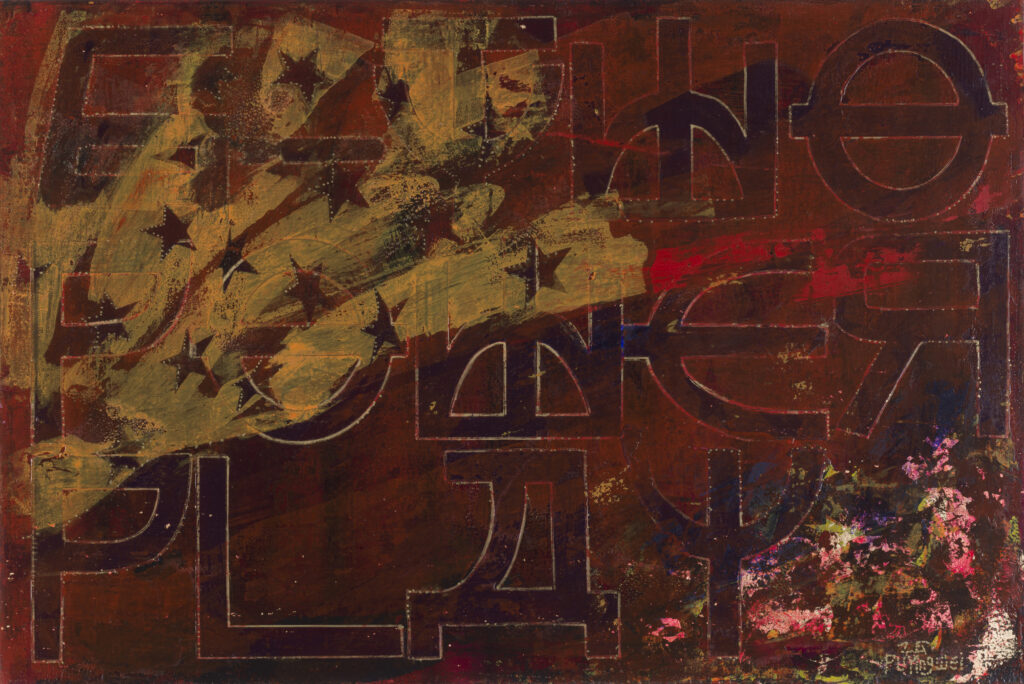
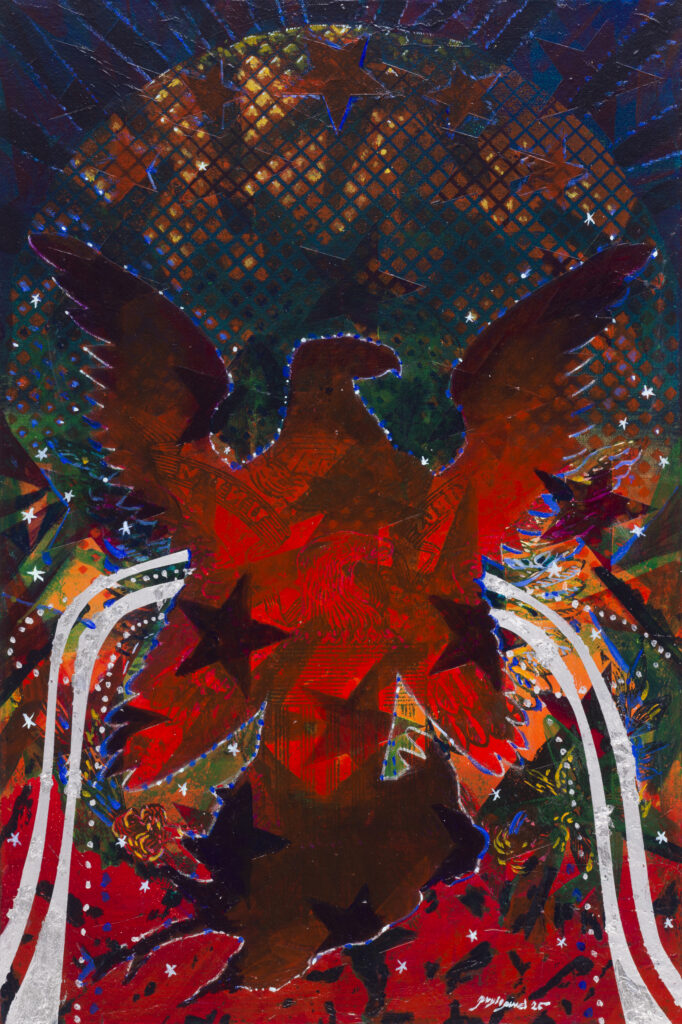
The scattered banknote floor installation ran beneath all the paintings in the booth. What did it ask viewers to do physically and conceptually as they walked through?
Every piece of these scattered banknotes takes the US dollar and RMB as their prototypes, rendered in three symbolic tones: red, blue and yellow. They carry strong ideological connotations, while also anchoring the wall-mounted works within a concrete contextual atmosphere.
My first intention was to craft a visually striking scene — an open invitation, or even a deliberate provocation, to draw audiences into the exhibition space. Meanwhile, the scattered arrangement evokes a sense of chaos and arbitrariness, mirroring the disarray of the world we live in today.
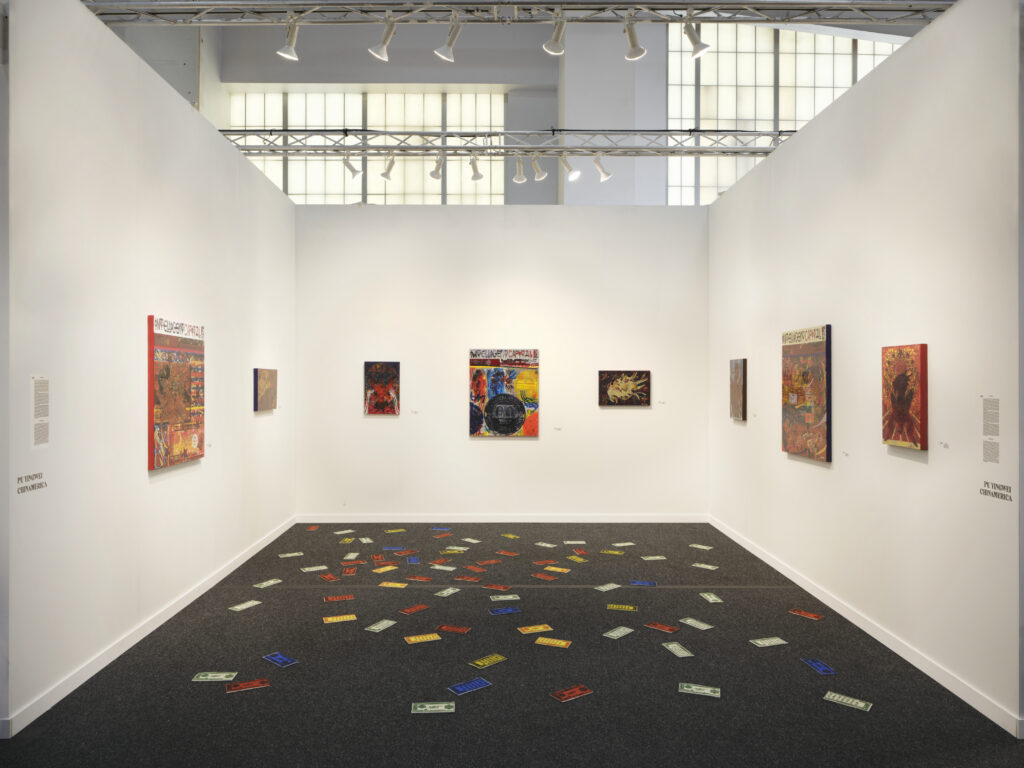
Red dominates your palette as a sign of China, but in an American exhibition, red carries its own political symbolism and weight. Did that double meaning feel useful or like interference?
Duality, and even multiplicity, have been inherent to my artistic practice from the start. Red is a symbol layered with manifold interpretations. Take the five-pointed star, a recurring motif in my paintings: it is adopted by nations with starkly divergent ideologies, each imbuing it with unique meanings.
I am endlessly fascinated by symbols that are at once definitive and equivocal. They shift and flow in intangible ways, yet always retain a piercing, incisive edge. Practically speaking, this artistic strategy helps my work steer clear of direct clashes with censorship and pervasive self-censorship across the globe. Even so, the political undertones embedded within remain unmistakable. In this regard, I see strong affinities with the Russian Avant-Garde artists. Their creations brim with abstract restlessness and stirring expressive force, laying bare the reality that our society is thoroughly politicized — and art can never stand apart from this truth.
You’ve traveled extensively through Eastern Europe, Africa, Central Asia, and conflict-affected regions, including Ukraine. These journeys seem central to your work. How has this bodily exposure to geopolitics fed the paintings?
I embarked on this series of travels in earnest in 2023, as the pandemic drew to a close and international travel finally became viable once more. My first stop was France, my former home of many years, which I established as my overseas base. This journey grew out of a set of long-term reflections, spanning both broad global perspectives and personal considerations.
From a macro viewpoint: throughout the pandemic, I witnessed profound, rapid transformations unfolding within China, while much of the world remained unaware of these changes. I felt compelled to step outside and serve as a bridge for cross-cultural communication. The isolationism and conservative tendencies that took root in many nations during the pandemic would continue to erode globalization long after the crisis subsided.
As an artist, I resolved to rebuild my global connections and reimmerse myself in the wider world. For me, as a Chinese artist, this worldly engagement was never vague or superficial. I deliberately set my sights on former socialist states and regions: the former Yugoslavia, Ukraine, Vietnam and Kazakhstan. My foremost goal was to engage with and carry forward the spiritual heritage of the past century. This journey became an all-round tempering of my vision, mindset and physical stamina. If I were to name the greatest inspiration I gained, it would be the power of what I term direct art — art unshackled from galleries, museums and the established art system. It regards the very traces of human life as artistic expression. This revelation emboldened me deeply: art can take root anywhere on earth, and my creative practice can unfold in boundless forms, allowing me to craft a one-of-a-kind artistic life of my own.
In your writing and exhibition texts, you push back against narratives declaring the “end of globalization.” Instead, your recent travels suggest globalization is mutating rather than disappearing. How do you distinguish between the globalization of the late twentieth century and the version emerging now?
This observation also lays bare the fundamental divide between the US-Soviet Cold War framework of the last century and today’s dynamic between China and the US: the modern world is bound together by deep, irreversible interdependence. Even so, the nation-state system continues to erect countless artificial barriers. Such divisions can never halt the global flow of ideas and influences entirely, yet they drive up costs, force detours, and bring about constant transformation along the way.
To my mind, the uncertainties arising from this process define this new era of globalization. I foresee the next stage of globalization will no longer follow a well-defined order. Instead, it will evolve into a form of chaotic globalization. Much like a raging tornado, it churns up everything in its wake, its core perpetually swayed by the gravitational force of China and the United States.
You drove along the US-Mexico border in 2024 at the same age Warhol was during his 1963 cross-country trip, but as a Chinese artist, in reverse, during a US election year. What does that American pop pilgrimage look like when you superimpose your own biography onto it?
I was equally captivated by Andy Warhol’s travels and the unfolding U.S. presidential election. No matter the outcome — whether Trump prevailed, or Kamala Harris made history as America’s first Black female president — a new chapter was set to unfold. It was then that the rough blueprint for my ChinAmerica project began to take shape.
I could feel America standing at a crossroads, China-U.S. relations poised for transformation, and the entire world bound to shift alongside them. That was when I embarked on this journey. Yet as I embarked on the cross-country road trip, driving endlessly through quiet small towns day after day, the election fervor I had expected was nowhere to be seen. We could not help but wonder if we had been overly swayed by media hype.
This was also my first visit to the United States. The road trip granted me a rare chance to witness the country’s vast, sprawling rural heartland. Each night we rested at roadside motels in different towns, grabbing only short hours of sleep before hitting the road again — a scene straight out of a film. Later, we traveled to Texas and toured SpaceX and NASA, where I encountered America’s futuristic, sci-fi side in full force. The whole journey was a deeply immersive experience. I found myself engulfed by layers of history and cultural stories, far removed from the election-focused atmosphere I had pictured at the very start.
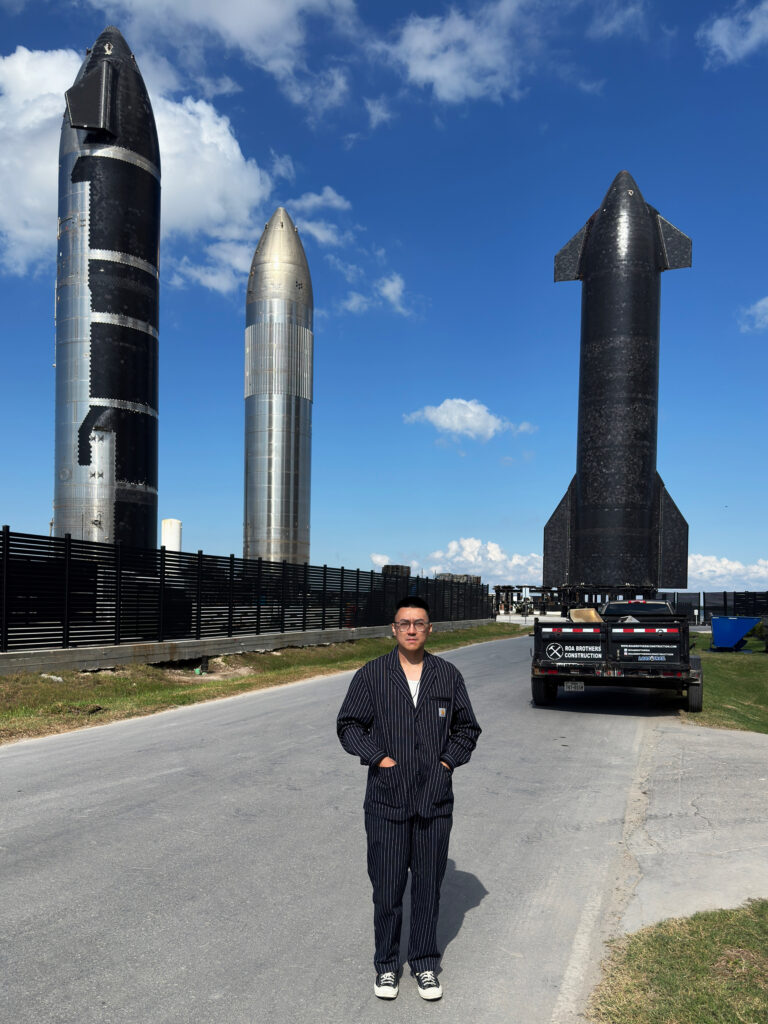
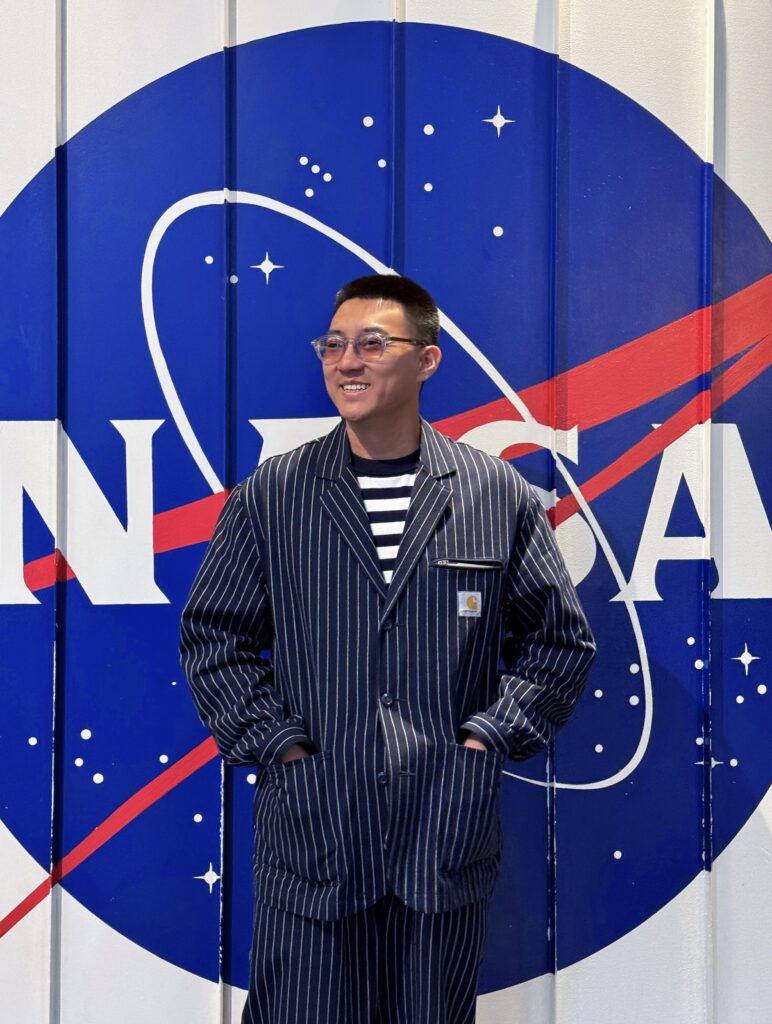
Your car got stuck in sand on a desolate border stretch and was rescued by a Puerto Rican officer and Mexican locals. You’ve said that the event determined your next destination. What did that moment tell you about America?
Our original plan was to travel on to Brazil or Bolivia after the United States, and we already held valid visas for both. Yet this cross-country road trip proved far more grueling than we’d anticipated. A string of troubles soon followed: the vehicle got bogged down in sand, we lost all cell reception, and we suffered multiple flat tires.
In the end, we decided to head for Puerto Rico to take a much-needed break and called a halt to further travel. This stop also led to an encounter with a local Puerto Rican officer who came to our aid. Coupled with my experiences in New York, this moment made me keenly perceive America’s inherent hybridity and spirit of inclusion. Throughout its history, the nation has continuously embraced diverse peoples and cultures, forging the multifaceted society it is today. Mainstream media often portrays this diversity against a backdrop of strife, confrontation, and civil rights struggles. But in that unguarded moment on the roadside, cross-ethnic solidarity came naturally, with no strings attached — it was simply people reaching out to help one another.
You’ve written that travel and art form a kind of ideological laboratory for you. After this American journey and your Independent New York debut, what questions are you still carrying forward?
To circle back to the topic of American diversity: my experience at this art fair has tempered my earlier perceptions of this notion. Throughout my time in New York, I noticed museum shows and auction previews featured remarkably few works by international artists — even European creators were scarce. It struck me that this so-called diversity comes with unspoken prerequisites: to gain public visibility, one must first win recognition from American society and be absorbed into its cultural landscape. Beneath the surface lies a centrist tendency to expand boundaries and incorporate outside voices.
This, admittedly, is merely my preliminary observation. A question that lingers constantly in my mind, especially when exhibiting abroad, is this: from what standpoint ought I to present my art? Should I create work framed solely around my homeland? Or adjust my practice to fit established themes and pre-set labels? Ultimately, I have chosen to take neither path. I strive to uphold integrity and coherence across my entire artistic practice, both in concept and expression.
In the short run, this path may demand extra explanation, and my work may take longer to be fully understood. It undoubtedly calls for greater dedication and mindfulness. Yet every forward move I make is genuine progress, rather than a hollow echo of existing narratives. My travels over the past two years have reinforced this conviction. For every journey and every project, I immerse myself on the ground, connecting with real people and engaging with authentic local realities. This approach may seem gradual, yet I am reminded of a timeless adage: A single spark can ignite a prairie fire.
After two years of such cross-cultural exchanges, subtle changes have begun to show. A growing circle of audiences across the globe now comprehend my work, and through it, gain insight into the cultural context I come from. Questions about the individual, the times, nations, the wider world, the China Model and socialism will accompany me throughout my artistic life.
For the next five to ten years, ChinAmerica will stand as my core creative focus. It will evolve alongside real-world shifts and continue to shape my artistic output. Today, my creative mission is clear. Still, my next destination remains unknown, as does how my upcoming body of work will engage with contemporary reality. This uncertainty brims with boundless potential — and it fills me with contentment and eager anticipation. I look forward to seeing where the world leads us next.

Be the first to comment