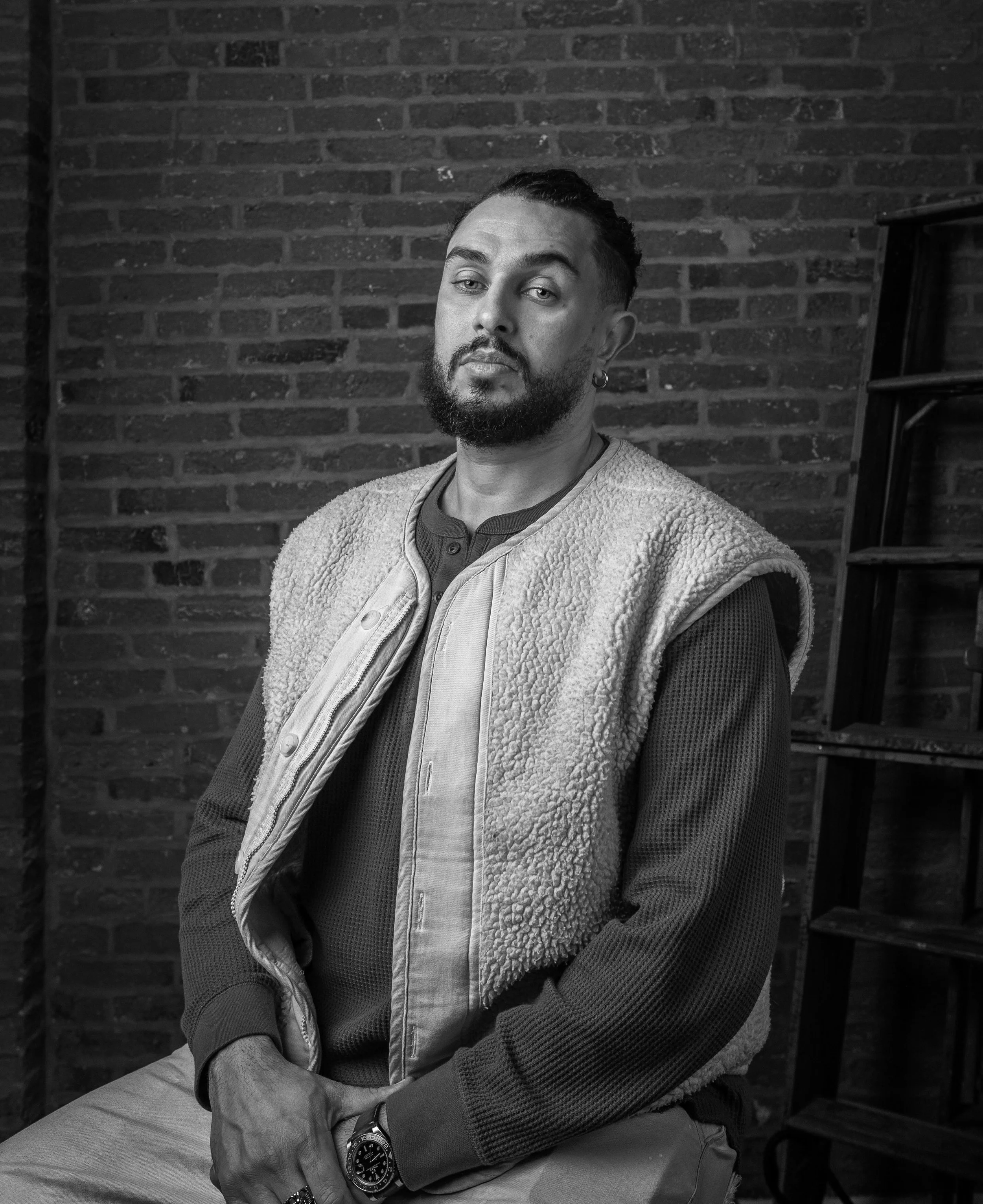
Arilès de Tizi's explorations of exile, migration, & memory
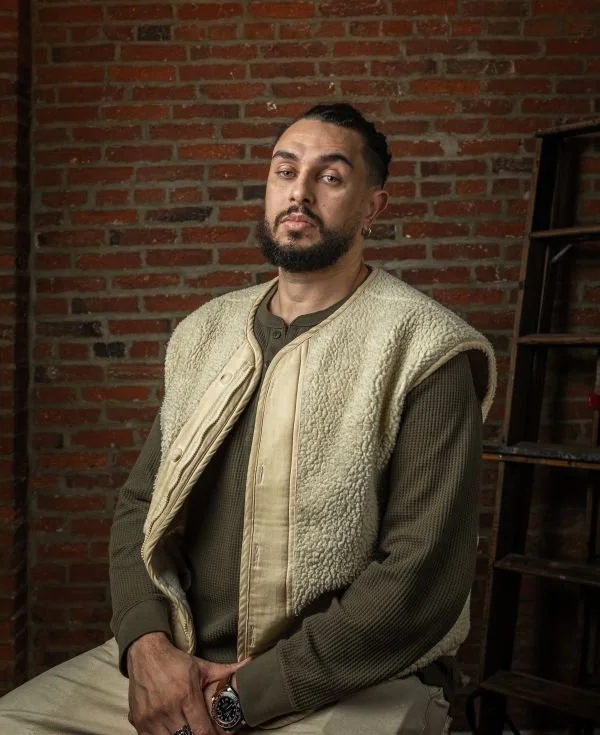
Arilès de Tizi is a multidisciplinary visual artist whose practice explores exile, migration, memory, and the reimagining of identity across cultures. His work moves between painting, photography, installation, film, and digital media, forging a visual language that bridges intimate histories with broader collective narratives.
Born in Hussein Dey, Algiers in 1984, he migrated to France in the early 1990s during the Algerian civil war. Raised in the working-class neighborhoods of Aubervilliers and Belleville, Paris, he was first immersed in graffiti and photography before developing a self-taught multidisciplinary practice that expanded into painting, sculpture, and installation.
His trajectory reflects a continuous negotiation between displacement and belonging, between personal memory and political history. Today, he lives and works between Paris, New York, and Tokyo, situating his work within an international dialogue that challenges dominant narratives of identity and representation.
Interview by Tyler Nesler
You were born in Algeria, and as a child, your family came to France during the Algerian Civil War as refugees, which you’ve said led to an immediate and deep sense of displacement and separation from French culture. Rap and Hip-Hop culture initially served as a way for you to forge your own identity. Who were a few Hip-Hop figures who initially deeply inspired you, and why?
When I first discovered Hip-Hop, I didn’t always understand the words, but I understood the bodies. I understood the attitude, the pride, the way of standing upright in a world that wanted to bend you. Figures like Jay-Z, Nas, Mobb Deep mattered to me not as traditional success stories, but as proof of existence. They came from neighborhoods shaped by fracture, violence, and lack, yet they spoke to the world with a full, sovereign voice.
For a refugee child, this was overwhelming. They showed that you could come from the bottom and still produce greatness. Hip-Hop gave me my first mirror. Not a perfect mirror, but a possible one.
You’re also influenced by philosophers and writers such as Frantz Fanon and James Baldwin. How did you come to discover their works, and in what ways have their ideas influenced your practice?
I encountered Fanon and Baldwin the way one encounters late allies, at a moment when intuitions I had carried since childhood needed words. Fanon helped me understand that colonized identity is an inner battlefield. Baldwin showed me that vulnerability can become a form of political strength.
Their writings didn’t give me answers. They gave me courage. The courage to accept complexity, to refuse simplifying what is twisted, fractured, contradictory. In my practice, this translates into an attention to shadow zones, silences, and bodies crossed by history.
You began expressing yourself visually and asserting an independent identity through graffiti art. How has the aesthetics of graffiti and street art manifested in your later works, such as painting and photography?
Graffiti taught me the direct gesture. Urgency. The necessity of leaving a trace without asking for permission. That energy never left me.
In painting and photography, it reappears through frontality, through the relationship to the wall, to the face as a surface of inscription. There is also a contained brutality, an economy of means, a taste for strong contrasts. Even when the works become quieter, more meditative, they retain that origin, a voice born in the street.

La Nuit Etoilee, 2024. mix media, 4'5 x 5'11

LOW, 2020, oil on canvas, 6'5 × 6'5

Riding Rocinante, 2025, oil on canvas, 7'3 x 5'11
What kinds of institutional messaging or pressures (such as from galleries, museums, collectors, etc.) did you find you had to work against and transcend in order to fully express your themes of decolonization and migration?
Very early on, I understood that some institutions expect artists from exile to produce images that are “readable,” reassuring, sometimes folkloric. You are tolerated as long as you stay within a controlled narrative.
Speaking about decolonization, migration, and memory from a complex, ambiguous, poetic place can be unsettling. I often had to resist the idea that I should simplify, explain more, or make the work more “educational.” I chose to remain faithful to a dense visual language, sometimes uncomfortable. My role is not to reassure. It is to open cracks.
You’ve described your long-term project, Borders, as “a traveling archive that gathers relegated voices.” What types of works are a part of Borders, and how do you represent these relegated voices within them?
Borders is made up of paintings, photographs, installations, texts, and sometimes sound. They are fragments, layers, presences.
The relegated voices are not presented as raw testimonies, but as symbolic presences. A face, a posture, a gaze can carry more memory than a linear narrative. Borders is not an archive in an administrative sense. It is a sensitive, moving, incomplete archive, like memory itself.
You’ve recently collaborated with Brazilian soccer star Ronaldinho Gaúcho. What drew you to him, and what types of work emerged from your creative partnership? What has the response been from his fans or from his admirers who may not be regularly exposed to art or visit museums or galleries?
Ronaldinho moved me through his relationship to play. There is an almost childlike joy in him, but also a melancholy. An awareness that the body is a fragile instrument.
Our collaboration resulted in paintings and hybrid images where he appears less as an athlete than as a contemporary mythological figure. The response from his audience was surprising. Many people wrote to me saying it was the first time they had looked at an artwork with such attention. That matters deeply to me. If art can cross circles that rarely meet, then it fulfills an essential role.
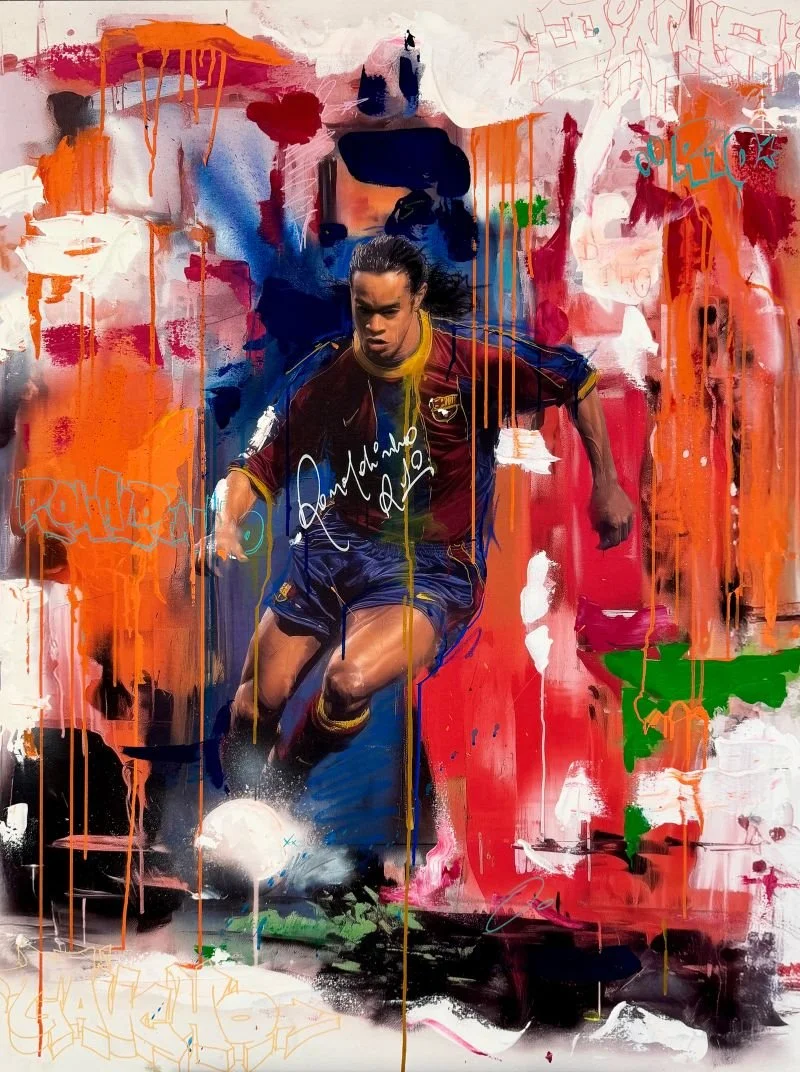
Ares
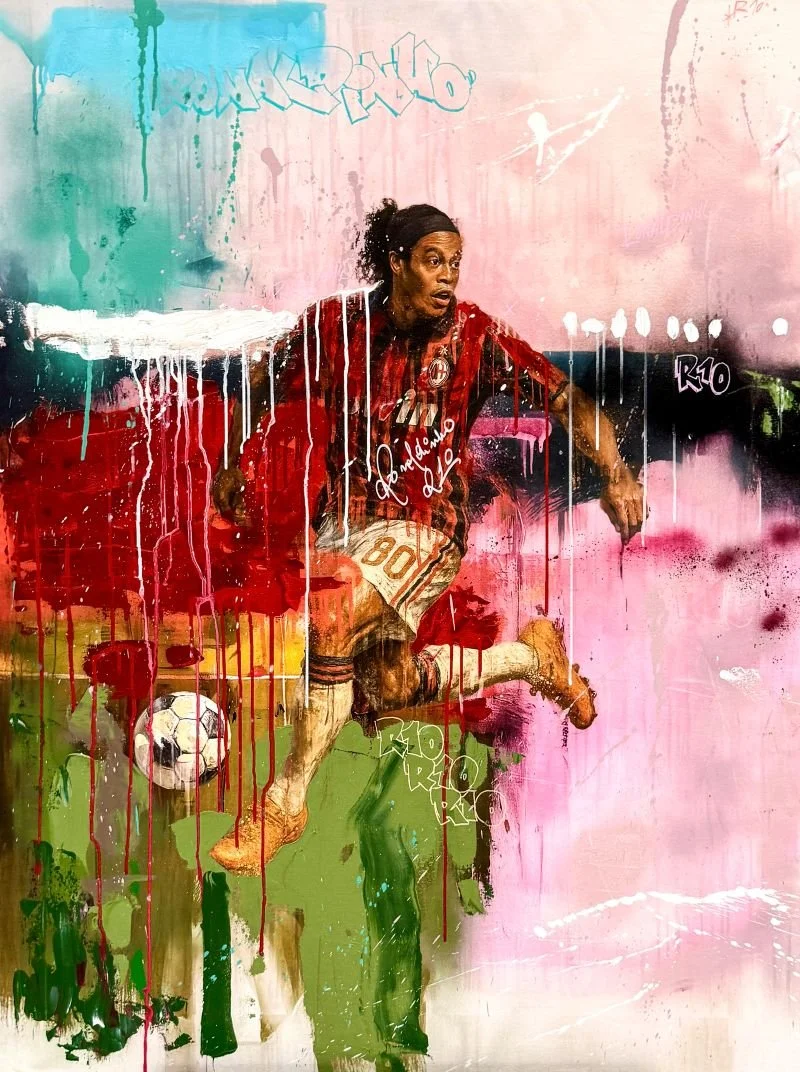
Hephaestus
In September of 2025, you unveiled eight original works in your new project titled ELEMENTAL GACKT – The Sacred Force, presented in collaboration with one of Japan’s most enigmatic cultural icons, GACKT. Could you discuss this project and its elements, and how it connects to your project with Ronaldinho, particularly your attempt to capture icons across diverse fields?
ELEMENTAL GACKT – The Sacred Force explores the elements, fire, water, air, and earth, as symbolic forces. GACKT appears as a figure traversed by these energies, both human and mythic.
As with Ronaldinho, this is not about celebrity, but about collective projection. These figures condense desires, fantasies, and wounds. Working with them allows me to question our contemporary need for myths, and what those myths reveal about our absences.
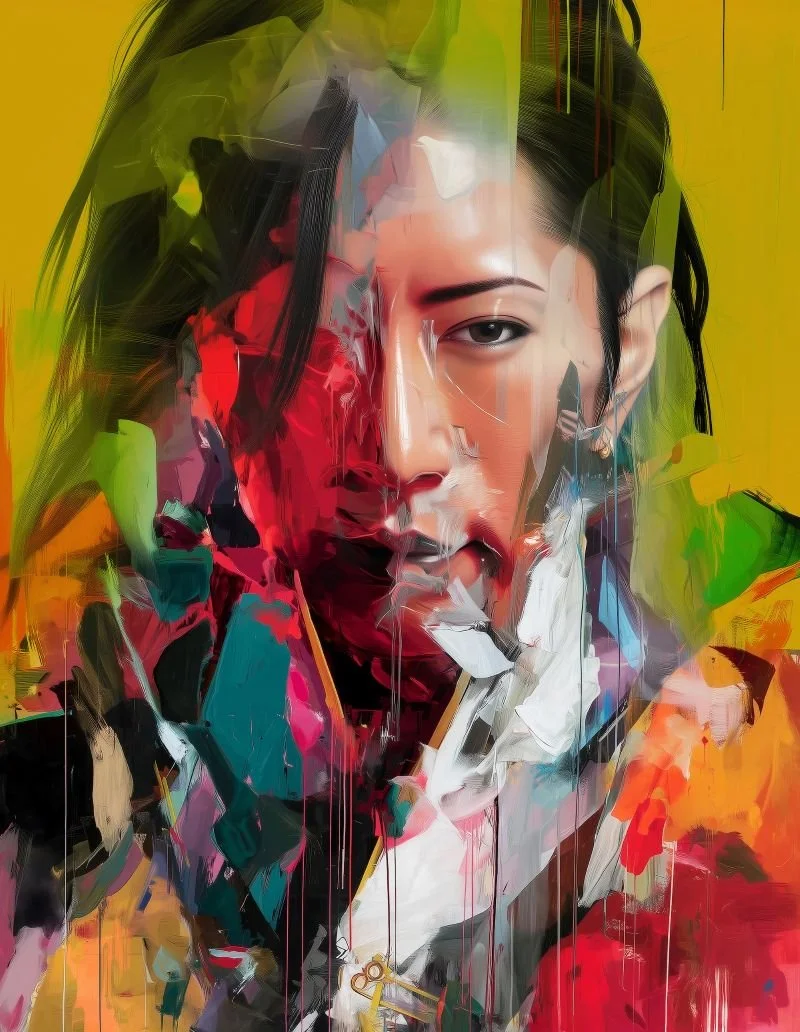
Amaterasu - The Sun, mixed media on canvas, 97x130cm
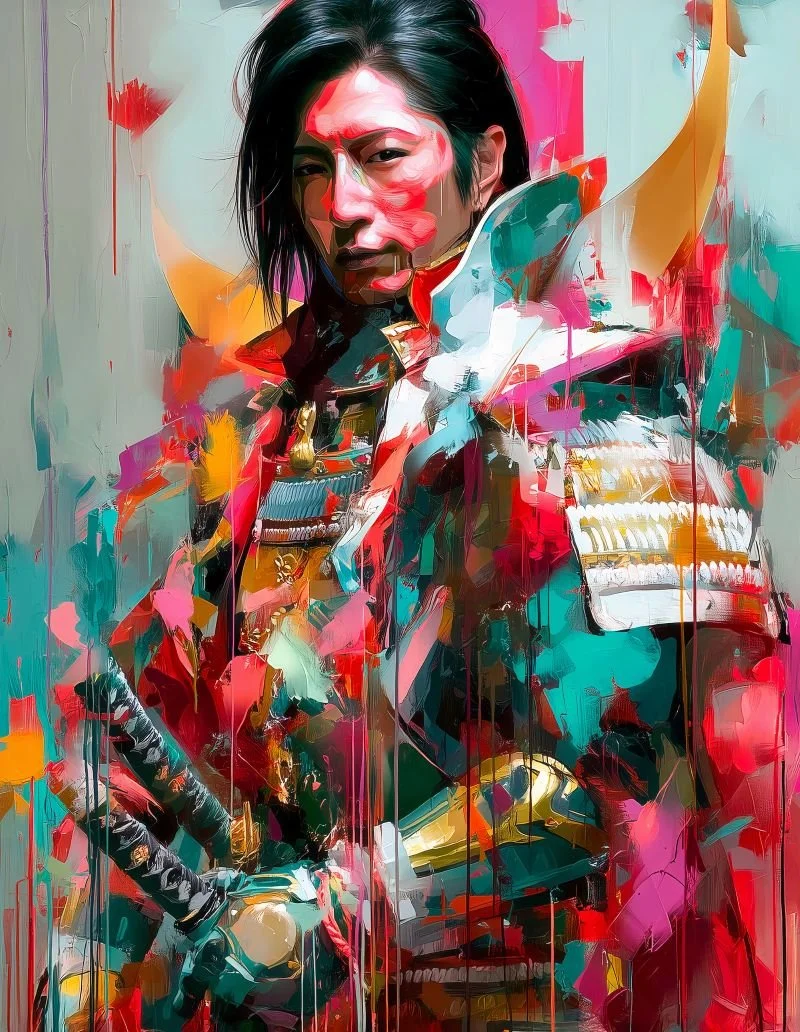
Raijin - The Thunder
I’m curious about what types of work you have done to date in film or video. Is there anything in particular you’ve created in these mediums that you would like to highlight here?
Film and video interest me as spaces of breathing. I have developed and created several hybrid projects, between documentary, fiction, and performance. They are often silent, slow works, where image takes precedence over narrative.
What matters to me in these mediums is not classical storytelling, but the possibility of creating states, durations, suspensions. As in my painting, I am less interested in telling a story than in opening a space of presence.
Did you like what you read here? Please support our aim of providing diverse, independent, and in-depth coverage of arts, culture, and activism.
Tyler Nesler is a New York City-based writer, editor, and podcaster. He is the Founder and Editorial Director of INTERLOCUTOR Magazine.