
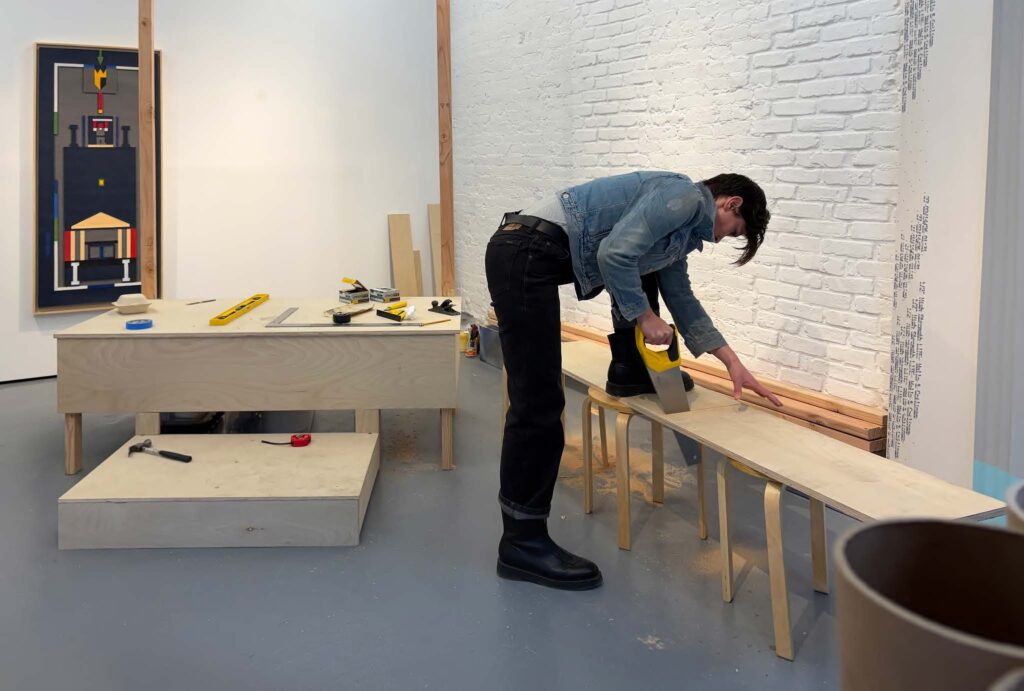
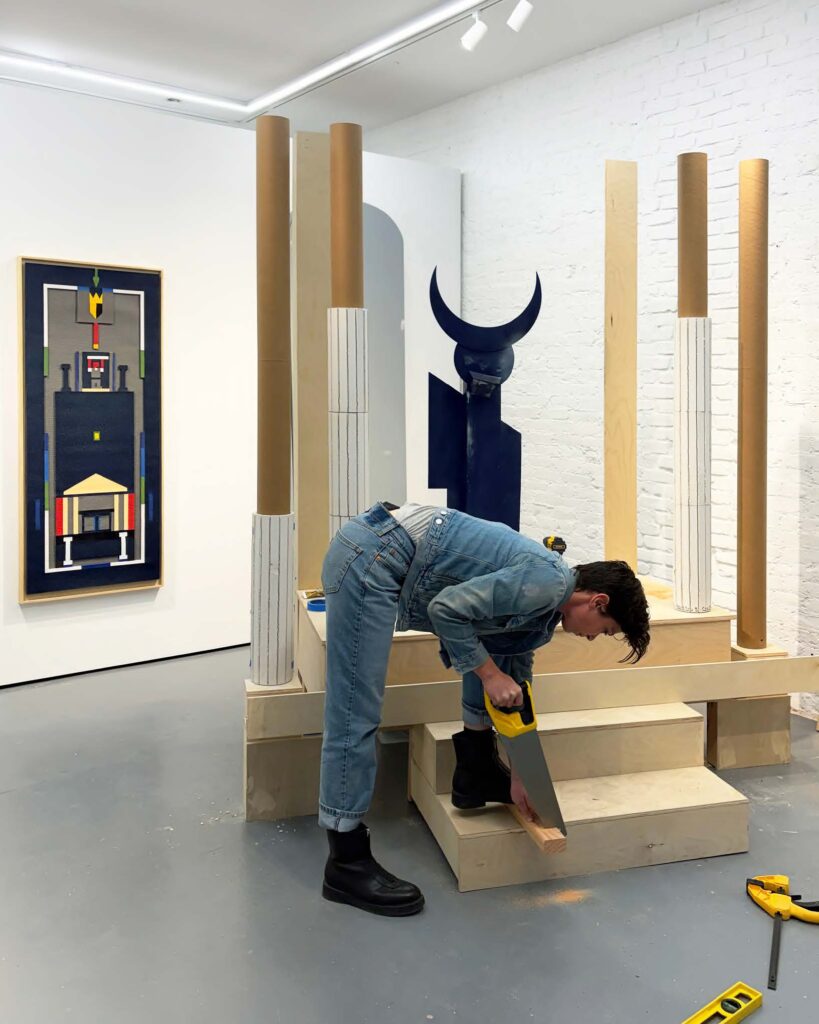
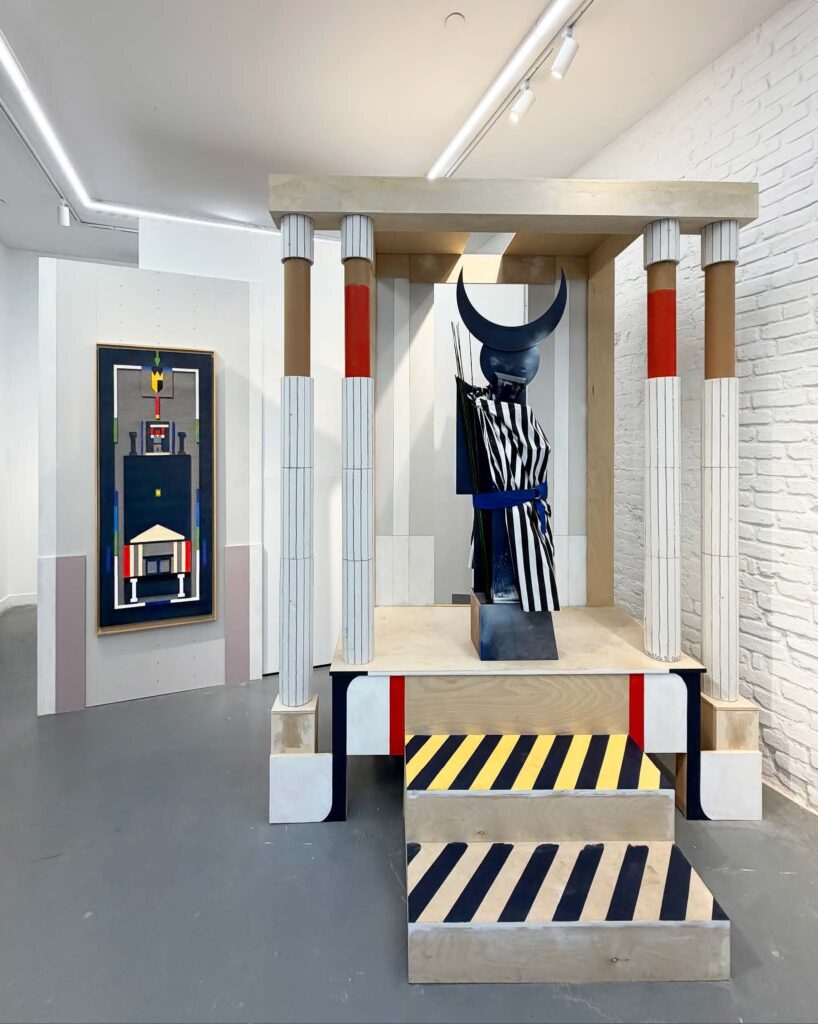
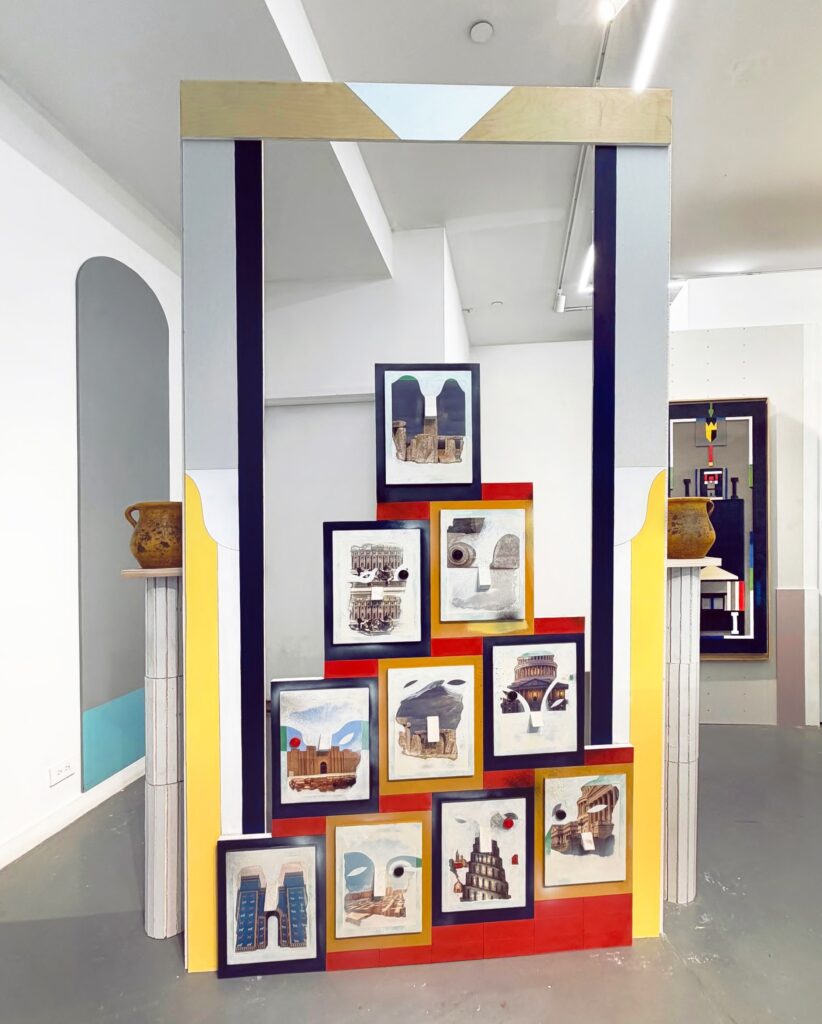
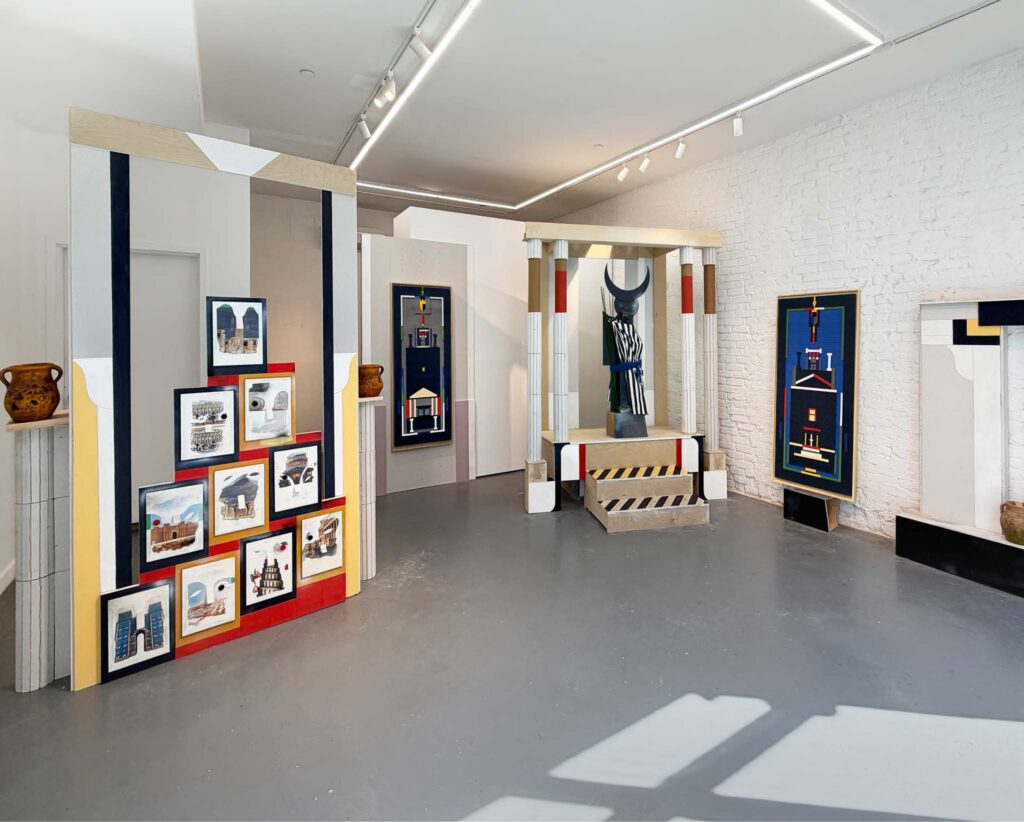
Trotter&Sholer is thrilled to present Capitol Babylon: The Narrative Falsehood of the Static Monument, a long-term performance by Leah Dixon. Dixon will spend five weeks in the gallery space at 168 Suffolk Street, building an imagined government building and, in the process, a reverential structure – in the style of the Capitol Building, the Parthenon, or Stonehenge. The exhibition runs until May 2.
The exhibition opened on March 26th with a landscape tableau of building and construction supplies that Dixon will spend configuring into an imagined seat of strength and mythology. Her act of building is a physical representation of the idea that the systems of power, real and imagined, are dreamt and built by us.
The gallery’s large ground-floor windows and a cordoned-off viewing area allow viewers to engage with Dixon and the documentation of her work. The viewing area inside the gallery is set up as a real-life venue for the umarell, an Italian term for a retired man who loves watching construction sites, often giving unsolicited advice with his hands clasped behind him. In the project of nation building, we are often the umarell, but this large-scale work posits that curiosity and intercession are fundamental.
Let’s start with the title of the exhibition, Capitol Babylon: The Narrative Falsehood of the Static Monument. To you, what is Capitol Babylon? Where is it? Does it exist in three-dimensional space and/or also virtually, also as a state of mind or a state of public collective consciousness?
CAPITOL BABYLON is a state of curious consciousness, based in the imagined construction of communal space. It’s the first part of the two-part title. The second part, “The Narrative Falsehood of the Static Monument,” came from something I said in a stream-of-consciousness rant to Jenna, the owner/director of the gallery. We were talking in the months leading up to the exhibition, and she wanted to know what I was thinking about. So we got very caffeinated, sat in her living room, and she took notes while I talked. I was talking with her about how our entire built environment is unfinished, unstuck, and is a giant subliminal collaboration between all of us who are all, in unison, simultaneously destroying it by using it, and constantly healing it by maintaining it. This is really the basis for the performative aspects of this show.
I was also talking to her about my frustration with the art market’s assertion that we make products, finished on a certain day, never to be touched again, because they are “finished.” I believe that the notion of an “archival” process or an “archival” material ended on 9/11. The largest monument to capitalism, possibly ever, was turned to dust and rubble in minutes. It’s now a mall, and even the mall is falling apart. So the fact that the NY art world is sitting in this shadow and putting forth ‘finished’ objects and imagery is so hilariously ridiculous to me (albeit fascinating in its delusion).
The first part of the title, CAPITOL BABYLON, is something I thought up while doing research. I am very interested in the ruined city of Babylon in Iraq. And during the Iraq war, the US and Polish militaries stationed themselves inside the ruined city, and were actively fighting from it. There is something so deeply honest about this. Like, I am very aware that it is easy to just clutch my pearls and gasp, “Oh my goodness, that is bad!” But actually, the bad part is the lies and the war itself. And those service members were already in it. At some level, they were simply using a city that was meant to be used. What is the purpose of us nostalgicizing a place into a monument, if we insist it must stay static or dead?
I have so many thoughts about this, but coming from this point of entry really gets me thinking about history, erasure, and how American monumentalization of place is often disempowering. What if we actually used these places, remade them, responded to them as sites of active gathering? This got me thinking about the Capitol riots. Obviously, there was so much absolutely horrifying and unnecessary illegal violence, but it definitely thrust the US Capitol forward as an activated space in a way that I had never considered it.
Just yesterday, there was an incredibly powerful and moving demonstration of US Veterans protesting the occupations and US participation in the destruction in Iran, Lebanon, and Palestine. So many of the veterans, including very obviously disabled veterans, got arrested – detained simply for using space. But all humans and animals use space all day, every day. We just really aren’t allowed to use space inside of monuments – even though monuments are positioned with super special symbolic use-value – just not actual use-value. So hybridizing these two places of inquiry led me to the title, CAPITOL BABYLON. And I think it just might be a project for me that is never finished. I’m so grateful that Jenna is giving me her ground-floor gallery space to work through this first very timely iteration.
Your aim with this performance piece is to build an imagined government building, a reverential structure, an “imagined seat of strength and mythology.” How does this conceptual approach comment on the transitory/illusory nature of human monuments? If it’s an imagined seat of strength and mythology, are you, as the builder, and those who are viewing the construction, all participating in the illusion or even a form of delusion?
We are absolutely all participating in the illusion, and to a certain extent, the delusion – which I guess are the same thing. Inside of CAPITOL BABYLON, I’m intuitively building without any plans or drawings, this monument and its adjacent gathering space. People walk in off of the street all day every day while I’m building it, and we talk. And I understand that this is positioning me as both the builder, and the mayor of the new local government. Which honestly, is kind of how I live my life in many ways – sort of touching all parts of the processes I’m active in.
One of the people who came to my artist talk said to me afterwards, “you are really showing us the importance of nomadic societies and structures.” I hadn’t said that to myself, but after he told me that, I realized just how on-point it is. A monument, or a “seat of strength and mythology,” really doesn’t have to actually physically exist. It can exist in virtual space, and virtual space is actually just the space of fables. It can also exist in the space of potential, as in, we are wandering together, about to set up our new civilization, but even when we dismantle it, we still possess the fable and technology of that collective space.
Maybe this is what I’m trying to get at by building in public as a form of empowerment to the viewers, and of course, as a form of empowering myself. I make almost all of my work from the same two Chinatown Lumber stores – Chinatown Lumber, and 123 Chrystie Hardware. As long as these places exist, my work exists. Because it exists inside of the materials in their stores (my most beloved personal monuments), even before I have assembled the materials into their new forms. Those places are like nature for me. I wander through my neighborhood of Chinatown, convene with the experts, amass the resources, and then the monument is already basically on its way into existence – because all of the phases of the monument’s potential are already here. All I have to do is use my life energy to live-design and arrange them. So is that an illusion or a delusion? I’m pretty sore and hoarse from talking and building, so it feels real to me.
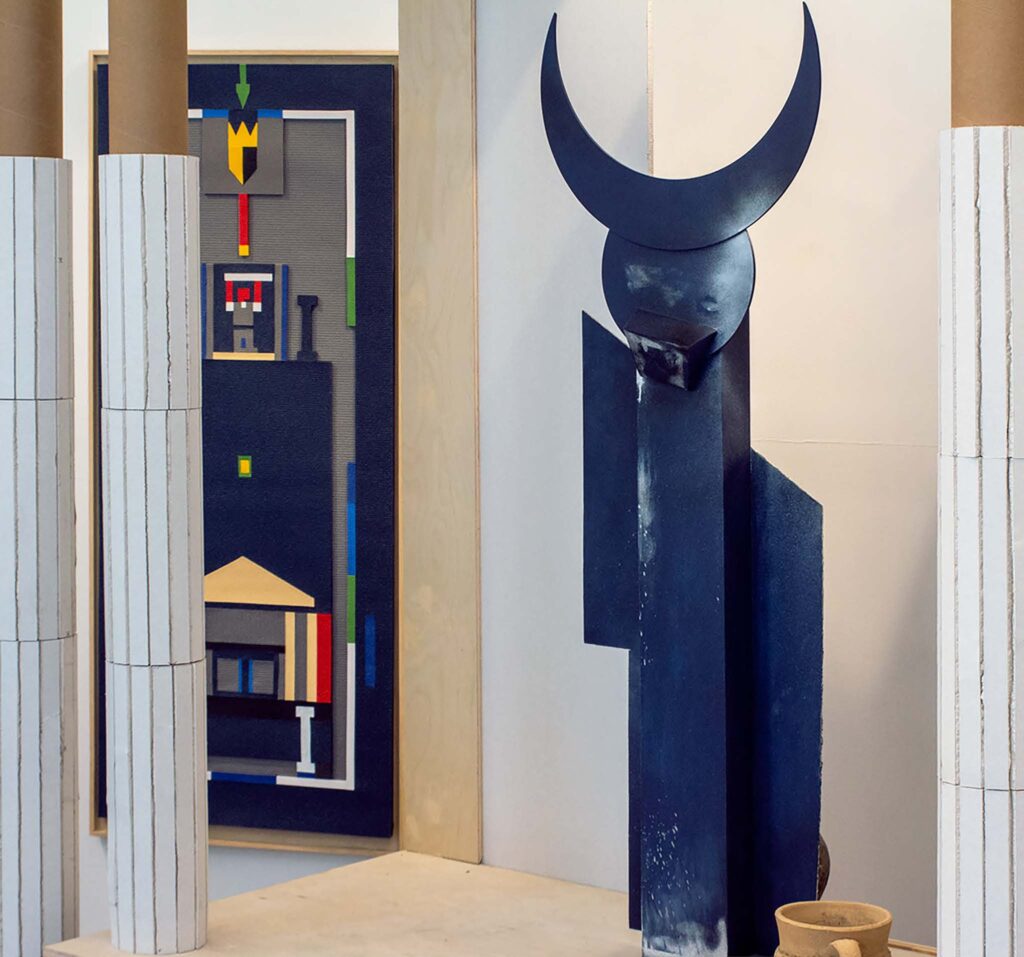
I had never heard of “the umarell, an Italian term for a retired man who loves watching construction sites, often giving unsolicited advice with his hands clasped,” but I love it because it is a level of conscious engagement with physical infrastructure that seems almost entirely absent from American culture. With the gallery’s setup of large windows and a viewing space for people to watch you work, visitors are becoming umarells whether they know it or not. As this exhibition has unfolded, what sorts of engagement and feedback have you received? Is this construction encouraging discourse in ways you hadn’t expected or anticipated?
I love that you pointed this out. I’m often grumbling to myself about this really checked-out version of being accepting of others that we have in America, this sort of “you do you” notion. But that just isn’t real. Like, we are actually interested in each other. It’s so much more powerful to be curious and supportive than to be checked out and evasively accepting. This is where the idea of “the umarell” comes in. Experiencing others’ curiosity is beautiful, although sometimes annoying when working in public, but that’s part of the bargain.
As a woman who makes large artworks, often outside, I sometimes get reaaaallly annoyed by men who want to come micro-manage me. It’s like, dude, get your own project. But I’m really trying to retrain myself away from this, because it’s missing the point that people want to find reasons to engage with each other in-person, and holy hell do we need that right now in America. And so I just need to get over it because we are all varying shades of awkward at the end of the day. Deep down, I’d rather deal with awkward and trying than neutral and aloof. I think that most of us would.
In terms of what reactions I get when people come into the gallery to see the show and talk to me, I’d say I get mostly really excited reactions. I mean, first off, the show is very cool-looking, and people have an immediate formal response to it. They talk about the materials, the construction, the colors, the symbols. They ask lots of questions. There are some construction workers who are working on a project nearby, and they walk past and give me thumbs up and big smiles. Kids on skateboards come by and stare. Lots of people who are interested in architecture and our built environment have found out about this show, and they come by, and we talk and talk and share references. Of course, there are occasionally like fancy people who are very startled to walk into a gallery and see work under construction, and they scamper away nervously the second I tell them that I’m the artist. I’m projecting, but I think that some of these people are deeply intimidated by the confrontation of it all. But the vast majority of people really want to talk. They see the ideas in the work immediately, and they start riffing. It’s so generative. People care.
We have a President who just demolished the entire East Wing of the White House to replace it with a garish ballroom (Trump’s own warped form of Theseus’ ship?), and he has other plans for epic reverential structures, such as his proposed massively scaled Triumphal Arch in DC.
One thing that’s been very striking to me is that his East Wing demolition has practically fallen out of the news cycle, and I suspect the ballroom has a low chance of ever being completed (like his unfinished Border Wall, which also seems almost forgotten now, even though it’s apparently still slowly progressing). In your view, what does all this say about shifting public perceptions towards reverential structures? There seems to be a deep numbness to all of the destruction/reconstruction now – do you see that as a lessening of the symbolic importance of these structures? How might you comment on all these shifts in this project?
We are very numb. I don’t want to talk about Trump because it’s so bombastic that it’s meaningless in a way. I want to talk about us. I think it’s so interesting how obsessed with domesticity and personal ideas of ‘home’ and ‘security’ we have become. Our bodies and our home spaces are our monuments – a truly commercialized turn inwards.
Would we be so obsessed with perfecting ourselves and our homes if down the street there was a central plaza full of tables, cheap coffee, drinks, and amazing conversation? So we would just throw on whatever outfit, and get out of the door, because we couldn’t wait to show up to the monument of social exchange and buzz and ideas? I know that’s a bit utopian, but not really, because these are the exact kinds of beautiful spaces that we all deserve.
I hope that the East Wing does go unfinished, and that it becomes a mess hall rather than a ballroom. And that our tax dollars get us entry, coffee, and a seat. I hope there are pencils, crayons, and paper covering the tables, and that we get to draw our ideas, draw each other, and play games. I might have just described the inside of a Denny’s restaurant, and yeah – maybe the East Wing should be more like a fabulous Denny’s.
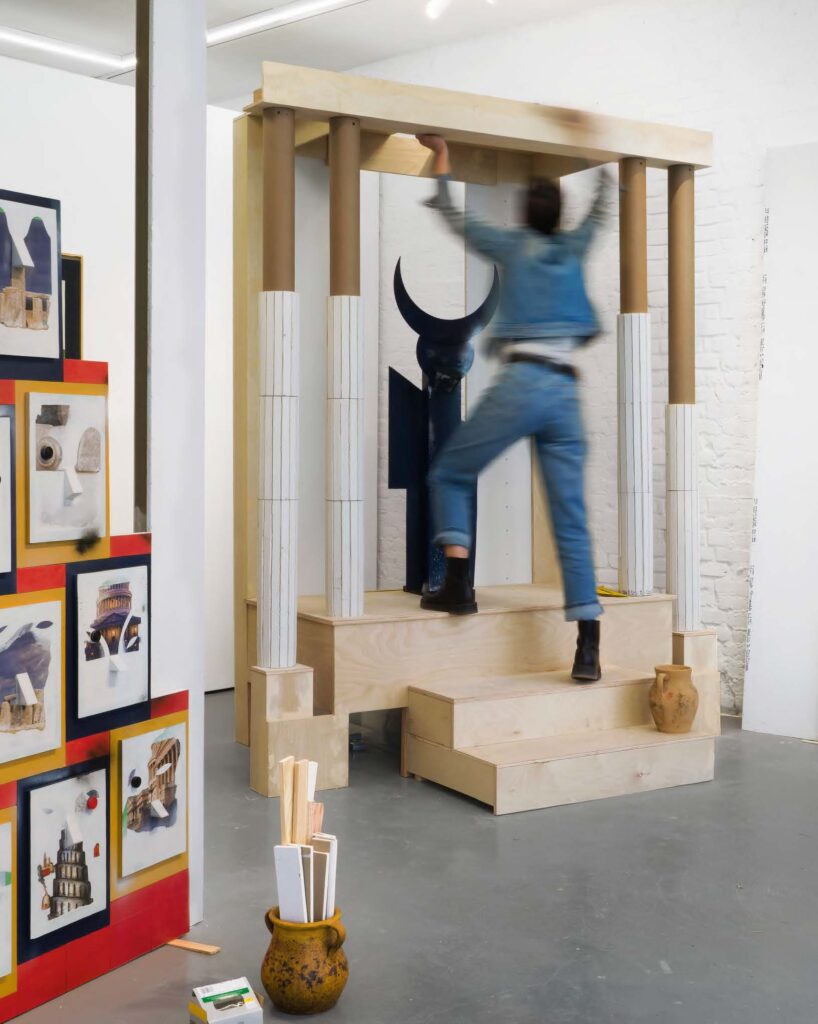
For me, what I know of the architect Rem Koolhaas came straight to my mind when considering this exhibition, especially his concepts of “Bigness” and “Junkspace,” and also the Brutalist architectural style as a kind of perfected approach to an ultimate expression of reverential structures, with its typically imposing scales and raw materials mix of utopian/dystopian elements. Are any of these theories/styles incorporated into this project? What are some additional architectural movements and/or theories that have been on your mind while creating this work?
I love these concepts of “Bigness” and “Junkspace” because, by design, they are almost undebatable. They are just true. Like when we have accepted such an impoverished built environment that we go from hallway to elevator, to reception room, to prefab bathroom stall, OF COURSE we nostalgicize monuments. Because monuments at least have symbolic flair.
It’s so wild being in Midtown, and sometimes you’ll walk down a block, turn a corner, and walk down another side of the block, and realize that literally every single door you just passed for two blocks was a different version of a service door to one single building. Where is the entrance, even? And like, whoa – this is a billion-dollar building in Manhattan, and they can’t even give us anything better than human-scale doggy doors? On this rant, my dream would be to outlaw the chainlink fence and have a worldwide competition to design and mass-produce 1000 new versions of it. There is basically almost no way that we wouldn’t immediately come up with iterations that are just as cheap to manufacture, far more beautiful, and without all of the horrible cultural and formal baggage of the current chain link fence.
Again, I live in Manhattan – the supposed center of our aesthetically boundary-pushing world – and I see chain link fence all of the time. And this is because we have accepted such environmental poverty in our built environments. How much different would our experience of public space be if we literally never encountered a chain link fence again? It would be astounding, I think. So back to the question – I mean I really consider myself in many ways to be a Constructivist, as it relies so heavily in our own empowerment, and bringing our lived experiences to our art and architecture. We believe in Constructivism so much that basically almost all of the toys we give small children are meant to manifest this hope in them. I think this is very apparent in my work. It helps me not get distracted by my own neuroses around craft and decoration, which I mostly find to be besides the points of what make me want to make things. It helps me understand scale and its relation to our human stories.
What happens at the conclusion of CAPITOL BABYLON? Will there be a full demolition of what you’ve built? Or will it go somewhere else, evolve in more unexpected ways?
On the final day of the show, May 2nd, I’ll start cutting it apart and creating my own relics and chunks. Some will be trash, some will be reborn in a new form. Of course, I’d love to get the chance to keep doing this over and over. I guess I’ll make sure that I get the chance to keep doing this over and over because that is the whole point – to reinforce the churn, the potential, and the shapes and forms in relation to my various human constraints and contexts. If it were collected for permanent display, I’d definitely leave the seams of where I cut it up and reassembled it. The scars are part of the process.
Note: materials used – plywood, drywall, latex paint, yoga mat, architectural adhesive, enamel, ceramic pots, wooden checkers, marble checkers, toy blocks, and painted and manipulated printed images of The US Capitol, Stonehenge, the ruined city of Babylon, The Tower of Babel, the destroyed Curia Julia in Rome
Capitol Babylon: The Narrative Falsehood of the Static Monument continues until May 2 at Trotter&Sholer, 168 Suffolk Street, Ground Floor, NYC.
Introductory text and all photographs courtesy of the artist and Trotter&Scholer




Be the first to comment