
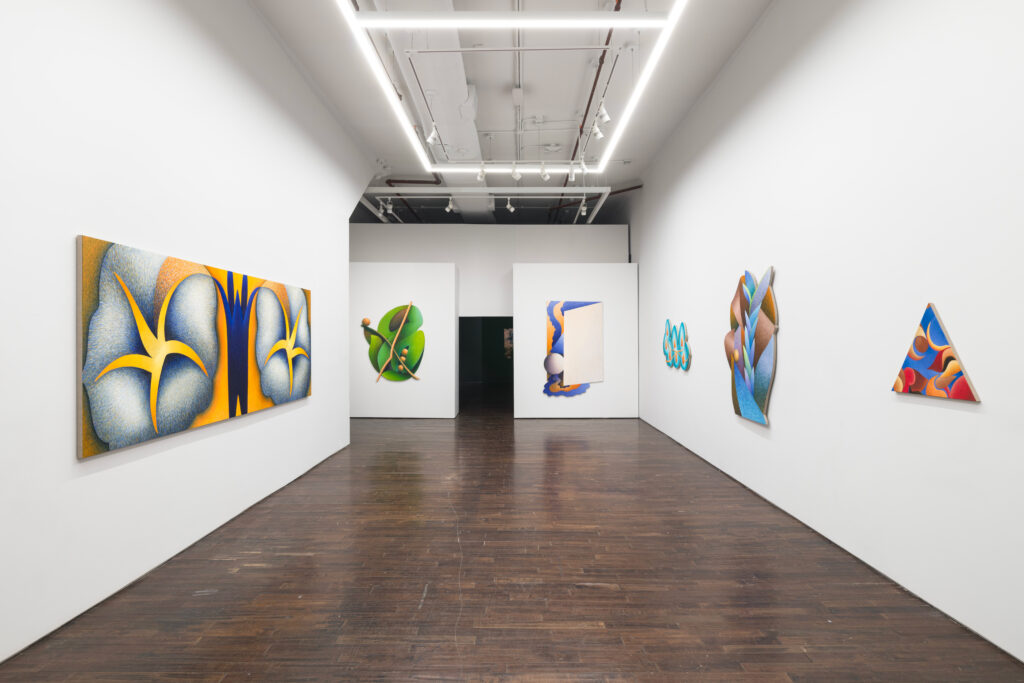
Cristin Tierney Gallery is pleased to present No place out of the wind, a solo exhibition of new paintings by Debbi Kenote. This marks the artist’s first solo show with the gallery, and will be on view from Saturday, April 4th, through Saturday, May 9th. An opening reception will take place on Friday, April 10th, from 6:00 to 8:00 PM, with the artist present.
No place out of the wind continues Kenote’s exploration of shaped painting as both image and object. Inspired by visual motifs—such as interlocking geometries and natural forms—each canvas starts with a stretcher customized by the artist before it is stretched and layered with oil paint. The support beam becomes a primary compositional element of her paintings, creating complex forms that extend the work into space. Inspired by her upbringing in the Pacific Northwest, where she was exposed to craft traditions such as woodworking and quilting, plus her background in sculpture, Kenote approaches the canvas as a site of construction as much as surface.
Your work is so heavily inspired by nature and to me seems infused with color palettes and forms that specifically gesture to your upbringing in the Pacific Northwest. Now that you live and work in New York City, what do you do to get a “nature fix” and find new inspirations for creating works based on the natural world?
Nature is certainly a big influence for me. I grew up on a rural piece of land in Washington State, and my parents structured my education outside of the public system until around age 14. This meant that when most kids were in school, I was often outside exploring the dense Pacific Northwest landscape. This physical and imaginative play outdoors was formative to my approach to making today.
Even though I’ve lived in New York City for almost 13 years, I still go back to my hometown twice a year. I have a large immediate family and I am the only one who flew the coop. These trips have kept the landscape of my childhood alive in my imagination as an active source of inspiration. At the same time, I also try to go to the beach here and into the various upstate forests as much as I can. For the last five years I have also returned to the Saltonstall Foundation, outside of Ithaca, NY for a weeklong artist retreat. This annual tradition of hiking in the snowy woods between creative sessions has certainly impacted my work.
There’s a cool literary foundation to this show – the title No place out of the wind is drawn from a poem written by you, with the phrase itself borrowed from Annie Dillard’s essay “Total Eclipse.” What aspects of Dillard’s essay in particular inspired you?
Annie Dillard’s Total Eclipse was written about her experience of seeing an eclipse in Washington State (where I also happened to grow up) in 1979. In the essay, she renders the event as surreal, psychedelic, and destabilizing. In particular, she goes into dramatic detail regarding the landscape of the hill she is on, where she is gathered with her husband and several strangers. Dillard’s visceral account articulates a sense of the sublime, along with her own vertigo and distress, as she observes the changing light falling on a windy, shelterless landscape. One of the lines, there was no place out of the wind spoke to me when I read the essay, and it prompted me to write my own short poem.
Dillard likens the distinction between viewing a total eclipse, opposed to a partial one, to flying in an airplane versus falling out of one. In my own experience, I can intuitively relate to this feeling of unexpectedly falling, or setting out into nature in an unprepared fashion. I chose to use this line as a bridge to my own metaphorical journey towards solace, through the destabilizing elements of life. Tied up in the feelings of being outside for a longer-than-expected duration, are also themes of awe, acceptance and growth, which I believe come across in the abstract and colorful surfaces.
You’ve said you draw source material from your poems for your drawing practice. As a writer myself, I’m curious about this writing/visual duality. Have you ever presented your poems as standalone works, or are they primarily vehicles for your visual artworks?
As long as I can remember, I’ve both written poems and created art. When I was in grad school at Brooklyn College, I studied with Vito Acconci, and he was the first person in the art world to encourage the bridging of these creative outlets. Since that moment I’ve longed to merge them, but it wasn’t really until the beginning of last year, when I switched back to oil, that I found my way into this hybrid process.
One of my reasons for returning to oil was a desire to imbue more drama and depth in my imagery. At the same time, I was also compulsively writing poetry. Somehow it just happened, through osmosis really, that I began to visually articulate the feelings of the poems. It felt like the oil paint could support the depth of my writing in a way that acrylic hadn’t been able to. In this sense they are vehicles for my paintings.
On the other hand, I consider the poems to be standalone works in a writing sense. I feel compelled to compile them into a book, opposed to framing them in an exhibition. I am very interested in putting together an artist book of sorts, that would combine the poems and the black and white drawings I make from them. This is a project I’m thinking of for next year. In the immediate future, there will be an artist talk on April 28th at Cristin Tierney Gallery, where I will be discussing the poetry with Harrison Wayne, a poet and artist friend. During the event I will read each poem and also share the corresponding drawings. I tend to intuitively link the poems with the drawings in an imaginative world, and the paintings exist in a separate, physical world for me.
You approach the canvas as a site of construction, creating customized stretchers – how do you incorporate this customization work to create specific compositional elements in your paintings? How has this process evolved for you?
I’ve always had a deep love for shapes. I’m not sure where that comes from, but it is a large part of my identity and as long as I can remember I’ve opted for an odd-shaped thing over a more common option. When I was finishing up my undergraduate education on the West Coast, I was shifting from painting into installation. This led me to apply for the sculpture program at Brooklyn College. It was a valuable experience to be engaged in three-dimensional exploration for two years. Afterwards, I really missed painting, but I was also attached to creating physical shapes in space. As I found my way I slowly landed on shaped painting.
In terms of compositional elements, I see the shaped canvas both as an exciting viewfinder and object. There’s a lot of room for exploration in the tension between the implied window of painting and the implied object in sculpture. In this particular show, I am flirting a bit more with objects than I was before, by aligning the painted imagery with the shape of the canvas. At the same time, I like when these rules are broken and it feels like something is on a different plane completely, or slipping off of the shape, made possible by the magic of gravity being suspended, that only painting can offer.
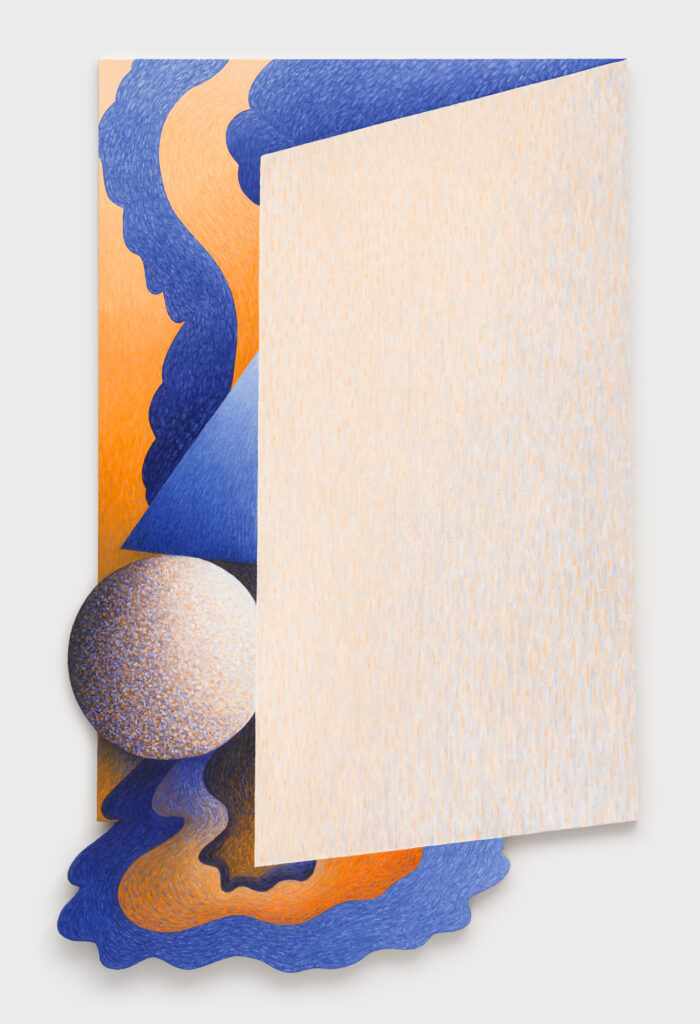
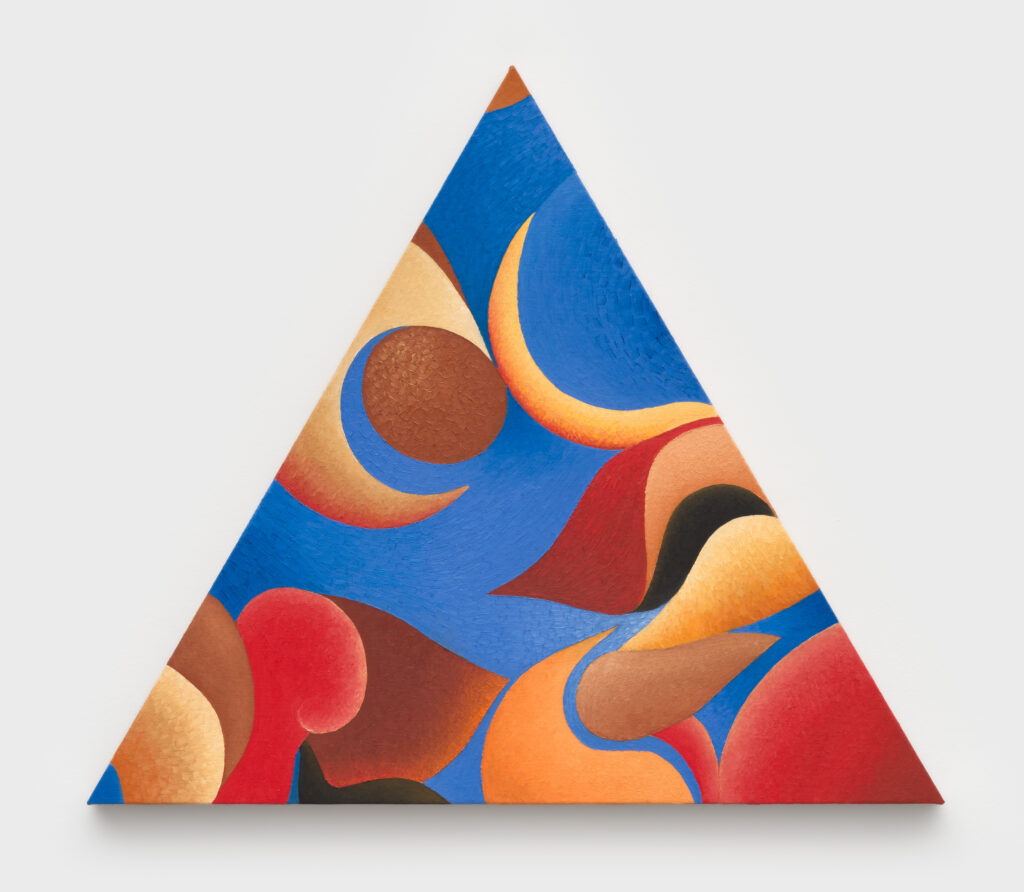
What are some of the challenges you’ve found with mixing organic forms derived from nature with more rigid geometric forms (such as triangles) while maintaining a sense of biomorphic symmetry?
The tension between geometric and organic forms has surprisingly been less of a challenge for me and more of an exciting point of exploration in my work. Up until this show, I exclusively created geometric canvases, and I enjoyed the balancing act of pairing this with organic imagery. Working this way allowed me to enter into dialogue with architecture and the built environment easily. The whimsical imagery suspended in an angular frame felt to me both more painterly and more architectural than it did sculptural. While this show is certainly still painting, I am finding that in this new work I’m pushing a bit more into sculpture by aligning the shape of the canvas with the painted imagery, and in this sense I’m moving away from the previous viewfinder approach.
My work is always evolving and I’m excited to see where it lands next. I can say that at this moment, I am hoping to create some standalone sculptures in addition to these shaped painted works in the near future.
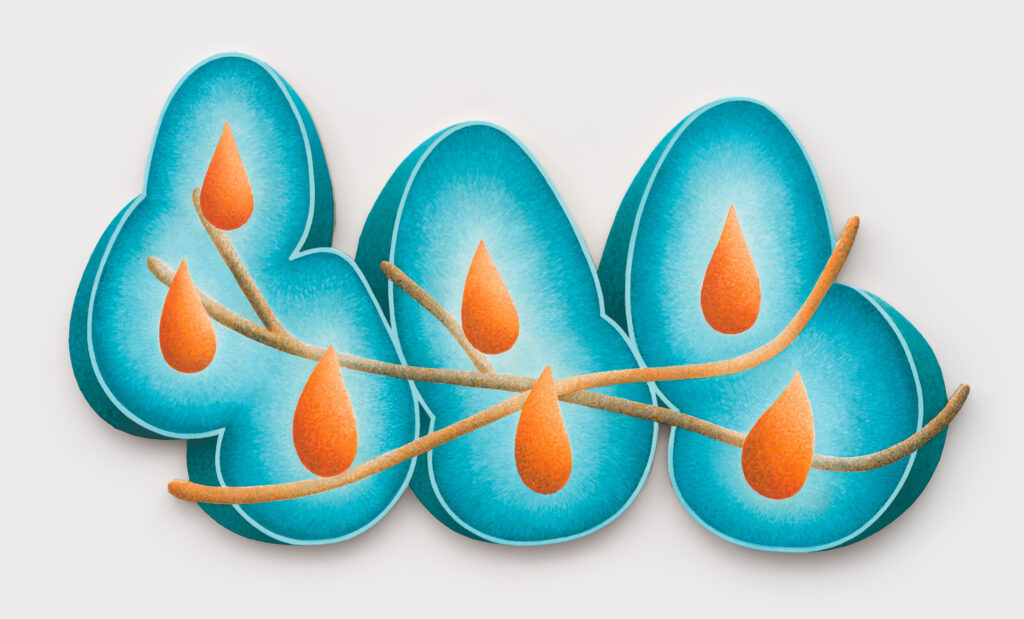
Circular motifs occur throughout the works in this exhibit. How do they act as anchors in your abstractions? In what ways do they work to pull each piece together?
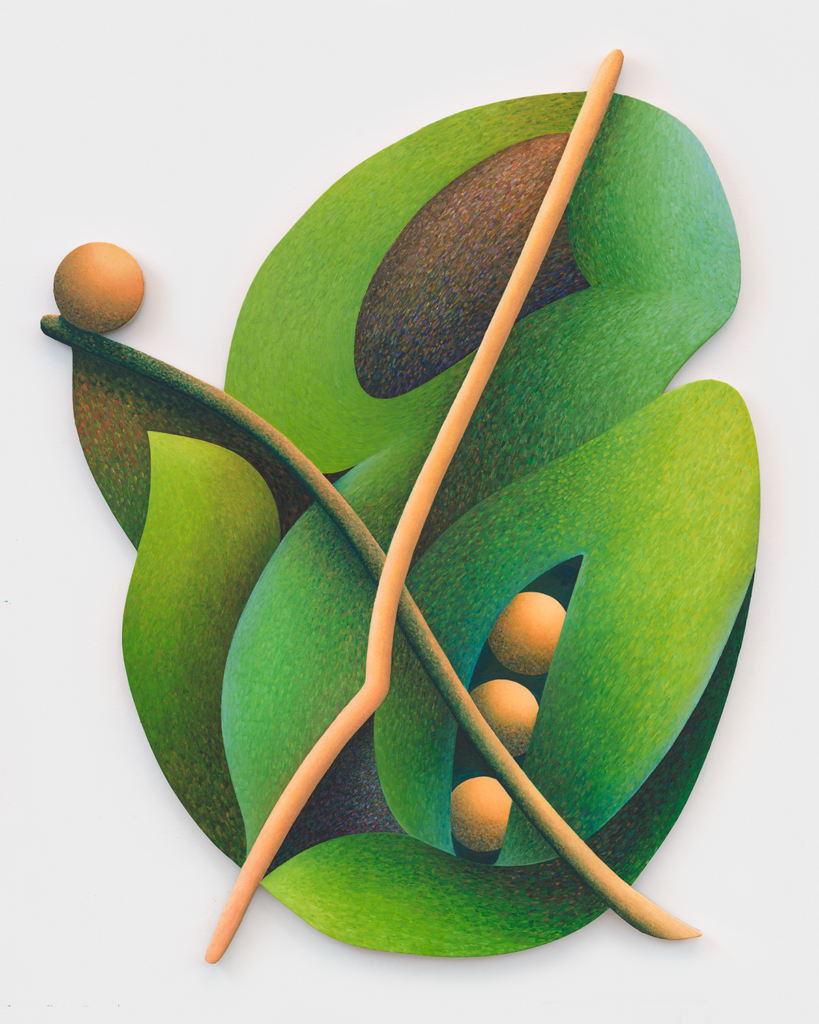
While the circular motifs in the works add a visual throughline to the show overall, I find that their anchoring factor is more conceptual. I’ve used circular forms in my work for years, often in reference to a moon or an eye.
In 2025, I began shading these circles more as their meaning began to shift into representing seeds. In this sense, they are a direct reference, yet conceptually, I find they still function quite abstractly. They are not intended to be a particular seed in a particular pod, instead, they operate as a future longing of sorts. Having studied a few languages, I have found that there’s a point in the process of learning a language where you get a grip on the future tenses. Up until that point, you’re really limited to speaking in the past and present tense, while trying to describe time more vastly. I would liken the use of these orbs to a shift into the future tense in my abstractions. In several works, these “seeds” are present, and their placements vary. Some are precariously balanced, some are nested. Overall, the theme of No place out of the wind is a journey through the elements without shelter – happening in the present tense. The circular seed forms are there to communicate that all the while, this experience is being harvested from the present and will, in some way, be planted in the future.
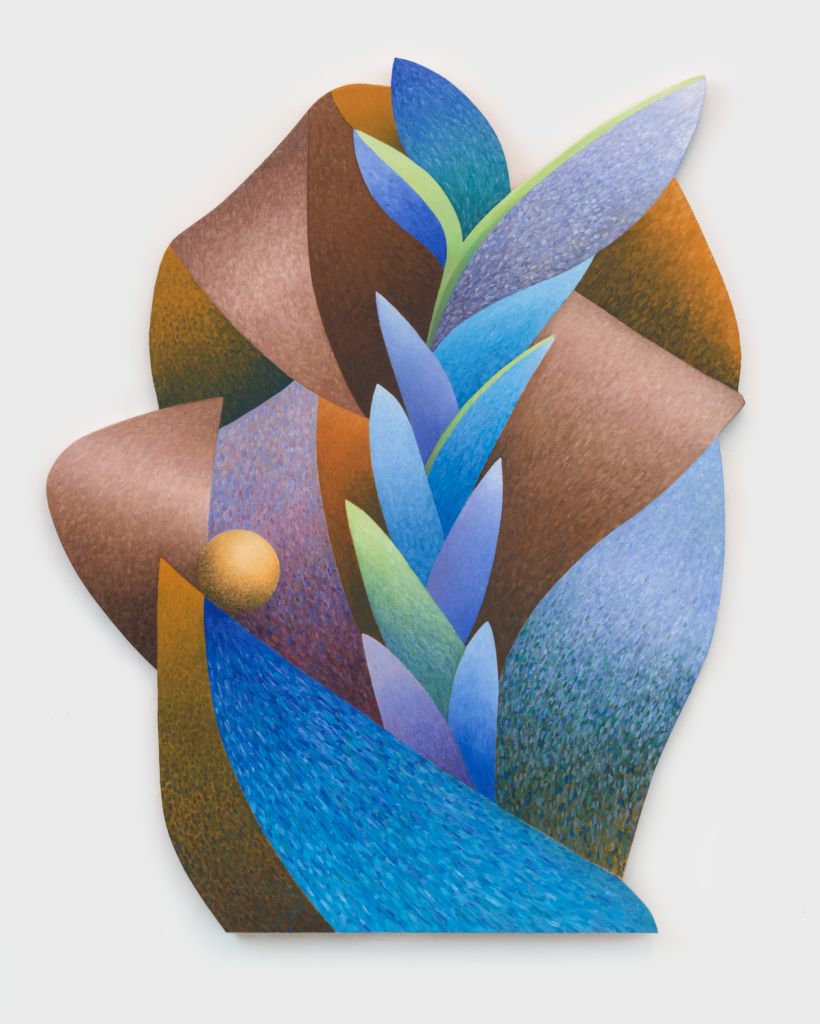
How do you work to create a sense of movement or flow in your pieces, depicting elements that draw the eye in particular directions and may reflect movement in nature, such as wind, water flowing, etc.?
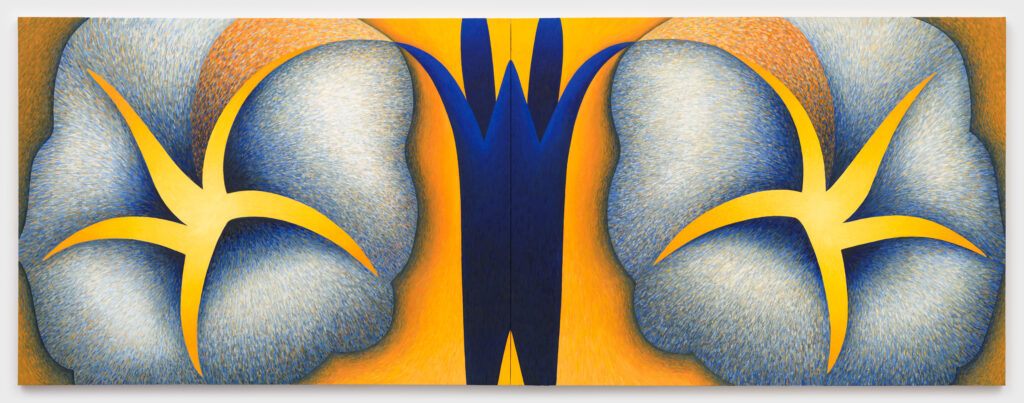
I’m glad you asked this, because I think that there is a strong sense of movement in these works, akin to wind or rain. The source material for these paintings were colored pencil drawings, inspired by my poems. The thin strokes of colored pencil on white paper create a loose movement that, for this show, felt like an elegant parallel with the writing I was referencing. I found that as the show unfolded the texture in the works got longer and thinner, feeling more and more like wind. A visitor to my studio remarked how they were reminded of water sliding down a window pane–which I loved!
In the past, when I was working in acrylic, I would often overlay a thin dotted pattern to regions of my canvas, that would mimic the shape it was in, working inward concentrically. This often came from articulating the feeling of water. Having grown up on an island and also having pursued a collegiate career in sailing, I spent a lot of my early life on or near the water. When I began adding texture to these works, I found I was working in that same concentric way, bringing the feeling of wind and water into the work. For the next series, I’m excited to see how the surface treatment evolves as I approach my practice with new poems and drawings.
No place out of the wind is on view at Cristin Tierney Gallery, 49 Walker Street, New York, NY, through Saturday, May 9th. An opening reception will take place on Friday, April 10th, from 6:00 to 8:00 PM, with the artist present.

Be the first to comment