
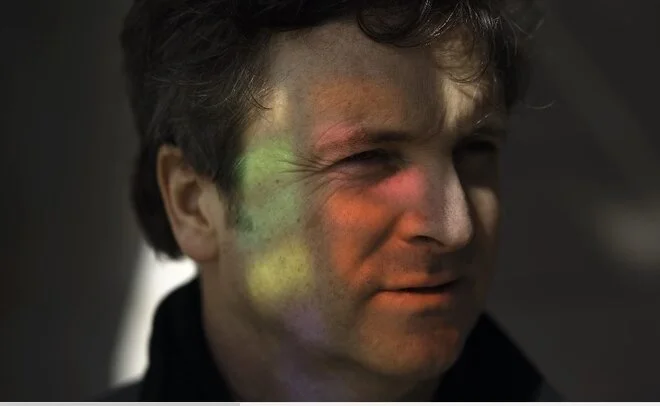
Marcos Lutyens’s practice centers on the investigation of consciousness to engage the visitor’s embodied experience of art. Exhibitions of infinite scale and nature have been installed in the minds of visitors. Investigations have included consciousness research with social groups such as the third-gender Muxhe, synaesthetes, border migrants, space engineers and mental architects to explore how unconscious mind-sets shift across cultures and backgrounds. Lutyens has extended these consciousness projects to involve our external surroundings. Works include interactions with pedestrian flows, social media dialogue, air quality levels, animal and biological intercommunication.
In this interview, Marcos talks extensively about his use of hypnosis as a major component of his performance practice, along with the ways in which he is directly engaging the new realities of the Covid-19 pandemic.
What was your first experience with hypnosis and how did that lead to where your practice is today?
The first direct experience was in Los Angeles with a hypnotist and professor of philosophy at University of California Irvine called David McLemont. He was working on pain suppression in an intensely physical, ritualistic performance with “bad boy” of performance art Ron Athey, while I was creating the set design for the performance. At dinner, the night before the performance, David performed a catalepsy on me which made my body become extremely rigid, while I stayed in a very relaxed internal state. My body was lifted into a position in which my neck was resting on a chair back and my ankles on another chair back, with my body outstretched and completely rigid. Someone then walked on top of my suspended and outstretched body as I rested comfortably present, but also in a deep trance state. I had long been interested in trance states since spending time as a seventeen-year old with the Auca and other tribes in the Amazon, as well as the Huichol tribe in Mexico. It was through these encounters that I realized how hypnosis could be a perfectly viable route to access altered states of consciousness, as well as a fluid communication with our unconscious.
You have mentioned that you are interested in “blurring the boundaries of the self” through your performances — could you elaborate on this point? What does this mean to you?
Generally, as a society we are too wrapped up in ourselves, perhaps due to an overabundance of ego, or emotional insecurity. When we are in ego-mode like this, we miss out on better pathways to co-exist, to nurture, to co-create. In my performances, usually by way of hypnosis, I like to bring participants to a place in which their feeling of themselves dissolves away to be replaced by a magnetic-like connection to what lies outside their body membrane. This dissolution, or porosity as French philosopher Vinciane Despret would say, enables the self to link across to a much more extended frame of experience.
I’m wondering whether you consider hypnosis itself to be a medium or if it is just one component of your performance practice. What are your thoughts on this?
I see it as one component of my performance practice and my broader practice too. Hypnosis is really a lens or filter to experience what is around us in a more profound way, so it can be mixed with any kind of medium, such as touch, or smell, or sound, as well as installation, sculpture and 2D work too. For instance, at the Solomon R. Guggenheim in New York in a project with Raimundas Malasšauskas called Hypnotic Show we deployed sound and color to sensitize the audience to a different way of embodying the experience of art. At Culture Summit 2019 in Abu Dhabi, upon invitation as keynote artist by the Guggenhiem, I used smell and touch within the context of hypnosis.
Conceived by Raimundas Malašauskas and Marcos Lutyens, “Hypnotic Show” is an intimate experiment in cognitive exhibition making through art and hypnosis. A r…
The project was initiated at Culture Summit 2019 in Abu Dhabi, by invitation of the Guggenheim Museum. The 20 minute performance invited over 400 attendees t…
Hypnosis is a very subjective and personal experience, so how does control factor in to your practice when you are orchestrating these experiences for many people at once?
I am most interested in visitors exploring their own imaginations and generating visualizations that they themselves harness, rather than controlling them to see something in a specific way. I understand the process of hypnosis as generative and emergent and I like to give as much freedom to the visitor as possible. However, to get into a hypnotic state, a high degree of relaxation paired with focus is needed, so I do need to be assertive in the early stages to help visitors focus.
With regards to your process, how do you begin a project? Do you start with a question, an image, or something completely different? What is your entry point into an idea?
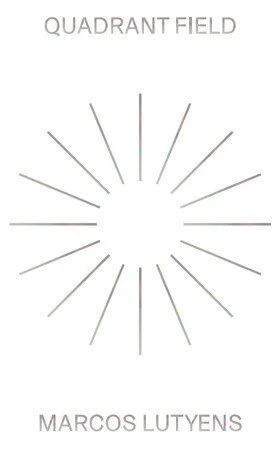
Most entry points are stepping stones from previous projects. Certain threads that haven’t been completed in a past project point forwards to more exploration and investigation. Intuition is also a great factor, with my finger on the pulse of unconscious drives and responses inside myself and in those around me. Gradually over time, the projects have built up a meta-structure which I have framed in a newly published book called Quadrant Field. The book explains how my past and ongoing projects fit within a matrix that goes from the internal, to the sensory, to the social, to the environmental and back to the internal again, in a kind of expansive loop that circles back on itself as one’s true internal nature is matched by the true nature at large.
I’m really interested in your Inductival Covid-19 sessions. What is specific about the series to the Covid-19 pandemic? What does it seek to do?
As the lockdowns were rolling across the planet we were all in uncharted territories. Never before in our experience had we witnessed such a thing, and there was a huge fear about jobs, the economy, contagion, access to health, which turned into chronic unspoken anxiety, exacerbated by media imagery of bodies in refrigerated trucks, and a huge looming recession. It was on this basis that I started my twelve Inductival sessions, which were thirty minute Zoom hypnosis sessions for participants from around the world. Each week I focused on a different familiar tangible object. I felt that objects that one could touch or see were a better starting point, more grounding say than a theme stemming from an intangible and amorphous verb or adjective.
The first object was honey. I chose this as my son and I had pneumonia just before the lockdown, which we were told by the doctor to assume was Covid-19. Honey helped soothe me back to health and I thought that it would be a great vehicle to help people overcome their anxieties, especially as many of us were wary of that first sign of Covid-19: the sore throat and cough. I also introduced associations of smell in the hypnosis narratives, as the loss of this sense was also a symptom of Covid-19, and by reinforcing it in the unconscious, in a sense we were warding off the effects of the virus. I posted the twelve sessions on YouTube which I’m sure will still be useful in days beyond Covid-19. The playlist can be found here.
Thursday 26 March. Friends and visitors from around the world joined on Zoom. Worried about the confinement, the quarantine, first in living memory, and also…
In a time where we are experiencing architectures in new ways through to social distancing, how does Inductival engage with architecture and space?
Space has now in some way collapsed. You hear large companies like Fujitsu, Twitter and Facebook announce permanent work from home plans. Shopping too has migrated online with online sales at 13% in the US and growing rapidly. In fact there has been an inflection point where Covid has accelerated changes that were already happening. In this sense the architectures of now (the word architecture stems from the Greek arkhitekton: master builder) are constructions that have become electronic and digital. Our body space is pixelated, turned into bits and bytes and passed along small tubes at the speed of light and then expanded into a flat representation.
So the architecture of today is largely formed by long glass wires and signals on waves transmitted through the air. The architecture of space has totally dematerialized and along with this transformation, the mental, imaginary worlds of consciousness have come to the fore, as our bodies and lived in spaces recede in importance as a part of exchange, dialogue, work and play. In a way the architecture of today is our collective shared space of mind, which meshes completely with the transmission of feelings and ideas at an unconscious level that was conducted, for instance, through the online Inductival community.
Your practice also deals a lot with eco-futurism and surrealism, blending the boundaries between science and art, reality and dreams. In your view, what role do fantasy and imagination play in developing a more sustainable future?
I grew up clambering on the rocks surrounding Dalí’s home at Port Lligat, as well as the nearby wind-sculpted contours of Cap de Creus, so the surrealist pareidolia of rocks morphing into people and other objects was ingrained in me form a very early age (I even have a book signed to me by Dalí). Perhaps the jump though, is from Surrealism which explored the ambiguity of dreams projected back into our daily lives, to a kind of super-realism in which playful and lyrical ambiguity (which has now morphed into fake news and conspiracy theories) is replaced by a hyper-connection to the world around us.
I envision our neurons progressively connected to the natural world around us, so we become hyper-sensitive to the planet’s health, with our own and the planet’s well being completely intertwined, and in this way creating a sustainable future. This connectivity, of course, is knowledge that has been harnessed for millennia by indigenous groups through the use of psychedelics, but one that is also being accelerated by the likes of Elon Musk with his Neuralink technology that hook up the human brain without any barriers to the internet and by extension to animate and inanimate objects alike, weather patterns, the stock market, planets and stars, microbes, historical narratives, etc. Perhaps this is a kind of impending collective schizophrenia or on the other hand a god-like state of omniscience or better still, omnisentience. It’s up to you to decide which interpretation you’d like to espouse, but either way, imagination rather than dogma is what is driving this change and perhaps is a hope towards change for the better.
I’ll just end by asking, do you have new projects currently in development? What can we expect to see from you in the next year?
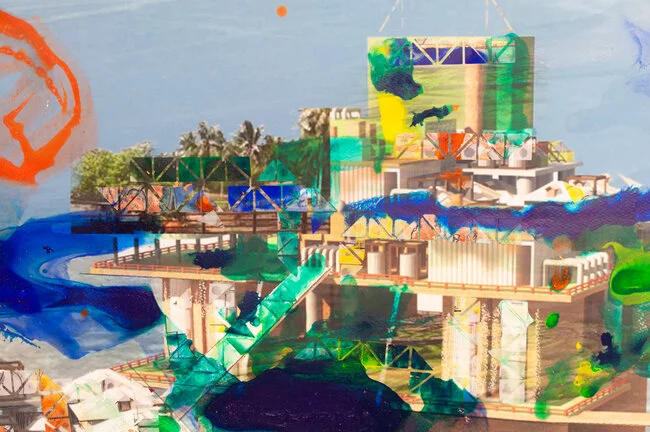
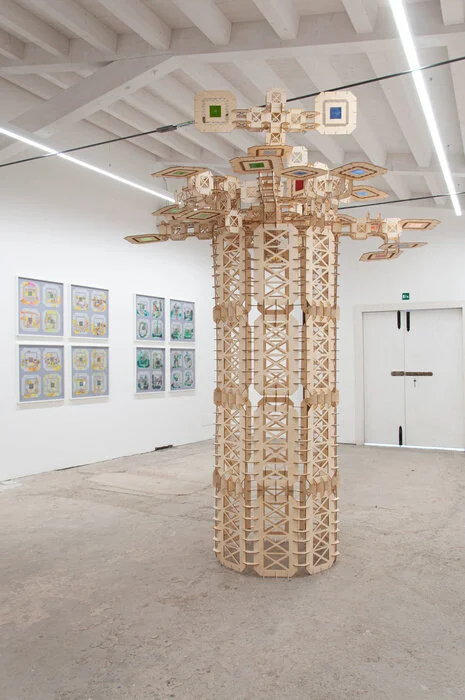
I am busy on many parallel projects. I am taking my Island Ark project into the South Pacific to work with communities there to help work on the issues of sea level rise and cultural extinction. I am also working on a Covid-19 memorial installation made with 200,000 personalized handmade flowers, that grew out of the Covid-19 Inductival sessions we mentioned earlier. An opera is in the works about the psyche and our place in the universe, and I am undertaking further research and experiments to do with therapies for stroke patients, as art should be as much about the imagination, as about healing us all.
View much more of Marcos’s work on his site and Instagram

Be the first to comment