
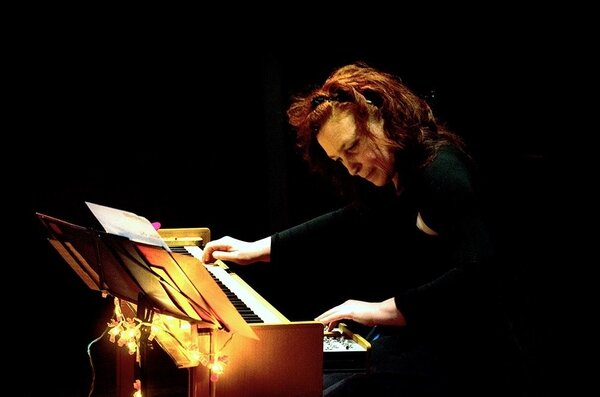
Christine Ott has performed as a solo ondist with numerous classical orchestras, at festivals around the world and in operas. In 2006, she was chosen to represent the ondes Martenot at the first Festival of Electronic Music in Budapest. At the same time, she has taught this instrument at the Strasbourg Conservatory since 1997 and in 2019 she received a music teaching prize for her improvisation and image composition workshops.
Intimately linked to cinema, she has created many internationally-praised cine-concerts (Tabuby Murnau, 2012; Nanook of the North by Robert J. Flaherty, 2019) and has been composing film soundtracks for many years; with her duo Snowdrops she created the soundtrack for Manta Ray by Phuttiphong Aroonpheng (Mostra de Venise 2018), or with her quartet for La fin du silence by Roland Edzard (Quinzaine des Réalisateurs, Cannes 2011). She also collaborates with other film-makers like Claire Denis, Martin Provost, Jean-Pierre Jeunet and Léa Fehner.
After Solitude Nomade (2009) and Only Silence Remains (2016), Chimères (pour ondes Martenot) (2020) is her third solo album.
Whereas there is a wider awareness of the theremin, the ondes Martenot is much less known by the general public. What initially attracted you to playing the ondes Martenot? What do you think its compositional and performance advantages are compared to the theremin?
My meeting with the ondes Martenot took place at the Strasbourg Conservatory, one of the first classes for ondes Martenot. I was a piano student there, and it was the visual and the graphics of a score that attracted me, called “Son-Relief.” Its title intrinsically contained what I discovered much later with the ondes, this incredible need for space to bring the sound to life, this crazy way to “sculpt the sound,” something quite incomparable among traditional and contemporary instruments. There are of course similarities between the nature of the sounds of the theremin and the ondes, the glissandos…the theremin is maybe more playful, more fun. But it is less rich and precise.
On your new album Chimères, you have placed the ondes at the center of your compositions for the first time. What ideas inspired you to finally build an entire album around this unique instrument?
The idea had crossed my mind to make an album only made up of ondes Martenot. This is something that I had of course experienced for some pieces or soundtracks, but not on the scale of an album. So when Frédéric Oberland and Paul Régimbeau came to me with this idea shortly after they founded their label Nahal Recordings, I told them OK!
How long have you known Frédéric and Paul? What did they bring to the project in terms of transforming the ondes sound with effects boxes and other sonic manipulations?
I have known Frédéric for a while. He invited me to work on several opus or concerts for his main project Oiseaux-Tempête. I also accompanied him for the release of his great solo album Peregrinus Ubique. In 2015, we worked with Paul and Frédéric on a special concert for their Foudre! project in Paris. It’s a nice memory, we had created together quite intense material with Greg Buffier and Romain Barbot from Saåad. We were like an electronic quintet, grouping together among others my ondes, modular systems and analog synths….I think that Chimères is part of the continuity of this work, except that the instrumental matter simply boils down to my ondes Martenot Dierstein here, and the effect derivatives manipulated by Frédéric and Paul.
Their importance is more or less strong according to the pieces, but it is certain that there are some moments in the album where we “sculpt” a singular matter, alive, almost like a trio than a solo. For example I’m thinking of the second part of “Eclipse,” or the end of “Sirius.”
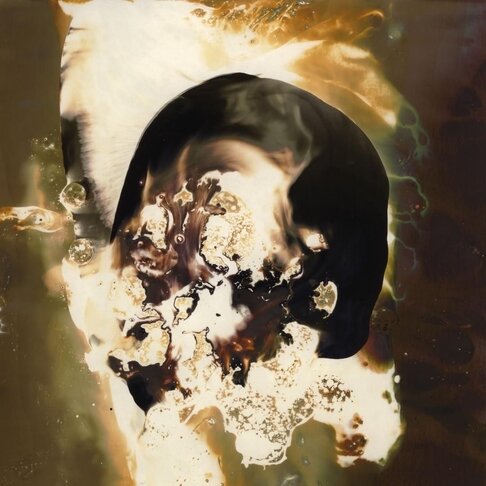
By utilizing vibrato and lyrical melodic lines, you bring an exceptional singing quality to your compositions on Chimères. Your works also incorporate complex rhythmic textures as well as percussive passages. Besides your skills on the keyboard, what other instruments have guided your artistic approach to composing for the ondes Martenot?
I don’t know if we can ask ourselves this question in these terms. But what is certain is that the piano remains an important starting point for some pieces, in particular to find the harmony, the polyphony that the ondes Martenot cannot give, as it’s a monophonic instrument. That’s especially the case for “Comma,” which was first written as a piano solo piece a long time ago. I adapted it as an ondes Martenot sextet. I have recorded the six voices which constitute the “Tutti” of the final part, layer after layer from the bass to the soprano voice.
Are there any other ondists you especially admire or find influential?
Nowadays I don’t think so. There are too few who play it. The instrument is unfortunately not accessible enough, and it remains too much a niche. Not enough manufacturers of reliable instruments, not enough schools, not enough good teachers and workshops…
Of course, I would like to pay tribute to my past teachers. I received various successful lessons from Françoise Cochet, Valérie Hartmann-Claverie, and finally from Jeanne Loriod at the Paris Conservatory. I had the chance to form very beautiful and strong friendships with Françoise and Jeanne. They have never left me and their voices still resonate in me today. More than teachers, they were two “great ladies” of the ondes, both inimitable teachers and interpreters, but also women of heart, sensitive and human with temperaments and crazy energy! It was natural for me to continue to transmit what they had taught me and to continue to live the heritage of Maurice Martenot, while translating it in my own way, with my vision and in connection with our times.
How do you feel that your composing style and sound has evolved across your solo albums? Has the music you have created on each album influenced the music you’ve made on the next, or do you view them as standing more as individual units?
There is undoubtedly an unconscious porosity between my albums and various projects and collaborations, but it is not something I’m thinking of a lot…In any case there is certainly a common denominator: a certain dramaturgy, on the scale of the albums. It was the case for Only Silence Remains, it is the case for Chimères, and I am sure it will be the case for my next albums. This musical dramaturgy is something that I try to defend.

Be the first to comment