
 Photo by Joshua Chekov
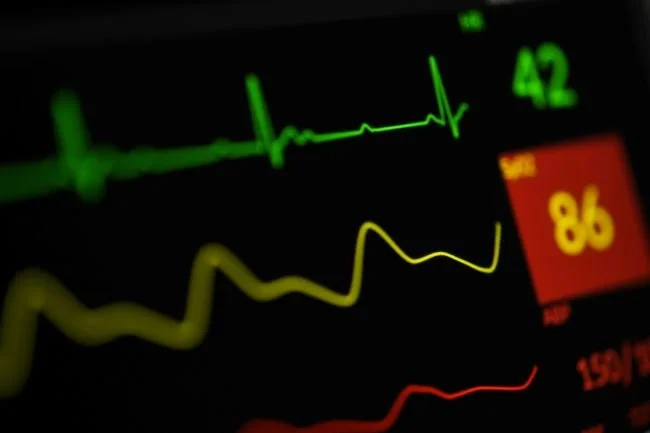
Imagine if your pulse could paint a whole room in vivid color. Contemporary artist Krista Kim made it happen in 2024 with her exhibition “Heart Space,” in which she transformed every visitor’s heartbeat into vivid waves of color, frequency, and light. Kim’s idea was to demonstrate the extent to which technology can unite rather than divide people. The myriad of connected waves, projected onto the ceiling and walls, enveloped her audience and reminded them that they were all connected. Kim’s work is an exponent of the “Techism” movement, which seeks out a future where technology is not only used for progress, but also to highlight human values and reveal the rich world of emotions.
Artists Leading the Way
Kim is one of a select group of artists who capture biometric data and convert it into something more. Rafael Lozano-Hemmer, for instance, collects different types of biometric data, including heart rates and fingerprints. His interactive installation, “Pulse Room,” features screens that transform the audience’s heartbeats into art on the screen, as well as water tanks that collect visitors’ pulses to create rippled patterns projected onto walls.
Another must-see creation is Allison Chan’s “Interpulse” installation. It utilizes the audience’s heartbeats to display light patterns across the screen. The work demonstrates how heartbeats interact with one another within a shared space. Also worthy of viewing is the Mindful Data Audiovisual Project (MDAP), which obtains real biometric signals from viewers, including their brainwaves, breath, heartbeat, and movement. The aim is to encourage people to see their biological data as a form of artistic expression.
The Technology Supporting the Vision
Different technologies are used to collect and display biometric data. For instance, Krista Kim’s Heart Space is made possible by Tenbeo AI. Each heartbeat is first captured via an ECG, which produces electrical signals. The AI system then analyzes the ECG signals and identifies distinctive patterns that are as individual as fingerprints. This unique signature (called a “Heart Signature”) is then displayed as a living artwork through waveforms and colors that capture and demonstrate each person’s emotional and physiological state. The installation reveals the extent to which new technologies are being integrated into art—and it is just one of many emerging art forms. For instance, it isn’t difficult to imagine a recorded heartbeat waveform converted into a visual pattern for a precision engraving tool or laser to stamp onto metal. Metal stamping is traditionally handmade; it allows for the embellishment of objects without requiring specialized equipment. Biometrics, however, can take this art to the next level, allowing audiences to take home technologically advanced metal artworks or jewelry.
Beyond a Heartbeat
Artists are already experimenting with many new ways to integrate biometrics into their works. For instance, artist and biohacker Heather Dewey-Hagborg uses DNA from human samples to create 3D-printed sculptures of strangers. For her exhibition “Stranger Visions,” she collected items such as discarded gum and hair from public spaces, using them to inspire her work. She aims to confront difficult questions, such as those related to genetic privacy and consent in modern life.
Rafael Lozano-Hemmer, meanwhile, frequently utilizes facial recognition technology in his large-scale installations. In “Surface Tension,” for instance, a massive projected eye tracks viewers as they move through the exhibition space.
Zach Blas imbues his work with playful touches; for example, his “Facial Weaponization Suite” features sculptural masks that confuse or resist facial recognition systems. He merges many faces into a single composite, defying classification. As such, he transforms collective anonymity into something powerful. His response is considered political in nature, a defiance of the idea that technology defines who we are.
Trevor Paglen and Kate Crawford have done something similar in “ImageNet Roulette.” They asked visitors to upload their photos, showing how AI automatically categorized them with bias and labeling errors. They hoped to show the profound extent to which AI can be culturally biased.
Biometrics are a fascinating way to merge the physical and the creative. Artists like Rafael Lozano-Hemmer are making profound statements about new technologies. Some are utilizing AI to reveal the connections between human beings, while others are reminding us that AI still has a long way to go in terms of processing data without cultural bias.
Jennifer Alder is a former musician turned freelance writer. Her passion for music lies mainly in songwriting, and now she uses her love of words in her daily work. Outside of writing, she enjoys European travel & crime novels.

Be the first to comment