

Krista Diamond’s writing has appeared or is forthcoming in The New York Times, The Paris Review, Cosmopolitan, and elsewhere. She holds an MFA from the University of Nevada Las Vegas and her work has been supported by Bread Loaf, Tin House, and the Nevada Arts Council. She lives in Las Vegas. Close Relationships with Strangers is her debut novel.
The blurb of your book compares it to Nightcrawler, which I thought was a really apt comparison—not just for the voyeurism/photojournalism aspect, but also for how Ben in your book and Jake Gyllenhaal’s character in Nightcrawler have a kind of obsession in common. What is that like in terms of character building—drawing out that narrative of obsession? How did you approach writing Ben as a character?
I often joke that Ben is a cautionary tale about what happens when you think you’re Ryan Gosling in Drive, but you’re actually Jake Gyllenhaal in Nightcrawler. That’s a bit unfair to Ben, who I love very much, but I do think there’s something to be said about the fantasy of driving around Los Angeles in a cool jacket versus the reality of circling it obsessively, desperate and sweaty and despised. Ryan Gosling himself has described his character in Drive as a guy who has watched too many movies and, as a result, is just playing the getaway driver role. He’s all facade.
Jake Gyllenhaal in Nightcrawler is uglier—I don’t mean physically, obviously Jake has still got it even when he’s being a weird little freak—but he’s also more human. And that’s essentially how I found my way to Ben. I initially wrote a novella version of the novel that was just the Los Angeles part. That version of Ben was an archetype. So, I started thinking about the things that make someone an actual person—where they’re from and what they think of that place, the people they’ve loved, what they’re like when they’re alone in their apartment. And of course, I thought a lot about obsession, specifically the role it played in his life before he got to be the version of him we meet as a paparazzo.
We all have obsessions—not necessarily to the extent that Ben does—but being fixated on something or someone to your own detriment is pretty human. That’s how I hope readers will see Ben: as a human. Even if he’s not someone they’d necessarily want to hang out with in real life.
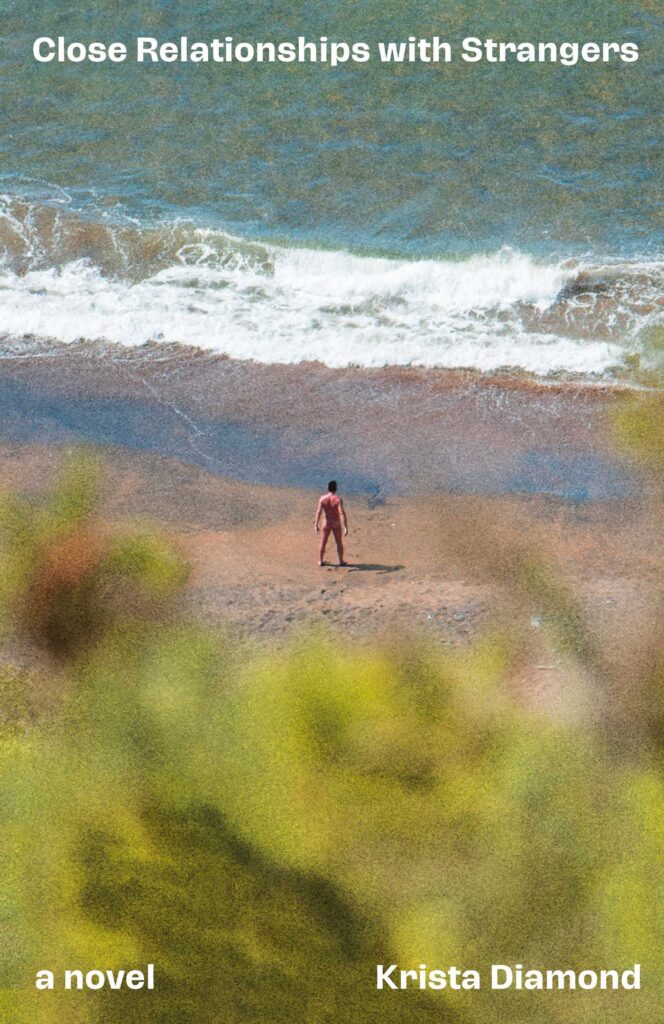
I find it interesting how the title of your book plays out in the novel. The “close relationships” take many forms—the parasociality of (online and offline) fanbases, the thorny professional space Ben operates within, but also a much more personal connection that Ben feels with the actor Jack Whitlock, which feels true to how many of us feel about our favorite actors or art-makers. (Of course, he takes it several steps further than the average person would.) Can you talk a little bit about those layers?
It was very important to me that the title used the phrase Close Relationships and not just Relationships, because parasocial relationships often feel close—so intimate and sincere. You’re right that there are layers to it. There are so many examples of parasocial relationships throughout the narrative because there are so many different kinds of parasocial relationships in real life.
In the novel, there’s stan culture in the form of a pop singer’s massive and threatening fan base. I’m not going to say which real life versions of stan armies I drew inspiration from for this because I like my DMs without threats, but you can probably figure it out. There are also parasocial relationships in a professional sense. It’s not just the paparazzi, but all of these other people, from the valet drivers who act as tipsters to the publicists who handle reputation management, whose livelihoods depend on the famous people they barely know or don’t even know at all.
And then there’s Ben who represents a one-on-one parasocial relationship with a celebrity. He’s first introduced to Jack, the actor he’s obsessed with, because he’s a very famous person who everyone is aware of. Kind of like how everyone is aware of Leonardo DiCaprio. It’s not something you opt into. Ben then comes to see Jack as this source of comfort, like the feeling you get when you listen to the same podcast for years and the host’s voice becomes very familiar to you. Of course, Ben’s parasocial behavior becomes pathological, but I do think there’s a little piece of him that is grounded in something we’ve all experienced, which is simply just having feelings and opinions about a public figure.
There’s a tension in this novel between dreams and reality—the promise of something versus its actual existence, and the urge to make something out of nothing. At one point, Ben quotes Mulholland as someone who said, “There it is, take it, and did exactly that, just as I have done, just as I will do.” What makes these spaces—Los Angeles and Las Vegas—so conducive to this tension?
I’m so glad you pointed out the Mulholland reference because an earlier title for this novel was There It Is, Take It. I realized that only Angelinos would appreciate a reference to the 1913 opening of the Los Angeles Aqueduct, which essentially stole all of the water from the Owens Valley.
I’m glad I got to use the quote somewhere, because it is such an incredible encapsulation of entitlement. “There it is, take it” can refer to a paparazzi taking a picture of someone who doesn’t want to be photographed, and it can also refer to a stranger arriving in a new place and immediately claiming water, land, and resources. You know, that whole Manifest Destiny thing, which is a beautiful phrase for something evil.
Los Angeles and Las Vegas are places that, like the rest of the west, exist in their modern form because of the entitlement of settler colonialism. That idea is essential to the geography of the novel.
Ben is made to draw a tarot card at one point, and draws the Hanged Man—he says, “It’s the card I have always drawn, every time a deck has been presented to me.” What does the Hanged Man mean to Ben? At another point, he gets an aura picture taken with strange results too—I found these really interesting moments that are telling us a lot about Ben, but sometimes through absence of information.
Ben has adopted a transplant’s idea of Los Angeles, which to him means engaging with stereotypically Californian trends like tarot cards and aura readings. He also carries a quartz. He claims to do this as a way of adapting to his ecosystem and also as something transactional.
For example, he gets the aura photo taken because he’s hoping to get some information about famous people from the photographer. But the truth is, deep down he really does believe in these things, which is why he takes it seriously when he draws the Hanged Man. One interpretation of that card is that it represents letting go of the struggle and surrendering to fate to find a way forward. Ben wants to believe in this. His life is lonely and out of control and in a way, he longs for a higher power. He believes the results of the aura photo, which is why he’s so upset by them.
This is a novel about wilderness and celebrity, which are maybe surprisingly interconnected—I love the comparison of the job of a paparazzo to a wildlife photographer. Ben approaches his subjects both with a kind of reverence for his subject and a simultaneous sense of ownership.
When I read about LA, I often think of Joan Didion’s essay “Holy Water”, in which she writes of a swimming pool as a symbol “of order, of control over the uncontrollable”, which feels apt here in many different ways. I’d love to hear more about what drew you to these ideas—wilderness and celebrity—and how Ben figures within these spaces.
I spent my twenties working in the national parks—Death Valley, Yellowstone, Glacier, and Big Bend—and then moved to Las Vegas because I love the wilderness that surrounds it. I’ve also always been really into celebrity culture. I’ve spent many a camping trip reading People Magazine.
The two ideas of wilderness and celebrity felt totally unrelated in my writing until this book. I’ve written a lot of essays about the human relationship with nature, but I never imagined that kind of subject matter would find its way into a novel about paparazzi until a paparazzi photographer who I interviewed as part of my research process compared his work to wildlife photography, pointing out that both types of photography require you to be on the move, pursuing an elusive subject.
That’s where I got the idea to make Ben an aspiring wildlife photographer, which allowed me to bring in so many of the places in nature I love. I think Ben likes both types of photography because they provide that sense of order you referenced. He is a person who feels very uncomfortable in his own skin and in the world. He has a hard time relating to other people. A camera simplifies things, reducing interactions to the photographer and the subject.
I saw a Goodreads review of your book that I loved, calling it the “feel bad read of the summer”—what a great phrase! Reading Close Relationships with Strangers reminded me a lot of the feeling I had when I read Emma Cline’s The Guest—a kind of constant low-level anxiety that never lets up but builds right up to the last page. How do you feel about that label—is it something that resonates? Are there novels or movies (etc.) that you looked to for inspiration while writing, or that you think make good companions to Close Relationships?
Well, I’m definitely getting that phrase printed on a t-shirt. It’s so cool to see readers’ experiences with the novel. For what it’s worth, I felt very happy the whole time I was writing it. Not sure what that says about me.
I appreciate you mentioning The Guest because I love Emma Cline’s work, that book in particular. What’s great about The Guest is that the narrator has this very specific thing she wants, and even though her journey is dark, chaotic, and destructive, she never loses sight of her singular goal.
I really wanted Close Relationships with Strangers to be oriented around a clear goal as well. In addition to The Guest, I was also inspired by In a Lonely Place by Dorothy B. Hughes, a noir with a toxic guy at the center that was written in 1947 but (unfortunately for all of us) still feels relevant today. Other books that inspired me include The Shards by Bret Easton Ellis, A Touch of Jen by Beth Morgan, Leaving Las Vegas by John O’Brien, Nobody Move by Denis Johnson, and Already Dead by Denis Johnson. Actually, everything by Denis Johnson.
For film companion pieces, I will of course point you to Nightcrawler and Drive, but only if you watch them both.


Be the first to comment