
LISTEN VIA THE PLAYER HERE (the episode is also available on Apple Podcasts and Spotify), or read the published version of the interview below.
GL0WING — directed by Beth B — is an immersive, genre-defying experience that blurs the boundaries between documentary, narrative, experimental cinema, and music video. Eight fearless artists step into the frame — their voices raw, their stories electric. As poets, musicians, and performers reveal deeply personal truths, their stories collide and intertwine, forming a powerful, living dialogue with the audience. What unfolds is not simply storytelling, but an invitation: to feel, to witness, to connect.
Drawn from lived experience, Glowing journeys through darkness and into transformation — where pain becomes art, and struggle ignites into radiant self-expression. Through hypnotic visuals and an electrifying score by Jim Coleman, the film pulses with emotional intensity, reflecting the inner worlds of its subjects — raw, unfiltered, unforgettable. Yet even in its darkest moments, it refuses despair — illuminating flickers of resilience, liberation, and hope. Glowing is a cinematic awakening.
Featuring an extraordinary ensemble including Rose Wood, Nick Flynn, Little Annie, No Anger, Joseph Keckler, Robert O. Leaver, Rose Tang, and Evelyn Frantti.
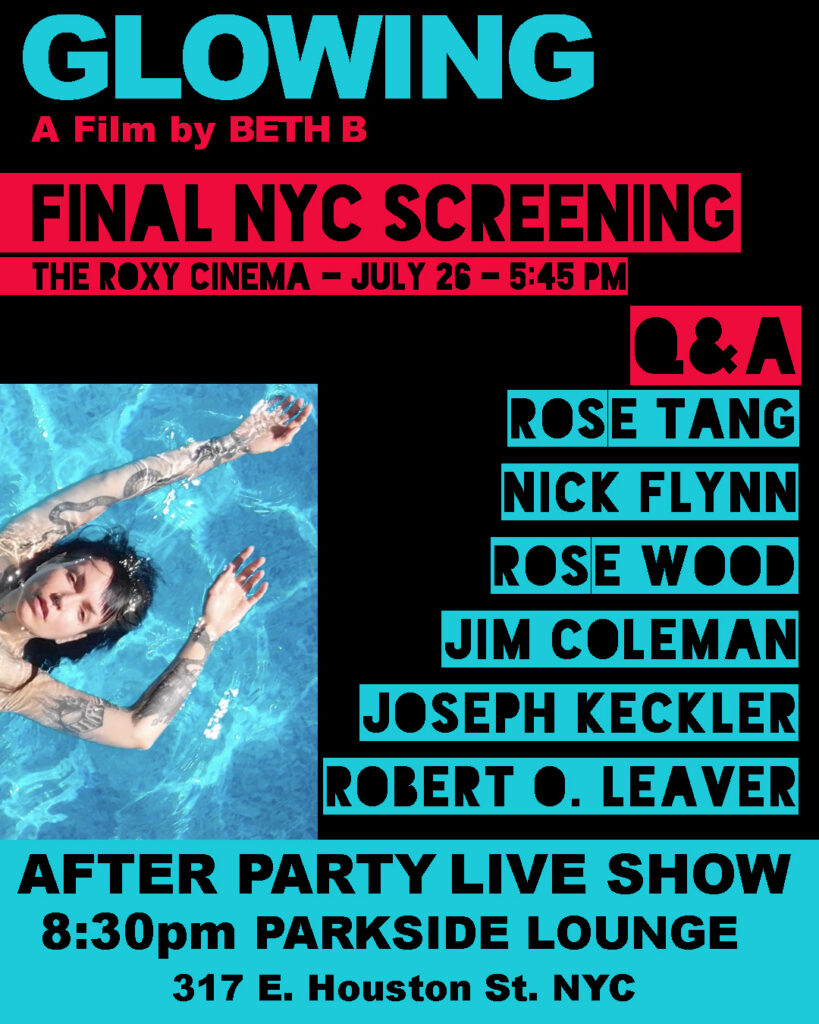
Glowing screens at Roxy Cinema in NYC on Sunday, July 26 at 5:45 pm, followed by Q&A moderated by Tyler Nesler and featuring Rose Wood, Joseph Keckler, Robert O. Leaver, Nick Flynn, Rose Tang, Jim Coleman, and Beth B. LIVE SHOW and AFTERPARTY at The Parkside Lounge, 317 East Houston
Beth B’s film Lydia Lunch: The War Is Never Over screens on Thursday, July 30 at Roxy Cinema, followed by a conversation between Lydia Lunch and Joseph Keckler. Read our interview with Beth B about this film.
Tyler Nesler: I just watched this last night and it really kind of melted my mind a little because it’s such an immersive experience, [with] all the senses…visual, auditory. It is very confrontational, but in a good and liberating way. It’s essentially an anthology ensemble film. You’ve got eight segments featuring a very diverse range of experimental performers. Have you already worked with most of these people in some capacity, or were some of them brand new to you?
Beth B: Some I had and others I hadn’t. And I began working with Little Annie and Evelyn Franti as part of a theater production I was doing. I knew Annie’s music, but I had never worked with her before. It was done at the Kampnagel in Hamburg, Germany. It was confusing at first because I’m primarily a filmmaker. I have done theater, but this was a large production, and I did not want to really use props and sets in the traditional way. And so, instead, I started making filmic backdrops with Annie and Evelyn in them. It was casting almost like this second self into the production. I really love that whole concept.
I think I do that as well in Glowing in many ways, but especially because of some of the aerial cinematography that Jim Coleman did, this hook concept of having a different perspective on my own words, my own life, my own vision of myself was something I really wanted to explore. And I was lucky because I had worked with Rose Wood before in the film Exposed, which was about the wild and extreme world of New York City underground burlesque.
I thought she would be really good for this project, because I wanted everyone to express the concept of the struggle of life and how we get through it, and actually create a transformative journey, as opposed to holding on to the past with resentments and hate and self-demonizing and all those things. Can we do that? And when people were telling their stories, I loved it because they were in the struggle. We worked on the writing. Most of them came from their sources, and then I worked on editing them. But, you know, once they had to actually say those words and commit it into action as well, I think, and I hope it was cathartic for most of them.
I think there is a catharsis element to every one of these sequences. I want to talk a bit about the title Glowing and its symbolic meaning. The film is described as “not just a film.” It’s a reckoning, a release, a spark. You’re facing the unknown. “Burn brighter.” And every performer in the film has a voiceover narration of their story. And it centers on a yearning for a kind of transformation and transcendence. Every segment is very striking in its own way. But what’s interesting to me is that anthology films are often considered kind of tricky to pull off in an even way…
There’s not even a genre for [Glowing]. I’ve been told I’ve created a whole new genre!
It kind of feels that way because each segment stands on its own, but they all still maintain a distinct through-line, tone, or stance of pushing through and transcending. Did you encounter any challenges in assembling these, in terms of the order? How did it all come together? Was it intuitive, organic?
I use a lot of intuition. People say they have a God. I don’t have a God, but I really feel my intuition acts as that within myself. A lot of what I do is based on that. I really wanted to create a kind of connection between the different voices. And I feel like it was challenging in the way that their stories are all very different. But when you start to really think about them, there are threads that become a throughway. There is a path. It’s woven in terms of the themes, of people’s presentation, the way they talk about themselves. I think there’s a theme of trying to understand and let go of the stories we tell ourselves.
Nick [Flynn’s] is a great example of that. When things happen in our childhoods, and no one explains what happened, we go our whole lives telling ourselves, “Well, maybe it was this, maybe it was that.” And I think he’s kind of trying out these different stories that he tells himself and the questions he would like to ask. And then you get a sense of a certain kind of acceptance and resolution in that. I think that No Anger does the same thing. This love story that, even though it’s been over for some time, she’s replaying it in her words and in her body to try to come to a place of acceptance.
And in all my films it’s like that. I work very much in that mode. To me, narrative is not important in the traditional way. I think every one of the [segments] has a narrative, but it’s woven in a different way. With Annie’s, we go from the past to kind of the present, to her imagination, and then at the end, she’s left with her tears. It’s nonlinear and yet each of them tells a very specific story.
I really want to talk about the music because I thought the visuals and the music meshed really well. The music complements the visual presentation and narrations rather than trying to tell the viewer how to feel, which is usually what most film scoring does.
Exactly!
How did you come to work with Jim Coleman?
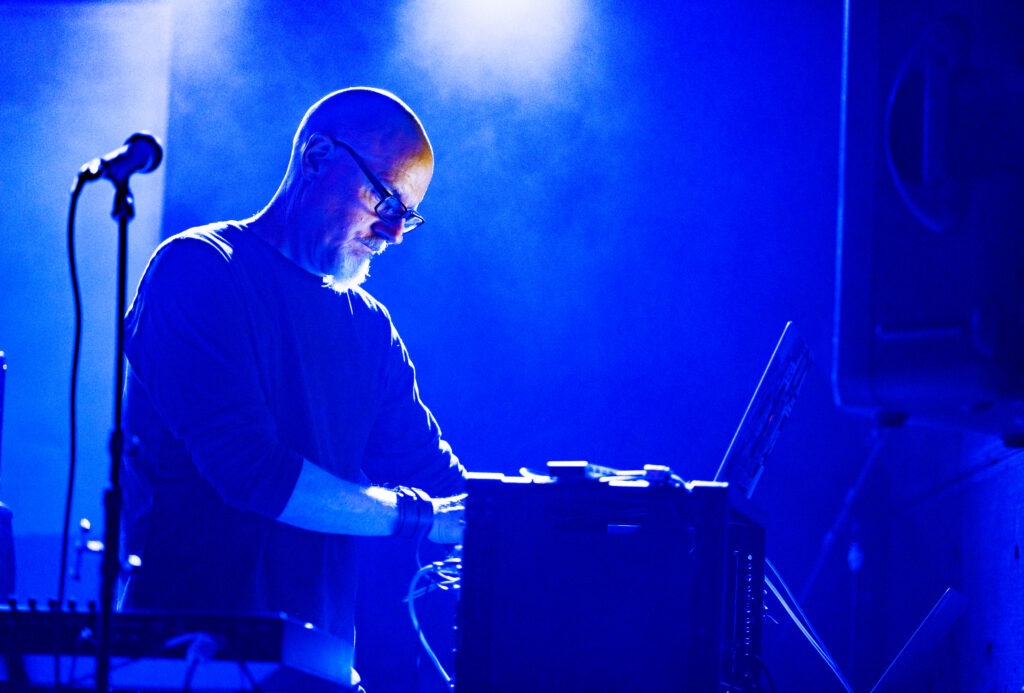
I met Jim 30 years ago. At the time, he was in the band Cop Shoot Cop. They were on Interscope Records. Phenomenal. So, we’re both in New York City. I’m making films, he’s doing music. I had seen the band perform live, and I was like, “Oh, I’m a huge fan, they’re incredible.” I was just working on a new short film called Out of Sight, Out of Mind. And I was talking to my good friend Richard Kern. I had just come out of a terrible relationship and had been single for five years. I was like, forget this, you know, too difficult. And he kept saying, “Oh, you should ask Jim to do the music.” And I was like, “Oh, no, no, no, they’re so great. Cop Shoot Cop, phenomenal. Can’t do that.” And then he said, “Oh, come on, we’ll go to one of their shows.” And so we went to a show at CBGB. This is a long time ago, people! And just before they were going on stage, Richard introduced me to Jim. And he was rather aloof. And I was like, what’s with him? And of course, I didn’t know in retrospect, they were going right on stage, so who am I to interrupt? Anyways, I did hire him, and he was just such an extraordinary human being. Just kind, gentle, smart, funny, and talented as a musician. And we worked together for maybe a month or so. He had been a projectionist at the Whitney Museum at one time and had shown my films, so he knew my work as well. So, it was really a meeting of like souls. And we got married six months later.
I’ve worked with him ever since on almost every single film that I’ve made. He did all the soundtrack music for the television work I’ve done. He is now just starting to work with East Village Radio. He’s going to be a DJ there. He’s just a wonder to work with.
In 2000, [we worked on my film Breathe in, Breathe Out]. I brought three Vietnam veterans and their adult children back to Vietnam to look at intergenerational trauma from war. Someone told Nick Flynn about my project, and he got in touch with me. We ended up bringing Nick and his stepfather back to Vietnam because his stepfather was a Vietnam veteran. I think he was just starting to write at that time. He made me aware of Thích Nhất Hạnh, the Vietnamese Buddhist monk, and brought that into the film about forgiveness. It was amazing. And then we kind of lost touch. But then he wrote this New York Times bestseller, Another Bullshit Night in Suck City.
Recently, when I started looking for other people to work with, he had just put out This Is the Night Our House Will Catch Fire. I called him up, I said, “Nick, I want to do this with you.” He said, “Okay, just take what you want.” So, I extracted a lot and tried to edit what I felt could create the story and the essence of what the book was and was about. And then I gave it to him and had him record it. And then [this is the point in the process] when I give it to Jim. He edits a little further and starts to compose music. I’m here in this office, and he’s right over in his studio.
He goes with the emotions, but you’re absolutely right, it’s not like he’s trying to amplify them. It’s really an underscore. And he’s taking in the feeling of the performers, of the words of the story, but not trying to overwhelm or manipulate the audience to feel something. And instead, I feel like we use the music, the words, the visuals. The visuals are very important to create, in a way, a different dimension that we are all in this landscape. And the landscape we are in is actually universal. And to see the stories, in a way, as a sense of connection between each other in these landscapes. But it was critically important to find what landscape could reflect what the character is saying at this particular juncture. And do we want the camera to be intimate and close on them and then reveal a broader way, a different perspective? And I think that is why, for me, the drone became really important. Because I think that when we are in our heads, when we are in our heads with our problems, it’s extremely difficult to see them from any other perspective. And it’s critical to reach out into the world, to bring other people in, to listen to us, to hear, to embrace, to connect, to be able to tell their stories. And when the drone goes out, it’s really looking for that other perspective for the character.
I wrote down the word “disembodiment” while I was watching this.
That’s a good word.
[It did] feel like that. That is a very consistent visual motif. Everything seems to wind up with this very sweeping, almost out-of-body experience where the individual is seeing themselves from above. Almost like the stories from near-death experiences, where people claim they float above their body and see their body. It’s a disembodiment and a massive widening of perspective.
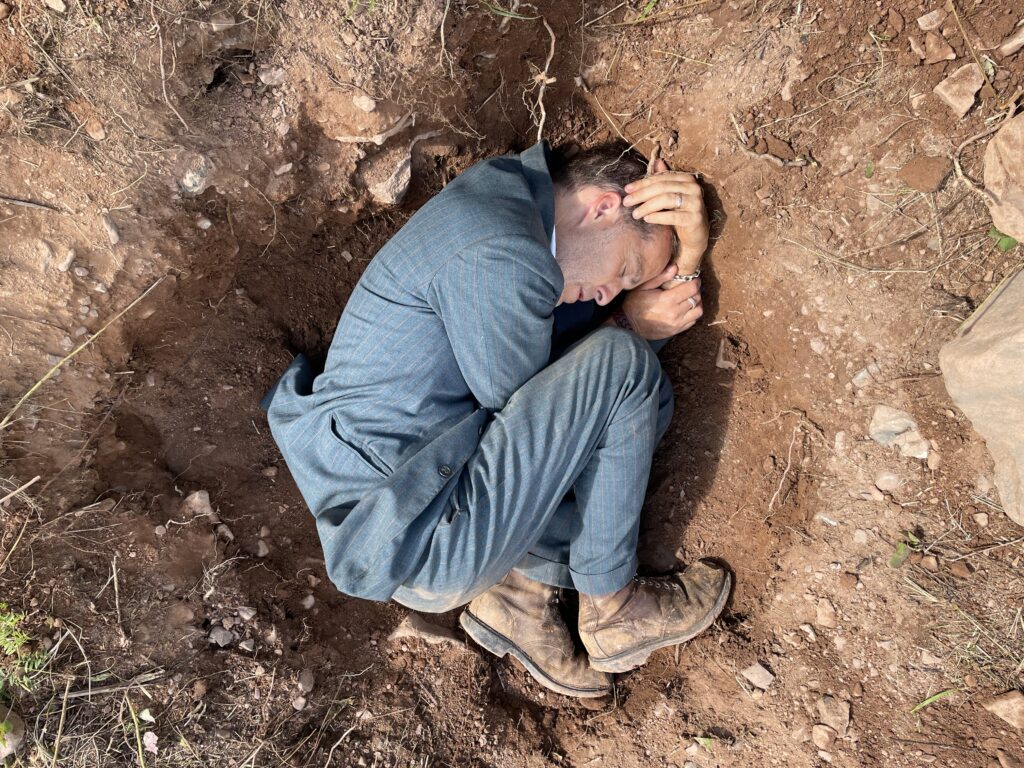
And you were talking about locations and finding the right settings and locations…there is to me a real focus on various kinds of terrestrial elements, both natural and constructed, but a lot of nature. A lot of geometric elements, like circles, [as in] the Robert O. Leaver sequence. The hole that’s dug by him. There’s also this rectangular pool that shows up in at least two, maybe three of the segments. And in the Rose Tang sequence, where she seems like she’s lying between two rail lines, and the camera sweeps out, and there’s a circle that’s cut through with the rail line. I don’t know if this was intentional or something that maybe I just picked up on. That resonated with me. I was getting references to land artists like Andy Goldsworthy or Richard Long.
Earthworks! But you know what? It wasn’t intentional. That’s what was so strange. And then it was especially apparent with Robbie when the drone went up. And then we were like, “Oh, my God.” Because he drove his truck around and around to try to get the long grass to press down so that we could walk through. So it was very accidental. But you’re absolutely right. As soon as I saw that, I was like, I’m recreating some very important art here. Like this whole idea of the rails with Rose Tang [contrasted with] the circular. I mean, a lot of it also has to do with what path are we going to take? The rails go in different directions. And just as when you’re on a train, you can go this way, that way, you turn, curve this way. That’s how life is. I think of it as individuals trying to navigate something that is not necessarily navigable.
Our experiences, especially from childhood…we’re not really set up very well. In most families, we’re mostly set up for disaster. There are a lot of struggles to just find a way in life that works to accept ourselves. And there’s also the circular, which I always relate to. Again, a lot of it is family cycle. What is a cycle? Are we going to perpetuate the cycle of violence, abuse, and neglect, or are we going to reach a place where we can say, “I want to find a different way to be in my own body, mind, and the way I relate to other people.”
Personally, I struggled so much with that in my life. I had a huge wall up for most of my life until maybe ten years ago. I was filled with resentment, rage, all those typical things. And then I had to kind of go, “I don’t want that.” I want to be able to see vulnerability as strength and power and connection. This film is very much about that as well, because I feel like all the characters, and maybe it is because most of them I knew ahead of time, they really trusted me, and I trusted them. And we already have a kind of bond of intimacy with which to create something that could go beyond just the facade or persona.
There is one other thing that you said – this disembodiment and rising above one’s own body and perceptions, [like a near-death experience]. And there are two shorts that will show at the same [Roxy screenings] as Glowing that are called Near Death. (Near Death Jared + Near Death Bliss). And that’s my next series with Jim. Jim thought of the idea, and he initiated it. You’re just so intuitive, dear. You saw it.
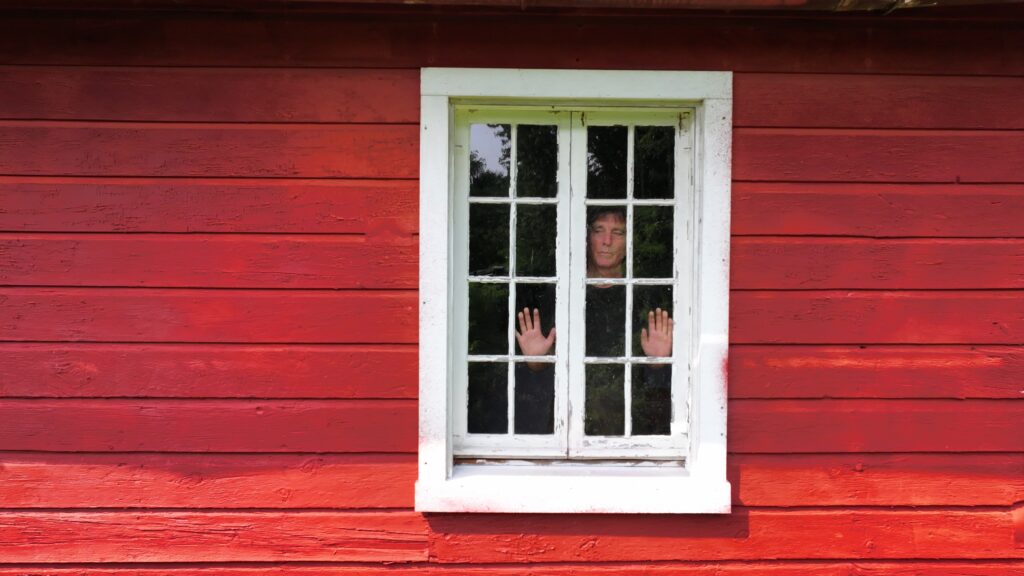
The earthy elements kind of ground these stories beyond human society, too, because of these elementals. There are literally these basic elements, like water and fire. And certain sequences emphasize those elements. Nick Flynn’s portion is very fiery, red…
Well, the fire’s burning in him always. I think through most of his life, he said, “Do I run?” He’s saying, “Run, don’t run.” And it’s from the fire. It’s from this really traumatic experience that he had as a child. So, yes, very fiery for Nick.
Absolutely. And I also thought Rose Wood’s segment was more water-based. There’s a cooler tone. And I want to get into the color palettes of these because there is also a through line with the color tone, but they all have their distinct kind of palettes, and it looks like different color grading for each section, or there were tweaks to fit the tone. Is there anything you want to talk about in the sense of how you worked with color in each one of these sequences?
I think it’s a reflection of my own life. Personally, I used to always work in blacks and reds. Those are my colors. That’s it! There’s no gray. There’s no balance. It’s just extremes. Black and white, red and black. And as I’ve come to also reconcile certain things in my own life emotionally, nature has become a really important thing to be able to go into.
I’m now living in Savannah, Georgia, and I get to go and see rookeries. Hundreds of birds that are mating and laying eggs and building nests. That gives me so much peace. Just listening to the sounds, the wind. And I know this sounds so like, uh-oh, where’s the hardcore Beth B? But you can only do that for so long, I think, and then you kill yourself. Whether it’s drugs or slitting your throat.
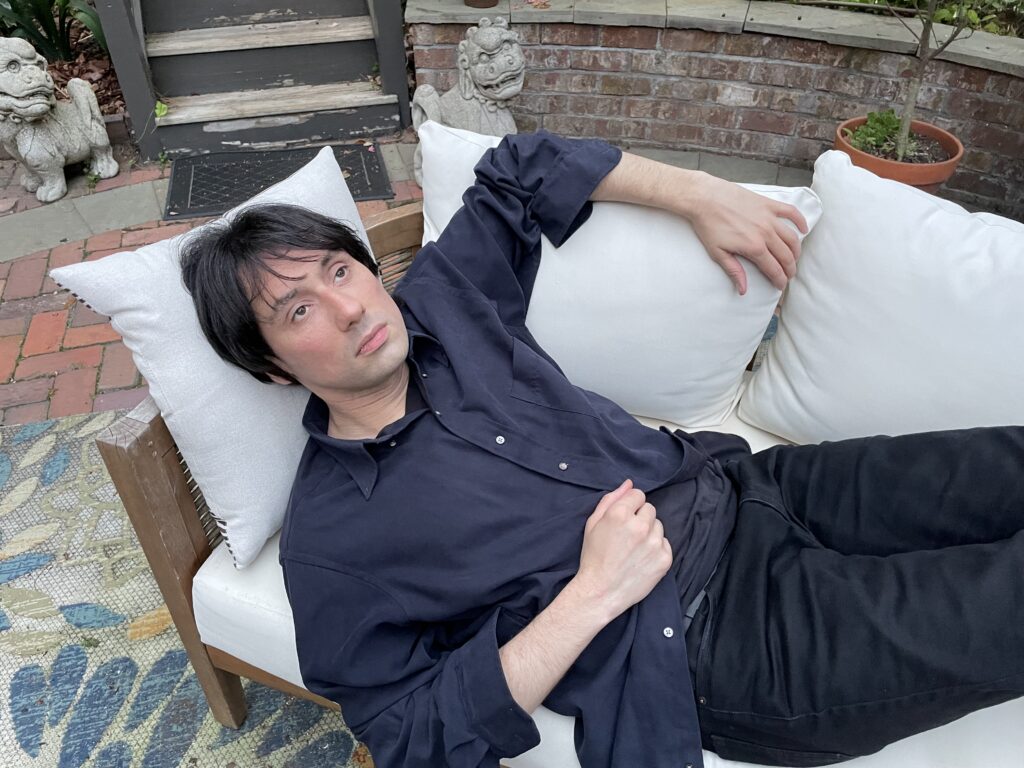
I have been to Savannah, which is a very distinct city, with a very particular vibe and atmosphere to it. And I was going to ask if some of this had been filmed in the South, because in the Joseph Keckler sequence I remember seeing palmetto trees or palm trees…
It’s not Brooklyn!
No, no, no! And I’m assuming that beach [Keckler was filmed on] must have been nearby.
Yeah, [this] beautiful, beautiful beach here [on] Tybee Island. We brought Joseph there. And that’s what I did with each character. Some were filmed here in Savannah. Joseph was filmed here, and some of Annie, some of Evelyn, and Rose Tang. I felt like, because of the landscapes here and certain locations, it would be wonderful to have some of them located here. And it also gave me more control. The whole film was done, I would say 90% of it, with just Jim and me.
Wow!
No crew! How liberating. It also served to give the pieces a sense of more intimacy. We weren’t having to deal with catering or this and that…I produced it. Jim was doing the aerial cinematography. I did some of the DP work on it. It was just a whole different experience, which I really needed. And then we filmed other parts. We have a little place in the Poconos, and Rose Wood is very, very, busy. And so I asked her when she could do this. She says, “Okay, I have three days for you.” And then she came up to the Poconos from New York City. And what a great experience. And we did one illegal day of shooting. When you see the film, you’ll see that Rose doesn’t necessarily wear all her clothes.
And I got this idea: she’s got to be in an inner tube in a lake. Okay? And I’m like, and she’s got to be naked. So, we got up really early in the morning. We went out on this lake. [I gave her] this raincoat and said you have to keep the raincoat on till way out into the lake. And then you take it off. When we finish the shot, put the raincoat back on. Well, Rose didn’t. I think she just loves being naked. It was really, really funny. When people see that inner tube with Rose on it in the lake, they’ll know that she was so happy. And it’s just a beautiful scene, I think.
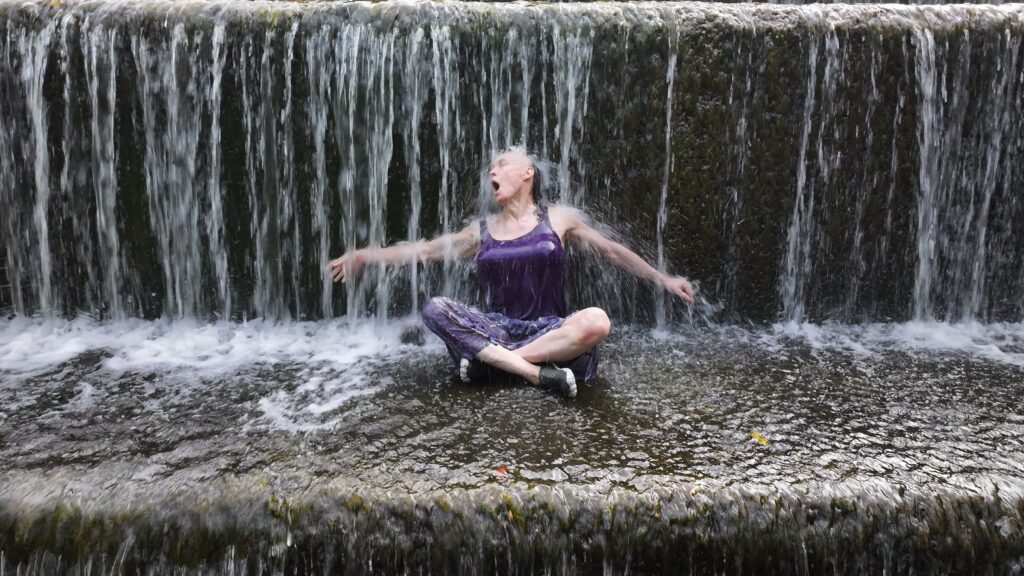
I think that comes through. It is a really memorable shot. And just to go back to your need to have a small crew to develop trust…I’m never going to forget the Evelyn sequences with the skin-piercing.
Yeah, yeah, yeah!
It’s interesting because we’re so accustomed to seeing special effects. If I didn’t know that was real, I would have thought that was an amazing practical effect, because of the elasticity of the skin up close, and the precision that she needs to not really injure herself, it’s like on a particular upper layer of skin. I haven’t really read about that practice yet, but it was incredible. And then going back to No Anger. Obviously, those scenes are very striking. She’s disabled. You have these sequences where she’s in a mobile wheelchair, and also on her own. And then there is the sequence on what looks like a tiled floor that feels like a choreography to me. It felt like modern dance to me. Was that choreographed?
Yes! She lives in Lyon, France. I saw her in a very short piece that was in a longer film, and she dances in it. And I was kind of like, ‘Oh, my goodness, I have to find this person.’ And it took me a while because she’s not known widely and her life is very different than ours. I thought this is someone who has a powerful story to tell. And I tracked her down, but it took me a while to find her. And then when I found her, we just immediately connected in a very powerful way. And she also does not have the ability to speak, to have her own voice, but her voice is so powerful. She types with her toes. She’s a poet, a writer, a dancer. She’s a disability activist. Quite a powerful person.
It really comes through in the film. It was extraordinary to watch the dexterity she has with her feet. She does so much with her feet.
And what I also found fascinating is it’s not like I go to people and then I have these expectations of what they’re going to write about. But with her, I did assume. Which was an improper assumption. But I thought that she would write something about her disability, and there was none of that in her writing. I almost felt ashamed and embarrassed because she’s a human being, and she has all the experiences, love, disturbances, and all sorts of things that we can relate to. And she wrote a love story.
Yeah.
And that was her story. The pain of love.
The longing. So much longing.
Yes. And that’s something everyone can relate to. And then just to show her as a human being. It’s not like we were trying to highlight her disability. It didn’t matter at that point. It did not matter at all because I wanted to show her as a human.
I think that’s what stood out to me so much about it. You don’t really notice. Her disability is not the point.
Exactly.
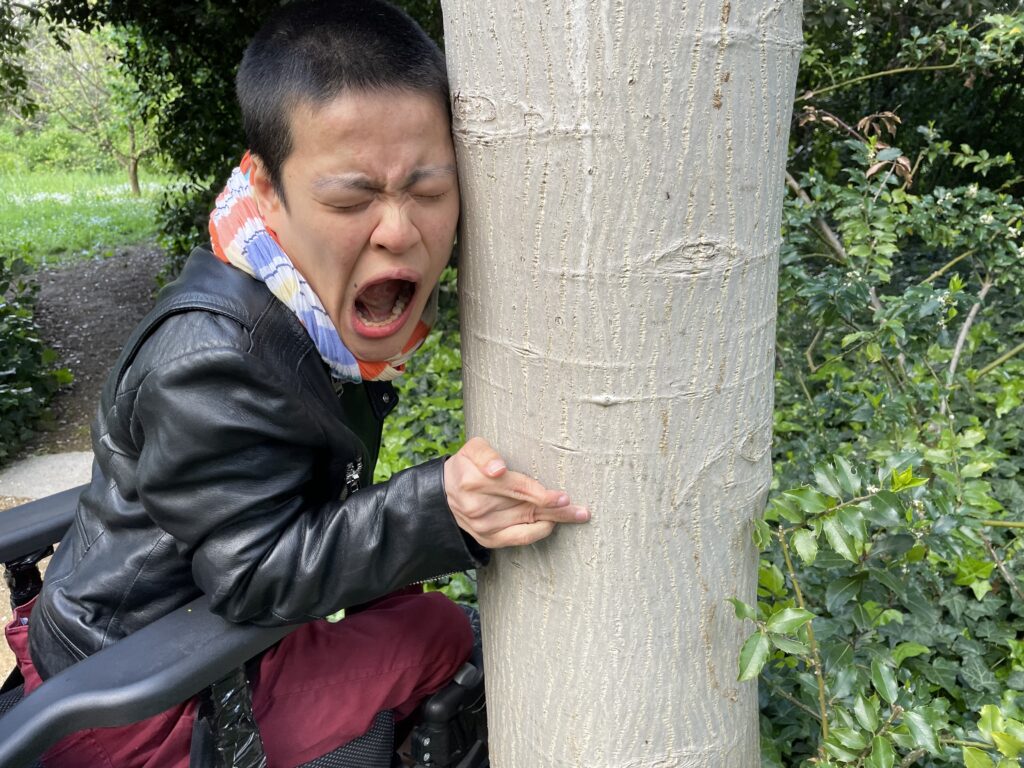
And then the beauty of the dance sequences in the interior, and that beautiful beach scene as well. She’s right on the shoreline.
And in her way, dancing with the water. Small movement. The location where we shot the dance was at this extraordinary exhibition center in Berlin, which is called Silent Green. It used to be a crematorium. Not for the Nazis, though. It was for free thinkers who did not want to be buried anymore. They said, “You know, we’re going up.” And I was invited by the directors there to come and do whatever I wanted. You don’t get that kind of invitation very often these days. And they raised all the money, which was a lot.
I did nine new installations that were all video and music-based. And then some of them were sculptural. And one of the installations was when Glowing was only maybe 30 minutes long or so. I showed it there, but on three huge screens. They were like 20×30 feet each. The projections were in this massive space in the crematorium, which has obviously been renovated. And we had live performances of the people who were in the film. They actually brought all the people, plus Jim Coleman, who also at the time was with the band Human Impact, with Chris Spencer from Unsane. We also brought Phil Puleo from Swans. We just had all these people come in and contribute to the exhibition with live music and live performance. Lydia Lunch came in. She did a performance, and then they did a retrospective of all my films. So Glowing was initially done as a film projection installation in 2024. And then after that, I was like, whoa. I mean, the audience was massive. The first night we had 800 people. I was like, I should be moving to Berlin! I’ve always loved Berlin. But it was also the nature of this venue, Silent Green. It’s so family-friendly. They have a vegetarian restaurant. They are so part of the community there and so kind and generous. And I don’t necessarily find that in the United States anymore. There’s no support here for art.
Anyone who is an artist or creative is feeling that very, very strongly right now in the U.S., unfortunately.
Especially for avant-garde film. There are no art houses anymore, or very few of them. I feel very lucky. We’re screening at the Roxy Cinema in New York City, and they’ve been very generous to us.

Be the first to comment