
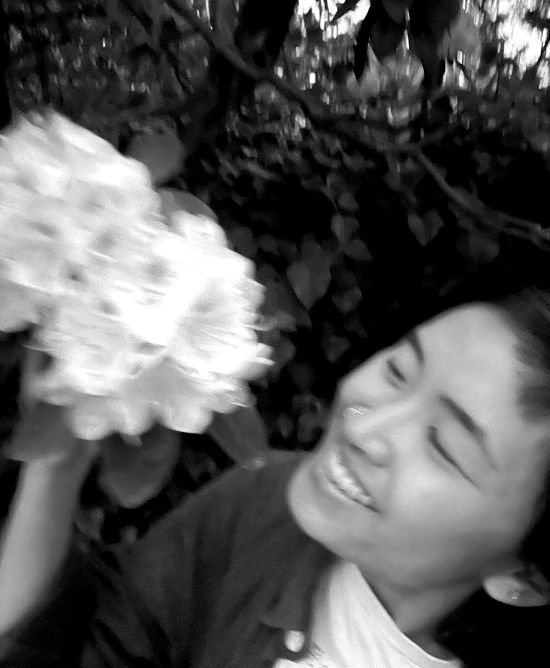
Photo by Jonathan Karp
kathy wu is an artist, poet, designer, and educator working across language, computation, books, and fiber. They currently teach at RISD Graphic Design. Her debut book, She Will Last as Long as Stones, was published by Wendy’s Subway as part of the Passage Series, for artists working in inter- and cross-disciplinary forms.
What was your experience like working with data from the United States Geological Survey? Was there data you chose not to use? Why or why not? What data would you like to work with in the future? And what advice do you have for artists who are interested in research-based work?
At the time, I was already in the practice of using USGS data to make simple procedural websites—these programmed, looping films where the satellite gaze pans between different copper mines. Even though spatially they are far from each other, materially they are connected. My hope with these works was to weave them together through narrative and framing.
[Later in your questions], you mention litany as a genre of poem that appears in the book. I have been thinking about data itself as like a list poem; I hope that scale works to communicate violence and illustrate global capital. This question is making me think of Steve McQueen’s End Credits, which I share with students in classes about visual writing, archive-based writing. End Credits is a projected, 13+ hour long film that uses redacted FBI documents on Paul Robeson as slow, scrolling material. From what I understand, McQueen’s interventions are minimal; it’s about presenting that information in a durational form which is presented as large relative to the body. That scale and duration creates a physical impact for me as a viewer—it’s very different than scrolling through the same content on a government website.
The book is an intimate object by contrast, and that scale shift feels interesting. Maybe that repetition, that obsession, that scale, and being able to hold all of it in your hands creates a new bodily relationship between geospatial data and the reader.
In terms of filtering the data, I mostly chose what I could understand—which was longitude, latitude, the country that the material is in, the company… These are factors I wanted to make visible. Maybe some of that relates to a wish to tangentially engage in what friends in organizing spaces call “power mapping.”
In recent projects, I’ve been working with weather data. It poses the question, how much can people predict the future? Forecasting, dealing with the unknown, is an interesting pursuit; there is a lot that we do know. But it’s not necessarily a conduit for action at global scale for the powers that be.
I don’t know about advice, I do think about my own research within lineages of artists working with “found” material, and invite students to consider directionality of power in such gestures. I’m definitely interested in questions of extractivism in creative contexts—there’s the fact that data mining is called “data mining.” To this end, I return to Eunsong Kim’s Found, Found, Found, Lived, Lived, Lived. There’s transformation of raw material.
I’m also thinking about Philip Metre’s essay on documentary poetics and the role of the poet or artist. He says something to the effect of, the documentary poem is not something which is going to stand up in a court of law, but it’s doing something different than a kind of legal document is.
Obviously, it’s reaching a different audience. Maybe it’s also making us think about those specialized languages or materials in a new way, doing something that a legal document can’t. Poets can be fluent in poetry—or, just simply experiencing language experimentally—without overpromising or overstepping their “expertise” in other fields.
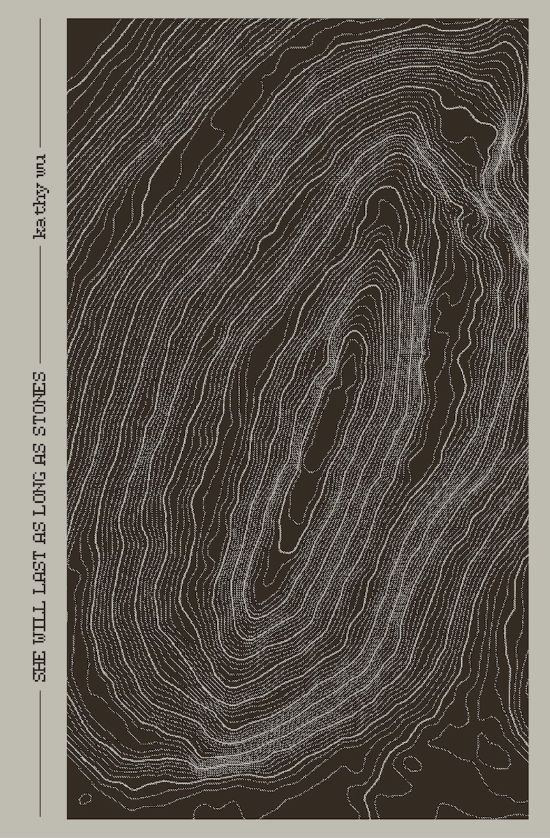
Time and chronology seem important to this book. Geological time is extremely slow—beyond human comprehension. There are different chronologies in this book, too. You reference the past, present, and future in some poems, bringing them together like convergent plates, creating new formations like mountains and trenches. How do you conceive of time in your work? Is it different for your poems, visual artworks, and computational works?
I can start with my computational works; they loop on and on forever, which is an affordance of the web and one thing which makes them different from film. The individual repeating elements go on their own timescales, getting in and out of sync.
Conceptually, it reckons with that question of virtuality and that question of, “Could there be infinite growth on a finite planet,” which is capitalism’s ultimate pipe dream. The computer poses as virtual when it’s in fact a very economic, networked, mineral thing.
For time-based works, they offer a space for my body to perform language. In the more visual works—sometimes it’s about slowing the viewer down or destabilizing my relationship with an existing object, like a phone or a landscape image.
For me, geologic time started with grief—a lifetime of knowing my mother, her lifetime, and those who came before, and following that ancestral chain into longer timescales.
Maybe that’s what’s most important—that entanglement that feels indisputable. Once things are connected, the temporal possibilities expand too.
At one point, my grief was so large, and I found myself feeling comforted by stones, by mountains. Maybe it’s because some had once been alive and some had never been alive. Some stones are fossils. They had things die in them, have carbonized matter in them. There’s a fluid, sometimes ambiguous relationship to life and death. Also, stones have been around forever. They’ve seen so much.
Also speaking of time, there is a timeline stretched across the bottoms of some pages, like an undercurrent, but also like a breaking news banner or a stock market ticker. Early on, it introduces information about anthropogenic climate change. This immediately made me think of “the magnificent seven” tech companies (such as NVIDIA), and their insistence that generative AI is “the future,” despite all we know about its impact on the environment.
In the notes section, you acknowledge that you used ChatGPT to generate the timeline. You wrote, “For me, to use ChatGPT is always to reckon with its materiality, with its origins in Silicon Valley capital.” How can we reconcile that environmental impact of generative AI with its potential to make a positive impact, for example, in medical research, and should we?
I like that you made that connection—I was thinking about it as a ticker tape as well. Here, I used Chat as sort of a conceptual experiment to ask if it saw itself within geologic time. The answer is not at all surprising.
In the classroom, we’ve wondered: is it possible to have a generative AI that isn’t based on exploitative labor practices and neo-colonialism, and environmental degradation? Perhaps AI is entirely predicated on those things. That capitalist hunger for scale feels so congruous with this technology, and so incongruous with the most humane, kind ways being in the world.
How would I feel if Chat could medically save my mother? If Chat could save so many people’s sick beloveds? I don’t know. There are so many other ways to improve people’s lives which are political, not technological. There is potential there, too. The answer for me is, there must be another way to make those advances for everybody without sapping all resources and ceding even more power to these massive companies.
Realistically, I’m like, AI is here to stick around. We talk about this in class, too. What if we did a general boycott of AI? The young folks were like, There’s so many reasons that wouldn’t really work. Obviously, we have some agency in ways we engage with it. Perhaps it’s about being mindful and mitigating harm in small, organized ways.
There’s no purity that is possible. I think about Dionne Brand’s answer in a Q&A—a question about scientific, industrial language in her poetry. I think she said something to the effect of how our water isn’t pure, it’s filled with microplastics. That inspires my poetics, too. There’s no pastoral space. Everything is contaminated with these non-consensual tech relationships which we are force-fed. It feels less about the future or past in tension with each other, but rather about proceeding slowly and in conversation—remembering that, you know, we never wanted this.
I am interested in the power of naming in your work. In “Knowledge Isn’t at Home Anywhere,” you’ve depicted a labeled diagram, for example, one of the lines reads, “for let earth. Earth is earth plus one.” I understand in some programming languages like Javascript, “let” is a command that creates a named variable which can be referenced later on in the code. There is also the allusion to the Bible, when God says “let there be light.” Conceptually, how do you think about code or computational poetics as an art form, and how does it compare to the traditional or analog use of language?
That phrase, “For let earth,” follows a strange syntax of dedication if taken at face value. It’s like, “This is dedicated to let earth.” What is let earth? Is the earth laying fallow? Is it being left alone? Or maybe it conjures up letting, and as in blood letting—this medieval connotation of something being purged.
The book’s epitaph from Glissant—it’s from Poetics of Relation—that quote does a lot of heavy lifting for me. I hold that quote to consider how language taxonomizes or makes things legible. Perhaps the poetics we’re seeking attempts to make those things less distinct.
It’s not something that only happens within code, even though code is easy to exemplify with its binary logic. Within histories of science, I’m interested in forms that tend towards capture, such as atlases or maps or nomenclatures.
Language’s relationship to fixity, to fluidity, to knowability, to unknowability… These are things that exist within syntaxes of other disciplines that use language. For example, science, computation, the law—which poetics can disturb by muddying borders.
Similarly, in “Books of the Dead,” there is a litany of lines describing images. For example, “Picture of miner + miner families. / Picture of tunnel with stone at the end of it.” Why write these lines instead of including the images? Do you see this as an exercise in withholding (by way of naming the images, but not showing them), or a generative exercise (by asking the reader to imagine the images)? Or something else?
“Books of the Dead” references Muriel Ruykeser’s Book of the Dead, which is named after the Egyptian Book of the Dead. In that way, there’s chained citation happening there. I’m interested in photography’s agenda in representing land and space. Other than the VHS still of my mother and me, there isn’t any figurative representation of people in the book. The book contains maps as well as my photographs of a Chilean mining town named Sewell, which was formerly owned and operated by private U.S. companies. The aforementioned litany mostly circles my experience touring Sewell, which is now a UNESCO heritage site. When the poem says “picture of no air,” it is pointing to the 1945 mining accident at El Teniente, where over 350 workers died and over 740 were injured. Halfway through the tour, we all stand to look at this big somber mural depicting the event. I wonder about the relationship of memory and memorial; what does it mean to represent something? Is that enough to “do it justice,” to remember something? These things which people lived, and I now have them as material in a book.
Another line in the poem asks, “Can you stop with this representation?” So there’s some internal, personal grappling with representation that’s not fully resolved. There’s wondering, what does it mean for somebody to see these mines from above, with the same gaze as a satellite or a drone? What does it mean for me to try—in the mildest way—to bring someone there by showing them a full spread image that I took?
It also points to things that aren’t documented as part of any kind of visual project or propaganda; these are pictures that could exist, but don’t. Pictures that exist in my mind, but not as evidence or archival material or memorial or testimony.
The last thing I’ll say is—because that litany also mentions websites and numbers—the use of “pictures of” wonders about language as both virtual and material. Of course, language is material. It always has to come from the body, but it performs illusions too—of floating, of seeming to be pure thought or intellect.
Transformation and memory seem to be important themes in this book as well—the transition from woman to mother, from native to immigrant, from Chinese to English via translation, and from life into death. What role does memory play in change and transformation, and why choose geology to represent and comment on these themes?
I hope the book’s poetics hold memory as this vast and fluid thing. I can only really speak to what I remember, and even that feels unreliable and in motion. Something starts to happen when I try to remember things that came before me.
Transformation also destabilizes the categories of things. There’s a gray potential in-between, something between 0 and 1 that you could become. The Chinese and English play is just a small nod at what’s glitched—and not in a negative sense—across generations and migrations. The glitchiness is already “complete” and valid within its own fragmented composition; simultaneously, it’s in a constant state of realization. There’s also the loop within a program or circuit, where something repeatedly begins and ends, but has changed in the process. Maybe the circuit is repeating across many lives and memories.
One inspiration for planetary metaphor is Callum Angus’s Natural History Of Transition. A student told me about this book; subsequently as a class, we read the chapter “Rock Jenny.” The protagonist Jenny begins as a human person, who then transforms into a mountain, who then transforms into a moon. The planet is changing all the time, and it’s changed so much. So many living things have been birthed and died on the planet; it’s natural for all things to change. I love this in the context of queerness and gender.
And then, in the context of the climate crisis, there are changes hinging on power and capital, which are concentrated in inhumane ways. Towards this, there is so much grief and anger.
But yes, zooming out on your question—the book wants to play with transformation and translation across multiple timelines, disturbing memory and heightening feelings of impermanence. Geology offers some permission for those transformations to reoccur different scales because—like you said—it’s operating at a scale incomprehensible to individual life.
Be the first to comment