
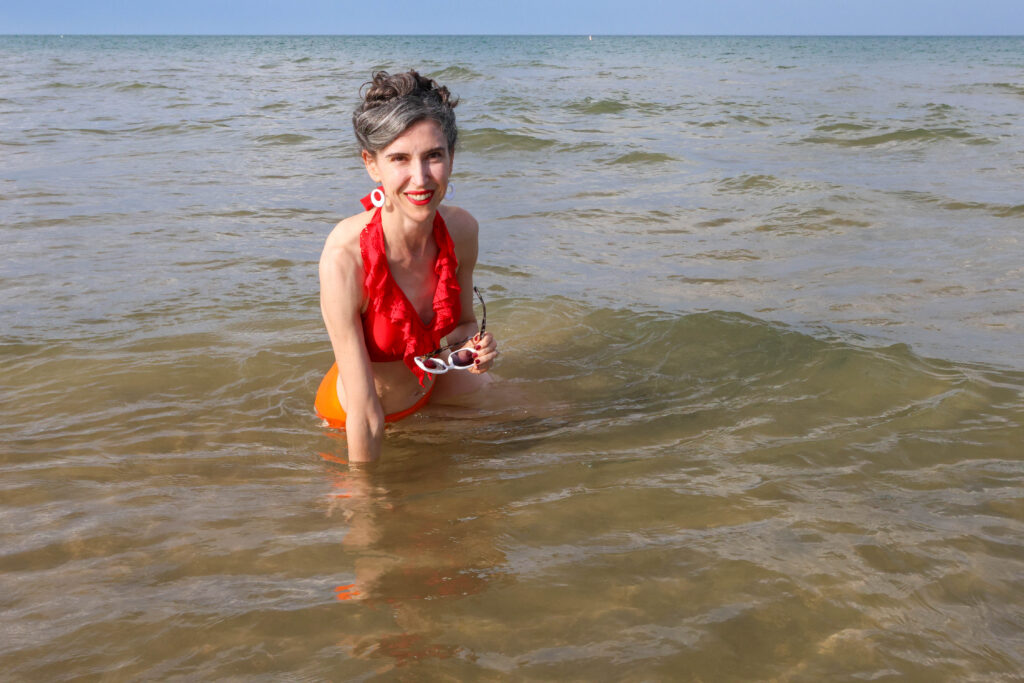
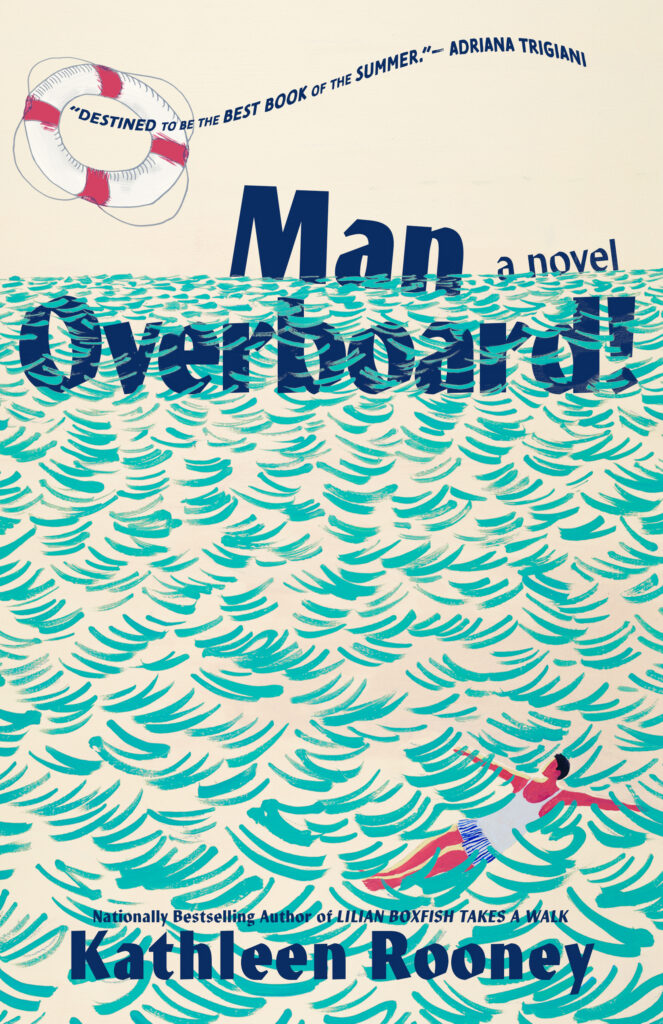
A founding editor of Rose Metal Press and a founding member of Poems While You Wait, novelist, essayist, and poet Kathleen Rooney’s fifth novel, Man Overboard!, is out now on Gallery Books, an imprint of Simon & Schuster.
A survival story set in the Gulf of Mexico after the last election, the novel follows Kick Kilpatrick, who has recently found himself floating in the sea as his cruise ship drifts away. He must tread for his life while he tries to remember the circumstances that led him to fall from the ship in the first place.
What unravels is a meditation on Kick’s sculpted–but otherwise fragile–personality and the culture and family that brought him to this life-or-death predicament. The novel is by turns perceptive and inspiring as it traces the impact unresolved grief has on Kick’s relationships and frame of mind. It’s also really funny.
Mitchell Harrison: Let’s start with the sea. Man Overboard! includes an epigraph from Moby Dick, in which Ismael refers to going to sea as a “substitute for pistol and ball.” But unlike Ismael’s enthusiasm for open waters, your hero, Kick Kilpatrick, has thalassophobia, fear of the sea. What is the sea to you? Something to fear? A substitute for pistol and ball?
Kathleen Rooney: For starters, the sea is just really really big. I mean duh, right? But I feel—as does Kick—as though most people don’t truly grasp this vastness. Like the scope and depth of the sea are simply too enormous for the mind to comprehend, and that, to me, is why it’s absolutely terrifying. It’s sublime. Sublime like in the sense that comes to us first from Longinus: any encounter with the ocean is a confrontation with that which is threatening and unknown, challenging our capacity to understand while at the same time filling us with wonder.
Sometimes when I say that I am terrified of the sea, people misunderstand. They’re like, “Why do you hate the ocean?” And I don’t hate it—I fear and respect it. Like Edmund Burke says in his Philosophical Enquiry into Our Ideas of the Sublime and Beautiful (something Kick probably read in undergrad and liked), “Whatever is fitted in any sort to excite the ideas of pain and danger, that is to say, whatever is in any sort terrible, or is conversant about terrible objects, or operates in a manner analogous to terror, is a source of the sublime; that is, it is productive of the strongest emotion which the mind is capable of feeling.” What better emblem of terrible beauty can there be than the sea?
I think the ocean also, in this novel, represents the feeling in late capitalism / our current era of full-on 24/7 omni-crisis, like almost everything is an urgent and alienating problem flooding over us almost all of the time. Kick is, to use an overused term, overwhelmed. He can just barely even with his life. Which is why the book opens with him coming to consciousness in the middle of the Gulf of Mexico, being like: Oh no, did I fall? Did I jump? What am I doing?
There’s a passage early on that takes a shot at a certain type of literary book that Kick’s off-again girlfriend Justeen reads. They follow creative types, “agonizing boringly about how best to make art while they undergo mild middle-class woes…” Kick is a reader, but prefers stories with stakes. Lost at sea, his situation is pure stakes. He doesn’t remember whether he fell or jumped, but he knows now that he wants to live. It’s a passive survival story, and while I can imagine many sluggish books produced on the same premise, his agonizing is thrilling. How did you approach the challenge of maintaining tension throughout this book, where the key action the hero must take is to tread water and wait?
Ha ha. Yeah, remember back in 2021 when Joyce Carol Oates tweeted “strange to have come of age reading great novels of ambition, substance, & imagination (Dostoyevsky, Woolf, Joyce, Faulkner) & now find yourself praised & acclaimed for wan little husks of ‘auto fiction’ with space between paragraphs to make the book seem longer…” Kick doesn’t particularly like autofiction either.
But to your point, his own predicament, life and death though it is, could have been boring as well if there were not momentum in a couple of directions. I always try to have a “central question” in my fiction, something the reader is going to get hooked by and turn the pages to find out. In Kick’s case, I knew I needed to have two, one that could let him retrospectively investigate what it was that brought him to this catastrophe, and one that kept him striving in the present, which, of course, is how will he survive? I think of him as a detective, trying to crack the case of whether or not he was suicidal and, if so, why, and then also an endurance athlete/hero who we are rooting for to just stay afloat and not die.
Kick is a clown–literally–and he also agonizes over his art. Through clowning, he wants to get to the bottom of his buffoonery. At sea, clowning is raised to spiritual dimensions. Clowns are “Trickster figures who cheated death,” which is something he’d really like to do. How did you land on clowning as an artistic and personal endeavor for Kick, and how do you feel it sharpens the arc of his journey?
Some etymologies for the word “clown” suggest that it originates with Scandinavian terms for “a clumsy fellow,” and there are few things clumsier than falling off a cruise ship.
I was drawn to clowns for being funny, first and foremost, because I wanted this to be a comedy, but the kind of comedy clowns do is not just cerebral but with their whole body. Kick, as a physical therapist and a gym bro, is attuned to his physical container—he puts in the hours to be a hottie—yet he’s detached from the emotions that container contains. On some level, he knows he needs to take action to get his inner and outer worlds aligned, and that is what—without being so explicit in his own reasoning—draws him to take Christophe’s clown class at Omaha Circus Arts.
I read many excellent books on the history and art of clowning, including one by Ron Jenkins called Acrobats of the Soul. He writes that, “In a high-tech society where people often feel overwhelmed by the impersonal pace of their environment, a simple act of individual virtuosity becomes a significant event, an affirmation of what a human being can accomplish without the aid of a machine.” I want Kick’s nearly 24-hour ordeal in the sea—whatever its outcome—to be life-affirming. He has no machine. He has nothing, just his corporeal body and the soul he realizes he has to explore more deeply.
The setting of Man Overboard! is the Gulf of Mexico, and it takes place shortly after the last election. It is pointedly present and political. Your last three novels were portraits of historical figures looking back on their lives. This book is structurally similar, as Kick reflects on how the events in his life carried him to his crisis. Alongside his reflections, we see America as a country going through a crisis, whether Trump (whose renaming of the Gulf would be only one absurd marker of his plan to disassemble American culture and government) or vulgar technocrats slamming AI down our throats. What brought you to pivot away from historical fiction and to this present tension?
Absurd is the word. Thank God that by now, even Man Overboard! is low-key historical fiction, taking place as it does on Thanksgiving Day of 2024, before that brain-damaged Hitler we are forced to recognize as our president signed the executive order (#14172 aka “Restoring Names That Honor American Greatness”) changing it to the Gulf of America.
In addition to my central questions, I like to have some thematic ones that are just for me as I’m writing, and something I’ve been wondering lately is: what is up with men? It’s a question with historic roots, yes, but it is very much hooked into the present.
In 2024, men—especially men under 50—backed Trump by larger margins than in 2020, and Kick’s not a Trump voter; he just didn’t vote. I’m curious about the disaffection and disconnection among men that’s been widely reported all over the place, like how middle-aged men are among the loneliest people, and how we’re in a masculinity crisis, and how they’re behind in education and the labor market and ahead on suicide. I understand wanting to hold men accountable for their own emotional state, for sure, but it has bugged me for a while now to see a subgenre of reactions to this situation cropping up that’s basically “who cares, whatever, they totally deserve it.”
The absurdity of life in the Screaming Twenties is hitting everybody hard, not just men, not by a longshot. But writing off half the population as fuck-them-they-should-suffer (especially when their suffering makes them inclined to wreak suffering on everyone around them, and when fixing the sources of men’s suffering would also fix a ton of everyone’s problems) makes no sense. Capitalism and its oligarch vampires are out to suck the lifeblood of us all, and we need to work together if we’re going to escape. I’m probably going to quote this book a lot while promoting this novel, but I am with bell hooks in The Will to Change: Men, Masculinity, and Love, when she says: “We need to highlight the role women play in perpetuating and sustaining patriarchal culture so that we will recognize patriarchy as a system women and men support equally, even if men receive more rewards from that system. Dismantling and changing patriarchal culture is work that men and women must do together.”
But yeah, I didn’t want to write an opinion piece about all of that because it’s so complicated. Thus: a 208-page contemporary novel.
The other key setting of the book is the cruise ship he falls (jumps?) from. Despite its surreal largeness, it functions as a survey in miniature of American life, capitalism, surveillance, and aesthetics. Can you talk about your process to build the cruise ship as a sub-setting–its bars, events (the air guitar contest), and horrible lighting–and why it functions so deftly as the stage for Kick’s drama?
Cruise ships are vulgar – they are obscene and offensive to good taste and morals. They are in many ways everything that’s coarse and spiritually vacant about America in a single huge object. Yet, like so many corrosive things about this country, they are presented as great.
Ever since I read David Foster Wallace’s “A Supposedly Fun Thing I’ll Never Do Again,” chronicling his terrible time on a Celebrity cruise back in the 90s, I’ve been puzzled as to why cruises are so many people’s idea of fun. Kick hates the cruise ship he is on, but tries (the air guitar contest) to throw himself into this putative fun before winding up in the water.
I found a report (on the occasion of the monstrosity the Icon of the Seas) that said that the world’s largest cruise ships are now twice as big as they were in 2000. One official says, “Today’s cruisezillas make the Titanic look like a small fishing boat. How much bigger can these giants get? The cruise business is the fastest-growing tourism sector, and its emissions are quickly getting out of control.”
The distracting, wasteful setting of a cruise ship was the perfect place for Kick to begin his journey toward understanding the internal and external factors in his life that are making him feel so so so bad.
Kick has been dealing with a paralyzing repressed grief over his mother that leaves him unable to sustain a romantic relationship, speak up for himself at work, or act politically despite his righteous political anger. How did you arrive at this form of grief as a subject, and how is the setting of the sea and Kick’s forced solitude the perfect location and circumstance to hash it out?
Grief is inefficient, and we live in a culture that prizes efficiency. There are so many things, personal and political and cultural and environmental, that I feel like I should be mourning every day. I am a cheerful person. I love to laugh and goof around! But that’s different than the toxic positivity that seeps into so much of American life. Again, I don’t want to write a think piece on this phenomenon—why America really needs to grieve and mourn but refuses or is unable to do so. But a novel? That’s the place to take this stuff on.
There are so many sweet images in this book that occur in the sea. The cruise ship floating away is a “monstrous fourteen-story layer cake…”; “the morning sun pours over the Gulf like syrup over pancakes”; clouds are, “marshmallows atop the sweet potato casserole…” Part of this is Kick’s painful hunger, and these metaphors (which act as mirages) are one of many devices that link Kick’s mind with his body. Did these images come naturally while you were writing, or were they part of the plan all along?
These are part of my aim for verisimilitude. If a person were going through this hours-long experience of treading water in the open sea, they would be ravenous. In so many of the survival accounts I read, the survivors recount their absolute obsession with food—what they wish they had to eat right then, all the stuff they’ll eat if they make it back to land. But then, like you say, part of it is voice—to show how Kick, a reader and the son of an English teacher, likes to use his mind to decorate the world with language. Finally, whenever my spouse and fellow writer Martin Seay and I host our book club for our brunch discussions, we pore over that month’s selection and cook to the theme—tortillas and beans when it’s Cormac McCarthy, fontina cheese, jam, and yogurt when it’s Natalia Ginzburg, and so on. I hope book clubs have a field day with Kick’s food fantasies.
We spend 22 hours with Kick through the course of the book, and it’s amazing how quickly the body breaks down. What was your strategy for writing the disintegration of a body in such a thought-forward book?
Here I give a shout-out to my fantastic editor, James Melia. I had what I thought was already a lot of that physical breakdown woven throughout the manuscript, but he pointed out that I could have even more. In his editorial letter, James wrote: “I also think we can play up Patrick’s deterioration as the book goes along. The betrayal of his body against a mind that betrayed it first.” So right on.
Kick has dialogues with a variety of sea-creatures–a whale shark, a hawksbill turtle, and a group of polyconscious jellyfish, among others. Each nudges Kick along in his journey to address his unresolved grief about his mother, while providing crucial complaints about human interaction in their environments and how that has contributed to another crisis that braces the book. The climate crisis. How did you pick these creatures, and did their real-life ecosystems define how you constructed their insights?
I appreciate how you read the animal encounters because they’re a place where the inner and outer griefs that Kick feels come together, and where he has a chance to decide what he wants his mindset to be and what he can do about them. I think even people who believe they don’t care or don’t believe in climate change are being profoundly harmed on a mental and emotional level (in addition to a physical one, of course) by the destructions and extinctions that humanity’s oil-guzzling, extractive way of living is perpetrating. We are KILLING OUR MOM, our planet, the earth, a miraculous place and the only one of its kind that we know or could ever reach in our lifetime. It’s fucking us up! We need to stop it!
I love animals so much; I can’t concisely explain it in this answer. So I’ll just end here by saying: animal stories are not just for little kids. We should not abandon them when we hit adulthood. I had a blast letting Kick get philosophical with the seahorses and dolphins, and I tried to give them voices that they might plausibly have, given their own rich lives complete with thoughts and feelings.

Be the first to comment