
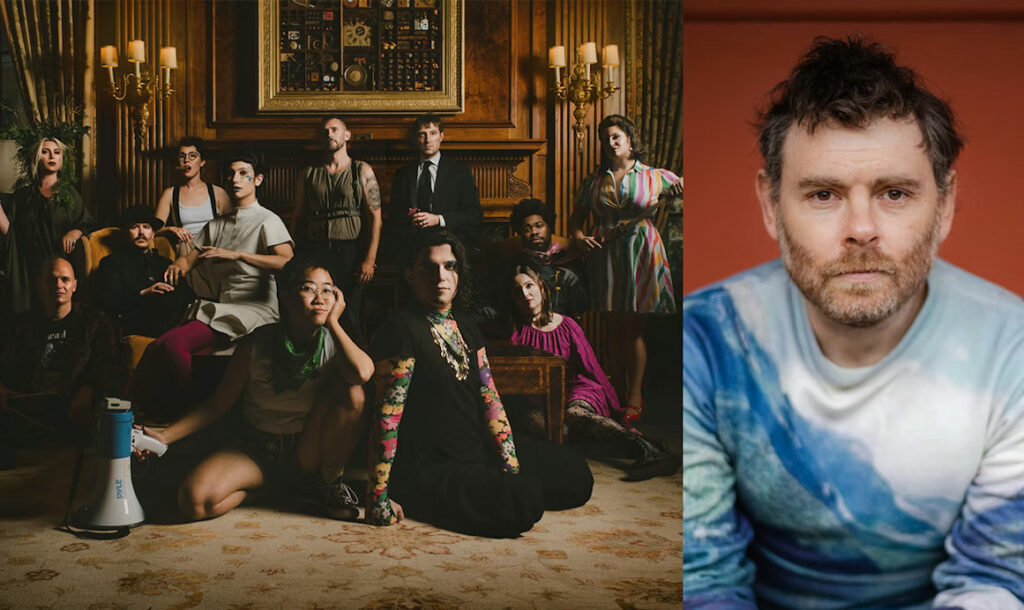
Over the last fifteen years, Gabriel Kahane has established a diverse career that has brought him from rock clubs and concert halls to off-Broadway theaters and beyond, where he is known for tackling politically thorny subject matter with grace and complexity. His wide-ranging discography includes five albums as a singer-songwriter, several orchestral projects, a disc of chamber music, as well as various other collaborative albums.
He has worked with an array of artists spanning the aesthetic gamut, from Phoebe Bridgers, Paul Simon, Sylvan Esso, Andrew Bird, and Sufjan Stevens, to the Danish String Quartet, Roomful of Teeth, Attacca Quartet, Caroline Shaw, and Pekka Kuusisto, with whom he plays as the duo Council.
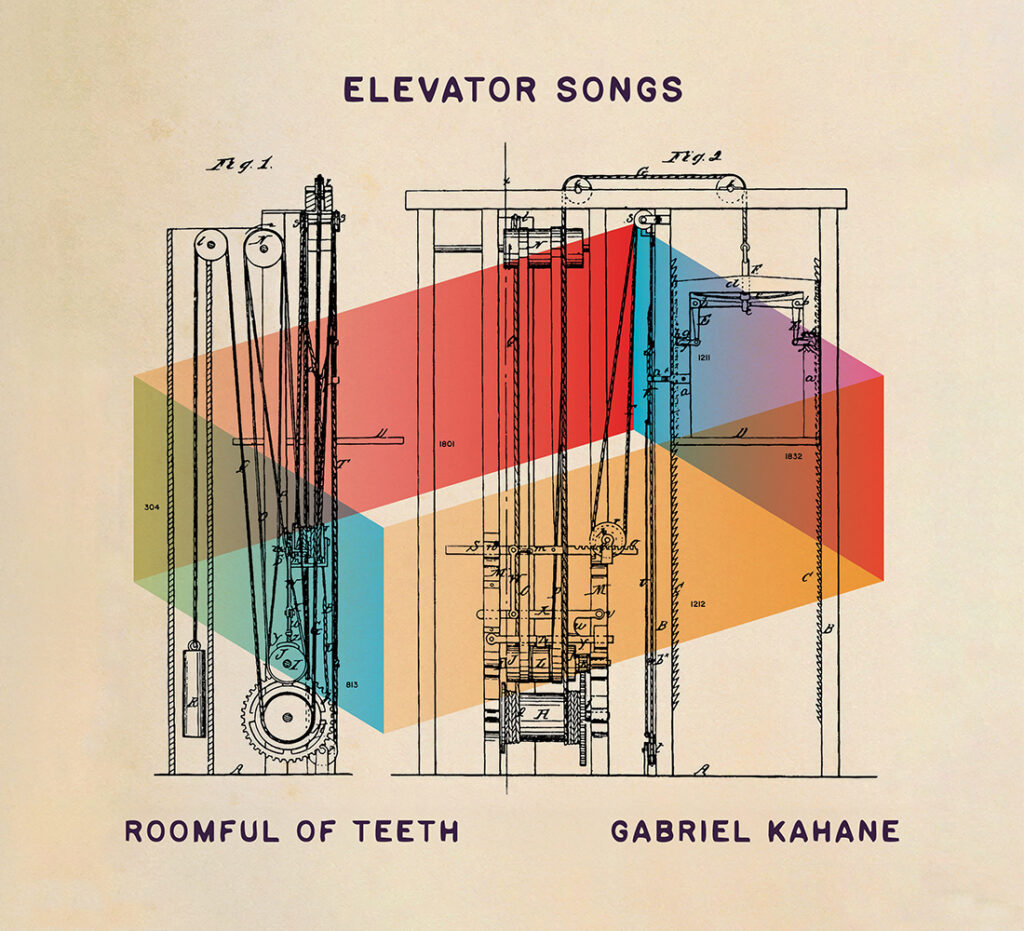
Multi-Grammy-winning vocal group Roomful of Teeth and Kahane have now released their highly anticipated collaborative LP Elevator Songs via Octoverse Media and Warner Music Group’s Arts Music.
As emotionally rich as it is sonically diverse, the album is an exercise in world-building: set in an interdimensional hotel unshackled from the laws of time and space, this collection of ten songs invites the listener to peer into the private lives of a group of richly imagined characters, each one embodied by a different member of Roomful of Teeth.
Kahane will be touring with Roomful of Teeth in Europe throughout September, and in other locations and dates through the end of the year. Click here for details and tickets.
Roomful of Teeth’s founder, Brad Wells, and current artistic director, Cameron Beauchamp, approached you about writing a “Roomful of Teeth Songbook.” How have you and the ensemble crossed paths before in ways that made you confident that this collaboration would be fruitful?
It was really mutual admiration from a distance. Before they reached out to me, it seemed that we had dozens of connections, shared collaborators, and so on, but we hadn’t crossed paths in the flesh. Initially, Brad reached out about a much smaller project, a contribution to a larger piece that never came to fruition. Somewhat later, he and Cameron reached out again, and the rest, I suppose, is history. As to what made me confident that the collaboration would be successful — I don’t know that I went in with the expectation that it would be successful other than the fact that we share some aesthetic ground around the intersection of formal and vernacular musics, and that, of course, I am primarily, though not exclusively, a composer of vocal music. But the project has turned out in a way that absolutely delights me.
Elevator Songs is essentially a concept album “set in an interdimensional hotel unshackled from the laws of time and space.” Were there any specific inspirations for this idea, such as a novel or film? What was the process of working with Roomful of Teeth to come up with the interconnected stories of these songs and to decide which member of Roomful of Teeth would embody a particular character?
In the summer of 2022, I went to visit Roomful of Teeth during their annual retreat at MASS MoCA in North Adams, MA. They put me up in a hotel that was in the process of being rebranded. It had been a Holiday Inn and had been bought by a boutique company, but the rebranding was very much unfinished when I was a guest there. And, to be honest, it was kind of creepy. Piles of concrete everywhere, very few guests, signage for both properties. It put me in this sort of, well, interdimensional state. The night before our last day together, I sat down and wrote, more or less in one sitting, “Speaking in Tongues,” which would become the first song on the album. That song opens with the line “To be honest, this hotel is kind of creepy.”
When I returned the following summer, I was supposed to have written half the piece, but I’d gotten seriously backed up with other writing commitments, and thus arrived empty-handed. This was August of 2023, and the premiere was set for November 1st, 2023, in Seattle. In order to save face, I asked Cameron if we could use our time together for me to essentially interview the group in order to generate material for the text. I wanted the singers’ lives to inform the lyrics that I wrote, so I prepared a set of prompts, and then we sat around telling stories all day. A handful of those stories led rather directly to some of the songs; in other instances, we talked about, for example, our packing habits as touring musicians. This is what led to the song, Valise, which is sung by a ditzy travel influencer slash pop psychology podcaster.
When it came to pairing singer to song, it was really about writing specifically for each singer. In every case, I wrote each song with a particular singer in mind, trying to find a balance between playing to their strengths while also challenging them to do new things with their voices.
The song “St. Vincent’s Hospital” is particularly personal for you. It’s a meditation on the track’s namesake, a site very connected to the history of AIDS care, and you’ve said that while writing the song, you were thinking of your late friend Michael Friedman, a musical theater composer who died of AIDS in 2017. Could you talk a bit about your memories of him and how earlier generations of artists who were impacted by AIDS influenced your songwriting, and also the choice of having Steven Bradshaw sing on it?
My memory of working on this song is a bit hazy, but I think it had to do with the intersection of two different impulses: one was thinking about how when I worked with Michael in my early twenties, he would often hand me songs that he’d scribbled on little pieces of hotel stationery or sheets from a steno notebook. It’s possible that thinking about Michael led me back to thinking about “the lost generation” of largely gay men, many in NYC, who died of AIDS in the 1980s and 1990s.
With Michael, of course, the tragedy was that for all of his gregariousness, his inner circle was quite small; by the time people realized how sick he was, the modern interventions available to those with HIV/AIDS came too late. I still miss him terribly.
Michael was loud, brilliant, caustic, but also incredibly kindhearted. And also self-sabotaging (both in work and life). Still, I learned so much from him about the relationship between music and theater, about collaboration. I essentially apprenticed with him for the first five years of my time in New York, and it’s impossible for me to fully take stock of everything I learned about the theater just by being in the same room with him.
The song, of course, is set in the 1980s or early 1990s, and so it’s not really about Michael. But I guess its final verse, “Back down to Christopher / dreams of a future / where all of the boys we’ve lost / come back to life,” is wishful thinking on my part. I wish we could have Michael back with us, and it remains inconceivable that New York carries on with the Michael-sized hole that he left.
“St. Vincent’s Hospital” is accompanied by a striking lyric video made by Robert Edridge-Waks. Have you worked with him before, or how did he become involved in the making of this video? What are some key visual elements that complement the song and underscore its themes?
Robert and I have now worked together on, I think, ten videos? Three for Elevator Songs, two for Magnificent Bird, and four or five for Book of Travelers. I met him when he was the in-house video guy at Nonesuch Records, where those latter two albums were released. Over the years, we’ve developed a shorthand; sometimes he comes up with the concept, sometimes it’s me, sometimes it’s a joint effort. In this case, he found an old poster by the AIDS activist collective Gran Fury to serve as the central image. For something so simple, I think it’s quite moving.
This album was co-produced by Grammy-winning engineer Joseph Lorge. What are some unique elements that Lorge brought to the production process, especially considering that the album was recorded in only four days? What was your collaborative process like with him?
Joseph and I have done a number of records together, and he’s my most trusted companion in the studio. He brings both incredible musicianship in the old-school sense — great rhythm, great sense of pitch, of phrasing — but is also extraordinarily resourceful when it comes to studio magic. He planned the session within an inch of its life, knowing that it was going to be a huge logistical challenge to track the album in four days. One of the things I love most about Joseph is that he isn’t satisfied with the sound until he is moved by it. He keeps moving the mic, futzing with EQs, until the sound activates in him an emotional response. So to the extent that Elevator Songs is viscerally moving, I credit him with capturing performances in a deeply human way.
When it came to overdubs, I did a lot of those at my home studio in Portland. And with production choices, my general m.o. is to set Joseph loose, encouraging him to make really bold choices. When he sent the first mix of “Not Even the Dead,” we were all shocked by the distortion on the vocals in the interludes. (He’d run the reverb through a distortion pedal.) Some folks involved were not convinced, but Joseph and I decided to die on the hill of keeping the distorted vocals. We both felt a bit vindicated when, during an episode of “All Songs Considered,” NPR’s Robin Hilton and Tom Huizenga specifically mentioned that moment…
But speaking of hill-dying: another great thing about Joseph is that he’s an incredibly flexible collaborator. He dies on hills so seldom that when he does, you know you need to take him really seriously. I think that’s very much to his credit.
You performed Elevator Songs with Roomful of Teeth on a tour this spring shortly after the album release, and you have additional performances with them coming up in Europe in September. Considering the storytelling and theatrical nature of this project, what can audiences look forward to experiencing at these shows? How do you work to present these songs live in ways that embody the core creative essence of this project?
The U.S. tour was incredibly cathartic. We’d worked so hard to make the album and tour possible (it’s not cheap to put eleven people on the road!), one of the singers had had a near-death experience, and it was thrilling to finally be in front of audiences again. My sense is that audiences connect very deeply with the piece/album because it is, at the end of the day, a work about the human condition. It’s got all the things: love, loss, death, absurdity, comedy, etc. I want people to come to these shows and leave feeling like they got a heart massage.


Be the first to comment