
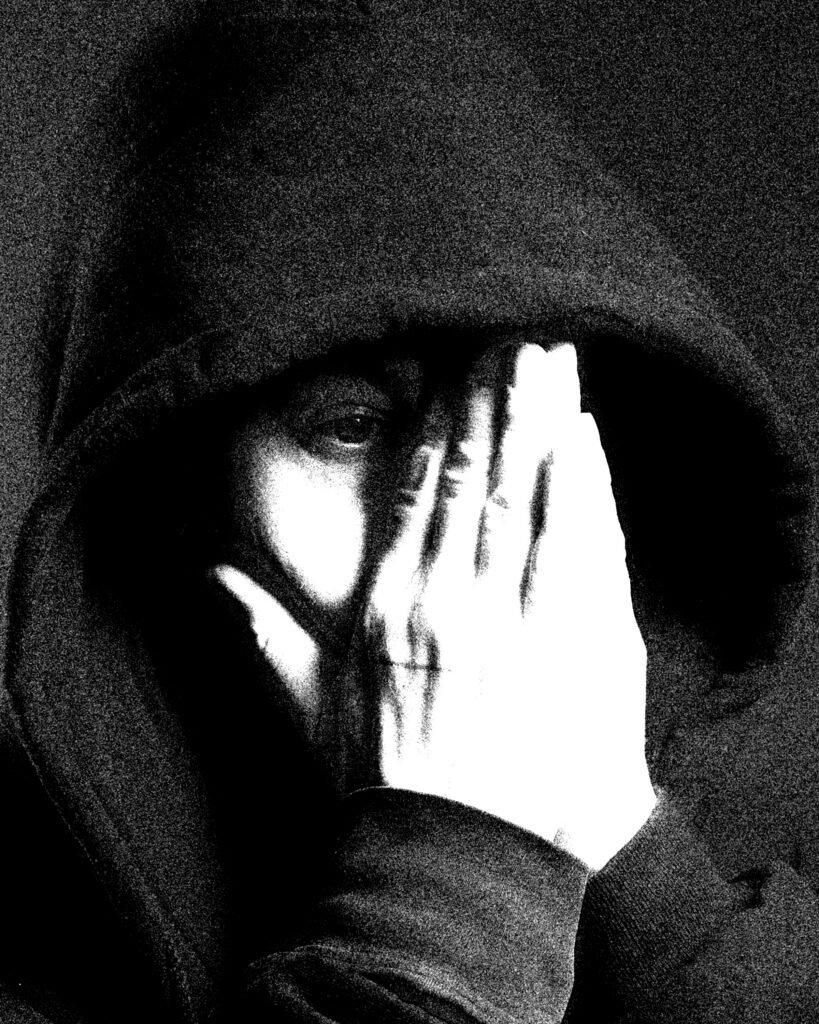
Artist, publisher, and image-maker Jesse Draxler is building something that looks less like an album than a human infrastructure.
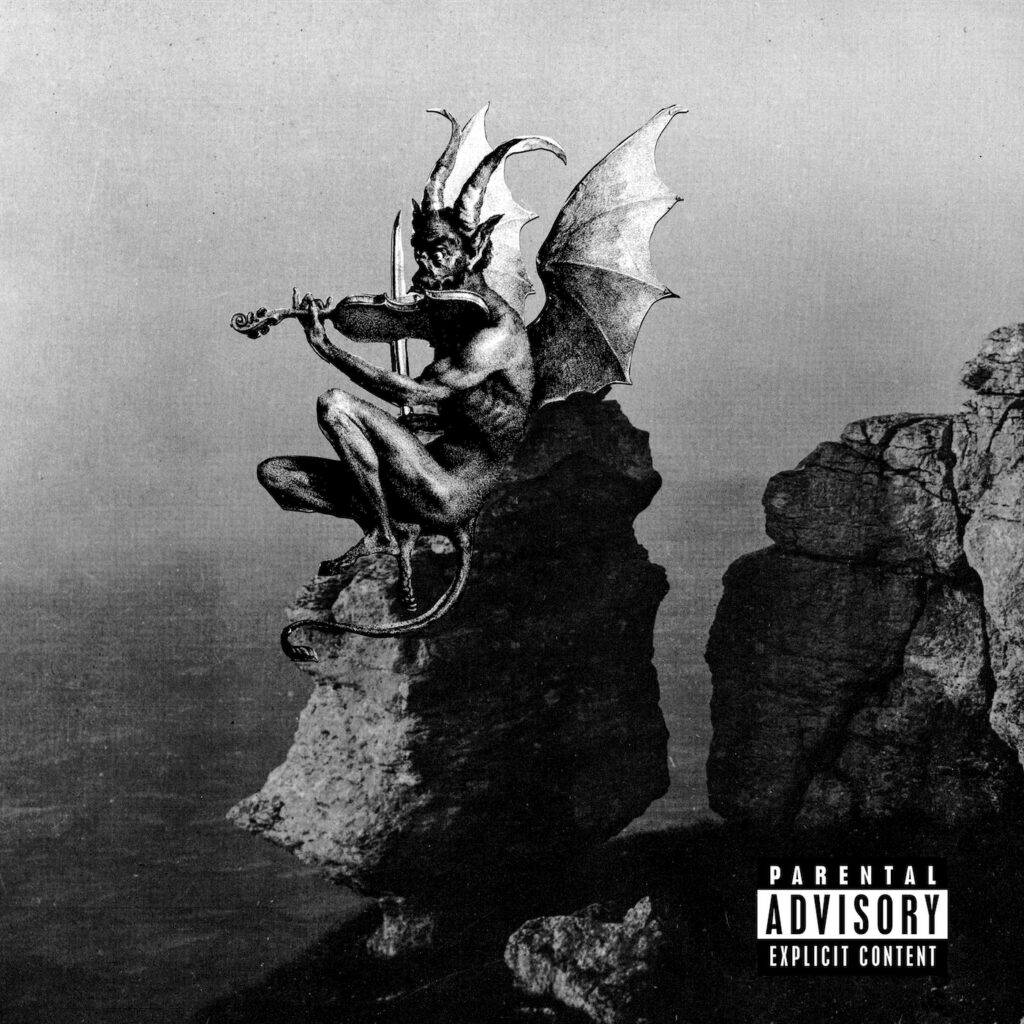
Tongue of Angels unfolds through RIP ID, Draxler’s artist-controlled platform uniting music, publishing, visual work, archives, audience access, and future developments. Conceived as an alternative to fragmented platform culture, it extends projects beyond conventional release cycles, making access, distribution and participation part of the work itself.
Tongue of Angels gathers a constellation drawn from Draxler’s wider creative orbit, including Zola Jesus, Iggor Cavalera of Sepultura, Lord Spikeheart, Venera featuring Korn guitarist James Shaffer, and many more. An accompanying text by cult novelist B.R. Yeager, author of Amygdalatropolis, Negative Space and Pearl Death, extends the project into contemporary literature, internet culture and speculative fiction.
Known for a monochrome practice moving between contemporary art, publishing, photography, music and fashion imagery, Draxler has created work for The New York Times, The Atlantic, The New Yorker and Alexander McQueen, collaborated with artists including Zola Jesus and Chelsea Wolfe, designed artwork for Prince, and recently saw his work featured in Christie’s First Open contemporary art auction.
You’ve described Tongue of Angels as your attempt to construct a new system of authorship, “one where authorship branches, overlaps, and mutates, but is never scraped away or handed over to an impersonal mechanism.” AI immediately comes to mind when thinking of impersonal mechanisms of authorship, but what other mechanisms do you think society is currently grappling with to exploit or impersonalize authorship, especially in music?
Jesse Draxler: I think there are a lot of mechanisms that do this without necessarily appearing to be about authorship. The mechanics of streaming platforms, algorithms, marketing systems, even the economics of attention and social media all influence what gets made and how it is encountered and perceived.
What interests me is the difference between distributed authorship and anonymous authorship. I don’t have a problem with a work being made by twenty people. In fact, I think that can be very interesting. The problem is when the system makes those individual contributions invisible and presents the finished thing as if it emerged from nowhere.
That distinction is important, I wanted authorship to multiply rather than disappear. Each person involved leaves something behind, and those contributions overlap and communicate as they move through the project. I’m interested in making a system where authorship becomes more complicated, but also more tangible.
What are some other historical or recent projects (not only in music but any creative field) that have also explored the concepts of authorship and collaboration and that inspired you?
The initial concept back in 2019/2020, when I was working on Reigning Cement, came directly from a project I took part in some years prior, where a group of artists were all sent the same set of collage materials and encouraged to make whatever they wished from them. The results were shared on a centralized website and socials, etc. A rather simple idea, but profound to me at the time, while I was wondering what to do with all the field recordings I had been gathering.
There are also many historical precedents for this. The Surrealists’ Exquisite Corpse is an obvious one, where the work is built through successive contributions and no single person has control over the final result. The Dadaists and later the Situationists were also interested in systems that disrupted the idea of the artist as a singular, autonomous author. I’ve always been drawn to those kinds of processes, especially the mechanism of making the work become part of the work itself.
In music, I’ve always liked Brian Eno’s approach to systems and constraints, although what I’m doing is somewhat different. I’m less interested in removing the artist from the equation than in creating conditions where multiple artists can leave identifiable traces on the same object. I’m not really interested in collaboration as simply having a group of people work on the same thing. I’m interested in what happens when you establish a system and then allow other people’s decisions to permanently alter what came before them. At a certain point, you can’t really separate the original contribution from everything that happened afterward.
For the creation of this project, you built an environment: a “shared dataset of edited field recordings, a constellation of 20+ collaborators, and a set of rules governing how material moves between them.” Were the field recordings made by you, others, or a mix? What was your process for selecting the collaborators?
All of the field recordings were taken spontaneously throughout my daily life. Some I edited in post before sharing them with collaborators, but the source material was always something I encountered and recorded myself.
I didn’t put much pressure on selecting collaborators. Most of those relationships happened organically, either through a direct encounter, through friends, or through friends of friends. I’ve been fortunate to work with so many musicians over the years, usually through their album art or merch, that I have a pretty large network of musicians who are friends, or at least we have a mutual admiration for one another’s work.
You describe Tongue of Angles as an open-source album, with all contributors working from a shared substrate. What do you think the primary creative advantages are when working in a decentralized creative environment such as this? Do you see any risks or disadvantages, such as a lack of cohesion across the completed work?
I don’t really see it in terms of risk. I don’t consider myself a musician, so this project exists somewhat outside of those expectations for me. I’m approaching it as an artist constructing a situation and seeing what happens, rather than as a musician trying to control the outcome or follow a conventional model of how an album is supposed to be made or what it is supposed to sound like.
The advantage of working this way is that I can establish a set of conditions and then let the contributors take it somewhere I couldn’t have anticipated. The lack of control is the point. If I were concerned with maintaining cohesion from the beginning, I most likely would have eliminated a lot of what makes the project magical.
During the creation of this album, you reintroduced finished tracks back into the network for other musicians to reinterpret, calling this approach “structural interventions” rather than remixes. You made “decisions like who touches what, in what order, and under what conditions, based on variables like provenance, friction, contrast, and texture.” Could you discuss how you came up with the parameters of these structural interventions – were these decisions more fluid and intuitive rather than fixed on any baseline of rules?
A few elements influenced those decisions, one being simply timing. If I had a track back to me early enough, I was able to pass it off to another; Iggor’s track is a good example of that, where I was able to send it to both DJ Speedsick and Exploited Body and achieve two polished results which sound completely different. So ultimately it was fluid and intuitive, as I had to be reactive to what I had and when I had it. Additionally, it was about relationships, who I happened to be messaging with, and things like that where, conversationally, ideas would arise. There were definitely no set rules for this process.
What were any creative results of this project that truly surprised you or may have even been uncanny? Were there any collaborators who produced work that was highly different from their typical output, and if so, how do you think any particular elements of this project steered these artists into creative territories that were new to them?
I find the whole thing uncanny. When you listen to the record from front to back, it flows as though there was purposeful intention behind the entire thing. The tracks relate to one another through the shared field recordings, but each collaborator interprets those recordings through their own lens, so they remain distinctly different. Yet each reflects the whole and the whole reflects each.
What surprised me most is that the result feels like a substantial album in the traditional sense. It feels like something that was deliberately sequenced and constructed to be listened to from beginning to end. Given the way the album was actually made, with all of these people working independently, that almost seems impossible.
Tongue of Angels will be available digitally exclusively via the RIP ID app, with the vinyl release through Federal Prisoner.
Also check out these tracks on Spotify:

Be the first to comment