
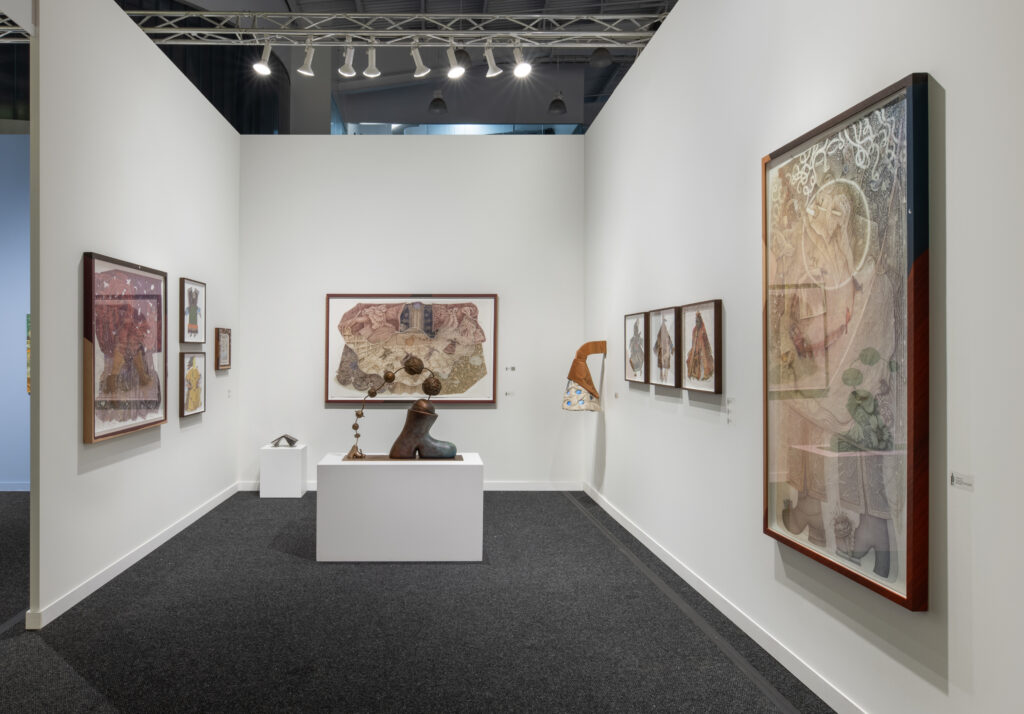
Laïla Mestari is an artist born in Morocco and now living in Montreal, Canada. Anchored in a compositional logic of collage and assemblage, her work with textiles, drawing, video, and print media explores notions of cultural hybridity and rerooting.
Probing personal and collective expressions of Québécois and Maghrebi identity, she creates surreal images combining domestic objects, cultural icons, displaced figures, and elements of the land. Through meticulously crafted surfaces and roughly cut-out shapes, she translates and transforms what captivates or concerns her about her cultural identity.
Mestari showed works at Independent Art Fair New York in May 2026 with Patel Brown.
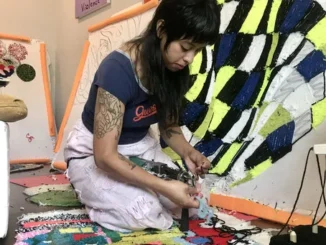
Beautiful, multilayered drawings are at the center of your practice. Alongside drawing, you also etch into your drawings, cut elements out, collage, and create marquetry frames. You create tapestries and small sculptures with fabric and even LED screens.
For your presentation at the Independent Art Fair New York, you also showed stainless steel and bronze sculptures. I would argue that you operate within the rules of collage but stretch it further by encompassing so much else in your practice. Your work is highly considered. You use many skills and practices to create work that’s well put together, elaborate, with a beautifully crafted finish. Can you say something about where you learned your art skills, and the importance of highly skilled practices in your work?
Thank you for this generous reading of the work. The different techniques I work with come from a long journey of learning skills from many places. The first textile-related techniques I learned were taught to me by my mom. Drawing was mostly self-taught, but I also got important teachings through my academic journey. Sharing with artist friends and looking at art from all disciplines taught me a lot as well. But, to be honest, I mostly learned by spending a lot of time making art.
Learning about techniques in drawing, textile, sculpture, installation, and others is an important part of my artistic process because they each give different material bodies to my thoughts. My ideas always evolve within the material processes, and learning new ways to work is correlated to learning new ways to think. When I discover a new medium, as was the case for bronze in this project, or when I am able to discover new possibilities within a medium I have already been working with for a long time, or even invent new techniques, it’s very stimulating because it allows my reflections to grow.
Also, yes, collage and assemblage, as a compositional logic, reflect the way that I approach any material. It allows me to address notions of fracture and (dis)continuity within diasporic identity, and to play with the idea that I can always rearticulate the fragmented narratives that shape my sense of belonging in the world.
I’d love to know more about the technical side of your drawings. How long does it take you to create a drawing? What is the process of completing a drawing: is there a research phase? Is it planned first? Is there a preliminary sketch? Does it come into being as you go along? Do you fall into any sort of trance as you draw? Or else, what does it feel like?
Every drawing is like a choreography of visual fragments. There is a lot of research behind every piece, but also a lot of intuitive decisions during the process. What guides the way that I select, organize, and articulate visual elements from my research for every piece is a curiosity toward a specific set of feelings and ideas that I want to better understand. For me, drawing is a way to know the world and translate feelings that words can’t describe. One drawing takes me between two months to a year to create.
There’s so much magic in your work, both in its mystical symbology as well as its flowy energy. Do you have a relationship to magic and spirituality?
Actually, my work is really about creating bridges between the two cultures that compose my identity. I look at visual traditions, contemporary material culture, and elements of the land from North Africa/Maghreb, where I was born, and from North America/Québec, where I grew up, considering that these are all porous and layered geographical spaces. I pay attention to places where collective identities and personal experiences overlap or contradict themselves, to how cultural memory moves through objects or within ourselves, and to the endless mutations and hybridizations of traditions. The images, fragments, patterns, and symbols that are in my art mostly come from that research.
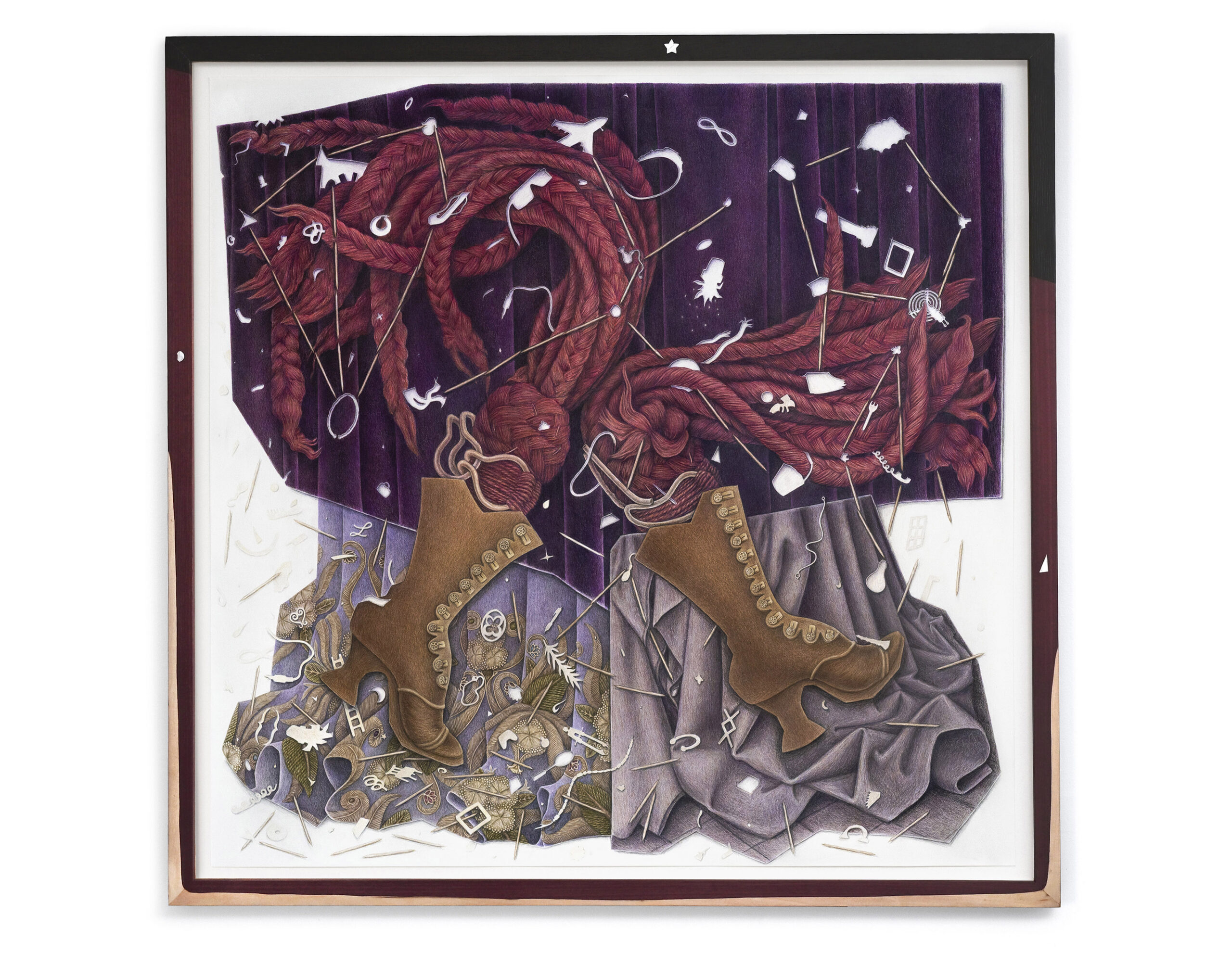
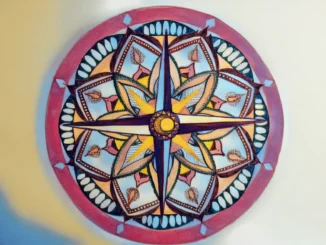
Taking this further, symbology appears to play a central role in your work. Keys, faces, ornamental Mocorran designs, shoes, stars, eyes, a Hamsa hand, flowers, plants, trees, roots, jewelry, dresses, hair, homes, fish, garlic, moons, walls, ladders, bells. Some of these symbols are beautifully indexed in your drawing, Constellations (2026). Can you list three specific symbols from your personally encoded taxonomy and explain what each means?
I look for visual anchors all around me, in books, in parks, at home, at the museum, in the street. They become elements of a symbolic constellation that is in constant evolution, and, in a way, they become a lexicon for my visual language. This lexicon is always evolving. For example, for me, planes symbolize diaspora and immigration because in my personal story, they are a physical hyphen between the country where I was born and the one my family immigrated to. Tables symbolize the transmission of collective memory because it is around the kitchen table that most of my family history has been transmitted to me through stories. Trees represent re-rooting because the trees that surrounded me when I was growing up became a visual anchor to my understanding of place here in North America.
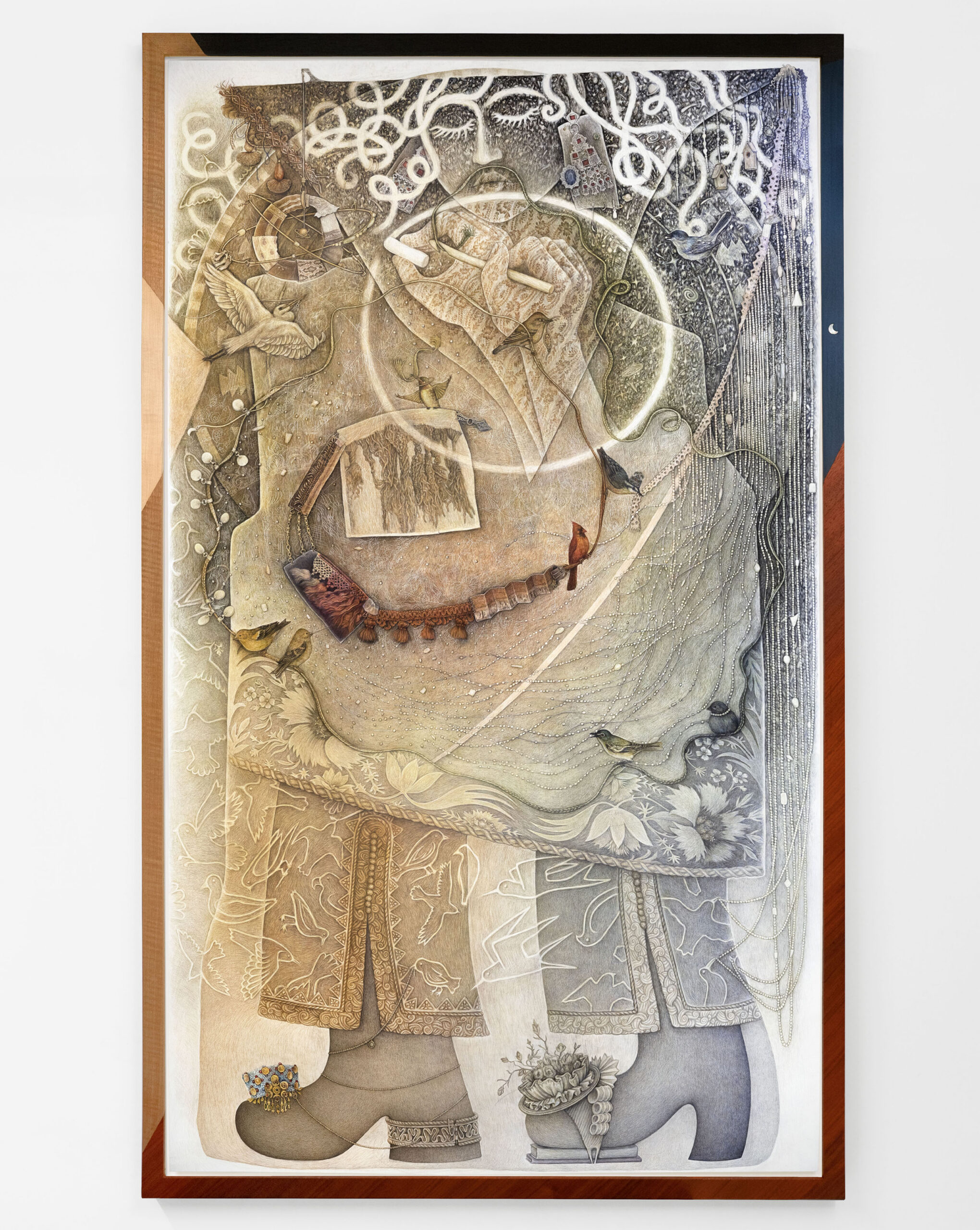
Your drawings create intricate, multilayered worlds. Let’s discuss a couple of the drawings. In Rien ne se perd (2026) (Nothing is Lost), a woman with curly white hair draws a circle in chalk. She is wearing lace gloves, knitting, and is surrounded by beads and many cyclical systems. Can you discuss this woman, who she is, and what it means that she is so adorned and surrounded by pearls and stars? Can you talk about the different systems and circles she’s surrounded by? What are all these objects and photographs she’s carrying with her, and where is she going?
I would say that she is a fictional character that I created to reflect on the idea of searching for your place in the world. She is surrounded by elements of all scales, from seeds to galaxies and everything in between. Everything is in motion around her. She is part of a world of fragments; she is made of what surrounds her, and she emerges as the world around her transforms.
Also, in my work, I look at the way that adornments like patterns and symbols in jewelry, textiles, and other objects of everyday life communicate stories of identity. I invent my own adornment languages that hybridize all the visual traditions that shaped my identity.
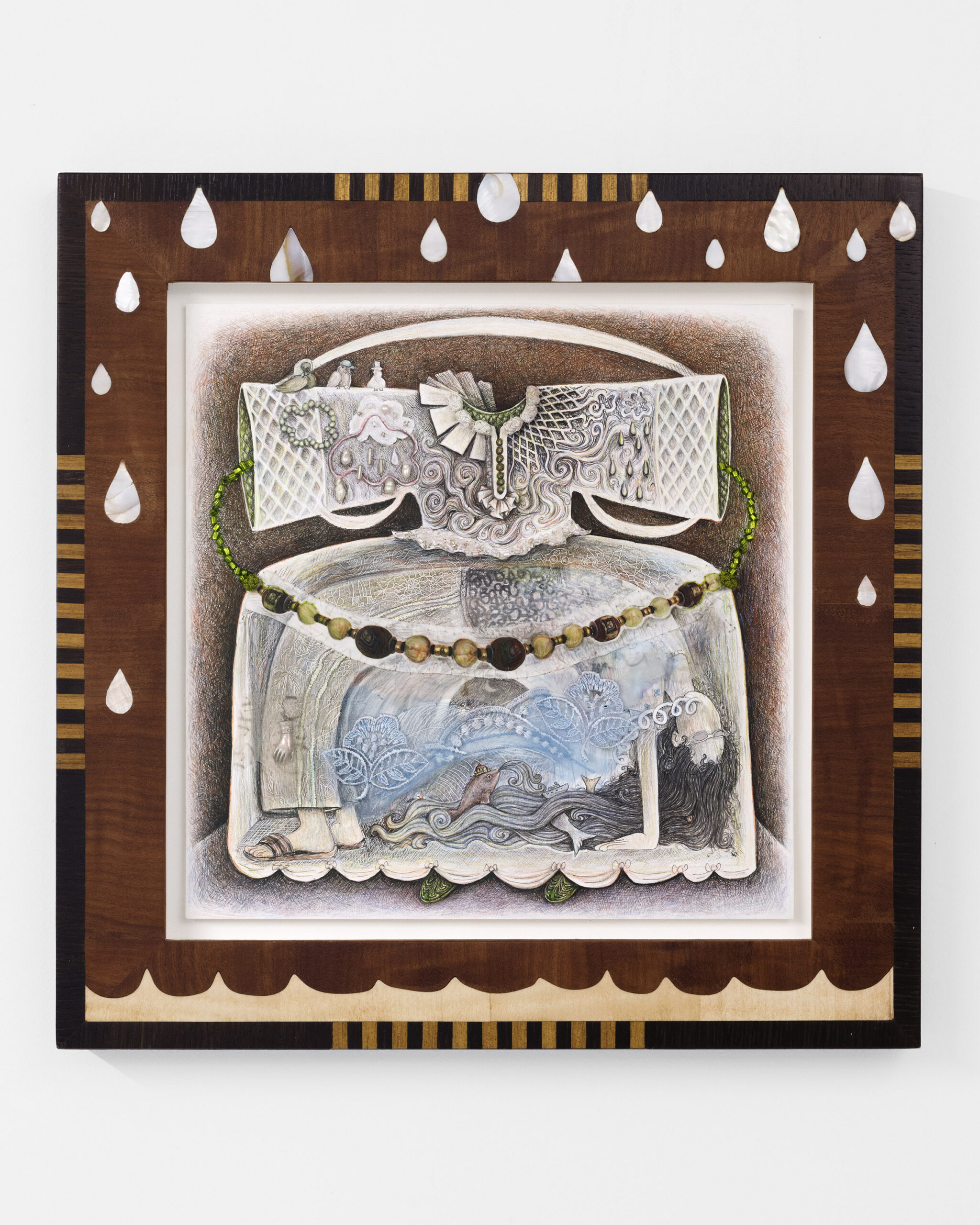
In Weather Dress (2025), a woman performs a bridge with her body inside a dress. Her hair becomes water-filled with fish; her breath becomes embroidery. At the top of the dress, we see wind and rain clouds drawn into the dress. Palm trees, cars, wind, and other symbols are etched into the drawings. Tell us about what’s happening in this world, its many influences, and most importantly, what was your purpose in creating it?
When I created this piece, I was thinking about dress as a container, historically used to encode ideas of collective and individual identities. I was also thinking of climate and how people around the Earth are connected through it, even if we try so hard to delimit ourselves with borders. The shape of the dress itself is a hybrid between Moroccan traditional dresses, historic European dress, and elements that I invented. The drawing itself is strongly related to the frame, which incorporates mother-of-pearl inlays in the shape of water drops. I was thinking about how fluidly water/climate moves across geopolitical borders, and in a similar way, how ideas travel across borders through cultural artifacts.
Can you talk about your upbringing? Where did you grow up? Please talk about what each place of your life has brought to you: Chicago, Canada, Morocco, and why you carry these symbols with you now in your work.
I was born in Morocco and grew up in Montreal. Yes, I also lived in Chicago for two years. All these places shaped the way I see the world, and they defined what I know about the world. They fed my visual memory and shaped who I am. But Morocco is where I was born, and most of my family is there. I come from this place, but I am also a little bit of a stranger to it, partly because I grew up here.
What was the process like for putting work together for the Independent Art Fair? What did you take into consideration?
Putting the work together was an intense and beautiful journey. I worked hard on this project, and I am grateful to all the people who helped me with the production. There were many challenges to overcome, and I didn’t get much sleep during the last months of making it. But I think that this intensity helped me to catalyze something in the work that was important for me to put out there.
Also, I usually work in “bodies of work” that gather drawings, collages, textiles, and sculptural works. This allows my ideas to keep evolving through a diversity of modes. From its beginning, the project presented at Independent Art Fair was created to be shown together as one body of work. All the pieces come from the same stream of research, and they are all complementary to each other and in conversation with one another.
Who did you find took interest in your work during the fair? Was it the audience you expected? What kinds of reactions do you get to your work? Who buys it?
People were so friendly and genuine at the fair. It was the first time I was showing my work in New York, and I didn’t know what to expect, but I never thought it would be that fun. I had really interesting conversations, and I was surprised by many of the things that people seemed drawn to. It’s fascinating to hear how we all approach the work with completely different points of view, or how some are able to read your artistic intentions so clearly sometimes. Overall, people were kind and generous.
As for who buys the work, I don’t have that much information. Sometimes I meet the person during the opening, and in these cases, I can say that they were very kind and open-minded. Sometimes I know the name of collectors, but that’s pretty much it because the gallery is the one who is in contact with them. I also had some museums or private collections acquire my work. It’s quite amazing for an artist when this happens because it means that the piece will be seen by so many different people, many of whom are not necessarily exposed to contemporary art and who will probably never acquire any artwork for themselves. I think this is very important because contemporary art creates spaces for everybody to reflect on the challenges, effects, and transformations of our times.

Be the first to comment