
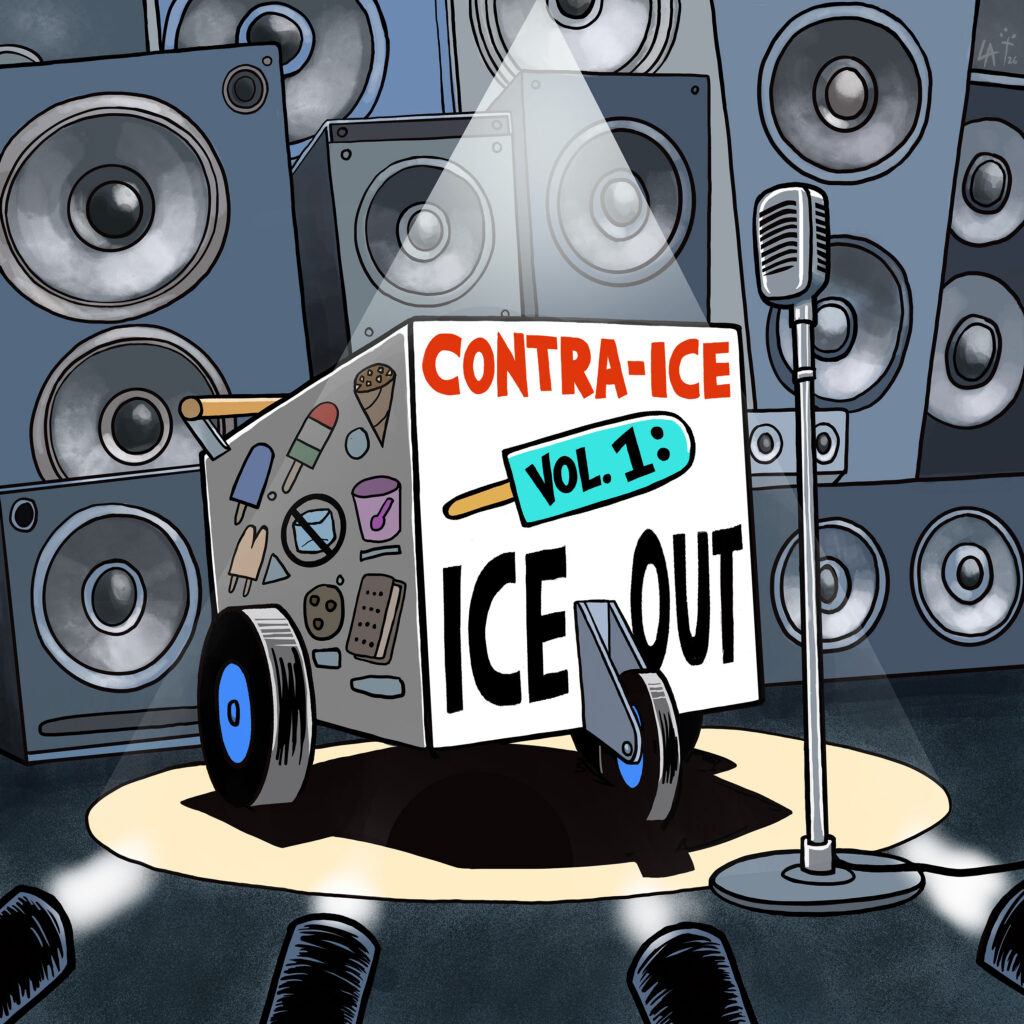
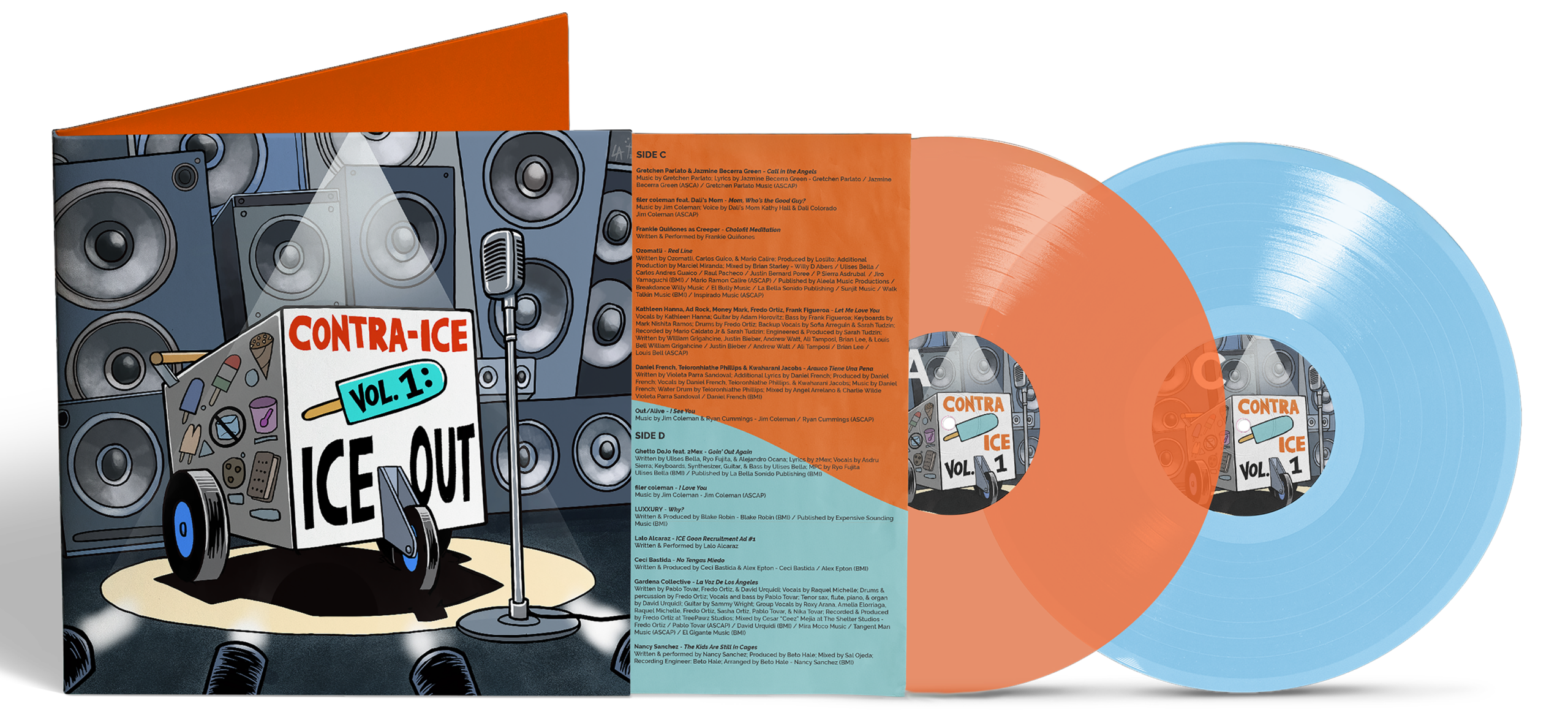
Contra-ICE Vol. 1: ICE OUT is a powerful new album uniting legendary voices across music, spoken word, and comedy to amplify the fight for immigrant rights and stand against inhumane immigration enforcement. Featuring an all-star lineup of over 30 artists, including Ozomatli, Kathleen Hanna ft. Ad-Rock, Tom Morello, Fred Armisen, Fishbone, Money Mark, David J (Bauhaus, Love and Rockets), and Jello Biafra, Contra-ICE Vol. 1: ICE OUT is a sonic journey, curated by DJ Dali to shine a crucial light on systemic injustices.
Jim Coleman, the Sound Director – Albums, Media & Sound Design for this project, was a member of the band Cop Shoot Cop in the 1990s, and in 2018, he and Unsane frontman Chris Spencer formed Human Impact. Additional projects include Phylr and filer coleman, The Children…, Here (with Teho Teardo), Baby Zizanie (with JG Thirlwell), This Wilderness (with Robbie O. Leaver), Deaf Doula, and 0UT/ALIV3. He has composed music for indie feature films and television, collaborating with directors such as Todd Phillips, Beth B, Hal Hartley, Rosemary Rodriguez, and Richard Kern.
Your role/title in this project is Sound Director – Albums, Media & Sound Design. How did you become involved in CONTRA-ICE, and could you talk about what your duties as Sound Director – Albums, Media & Sound Design entailed? What were some of the primary ways you helped to shape this project?
Dali Colorado (the founder of Contra-ICE) contacted me out of the blue. We had met many years ago, while I was with Cop Shoot Cop. She had been a fan of Cop, but I think she had a particular interest in some of the sound collage pieces and sample-based compositions that I had done with the band.
Much of my music has been social and political in nature, but it has often felt like I was working or playing in a silo. So when Dali pitched the idea of collaborating on this project, I was excited – it felt like I had been waiting for that call. It’s an opportunity for creativity to be more far-reaching, more collaborative, and possibly more of an agent for change, or at least awareness. And it’s also an opportunity to actually make direct street-level change through creativity – proceeds from sales of Contra-ICE go to National Day Laborer Organizing Network (NDLON) and Unión del Barrio, which are both frontline organizations assisting communities affected by current ICE actions.
As Sound Director, I created a number of sonic landscapes that helped determine and support the overall narrative of the album, providing common themes, threads, and continuity. I also collaborated with several of the artists on the album (Jodi Lin, Jake Trussell, Uli Bella, and Lalo Alcaraz). Additionally, I was involved in the mastering (along with Dali and Jake Trussell).
Other levels of involvement were more along the lines of production coordination – tracking delivery and collecting all the tracks from various artists as they were delivered, organizing for mastering, etc.
What was your collaborative process like with the other principals in this project, such as Lalo Alcaraz (Artistic Director), Uli Bella (Creative Visionary & Project Champion), and others? With so many artists involved in contributing to this album, what were some approaches taken to help keep a sense of creative cohesion and unity?
Great question. And I do think one of the strengths of this project lies in connectivity, community, and collaboration. Both in creativity and social resistance, we can do things together that we can’t do alone.
There has been pretty consistent daily communication throughout the past year with Dali, Jake, Uli, Lalo, and myself. Most of the decisions have been decided by the group. We have been fortunate enough to also find some amazing partners – strategists, social media teams, legal teams. The record is the inaugural release on Sounds Good Presents, which is a new label focused on Counterculture Soundtracks formed by Joe Steinhardt, co-founder of Don Giovanni Records, and Caleb Wilson, who ran musical partnerships alongside national advance logistics for the Bernie Sanders presidential bids in 2016 and 2020.
Cohesion can definitely be a challenge with any compilation that involves so many artists. The common focus and cause provides an initial foundation, even with a variety of voices and tones. This compilation also has not just musicians and bands, but also comics and spoken word artists. Dali was the mistress of sequencing the tracks – so she wove the overall narrative arc of the album. The interstitials that I created helped weave the fabric of the story and also helped create a shared sonic identity that is present through the album.
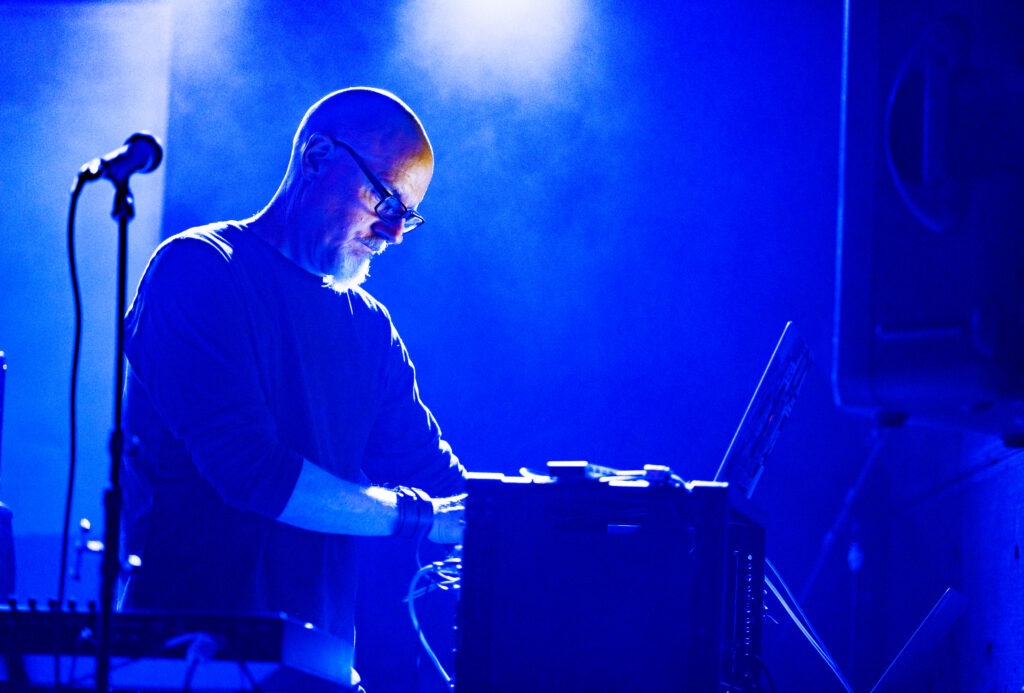
You contributed several tracks to this compilation as filer coleman, featuring voice samples and beats/electronic production. What was your approach to making these tracks, and how is their production related to the other work on your various other music projects past and present?
I have a long history of using field recordings, found and appropriated audio, and sampling to create sound collages and compositions. As a young kid, I would place 45s off-center on the turntable and hand spin them. In film school, I did a series of tracks based on found 16mm mag track loops from a scuba diving documentary. Through the years with Cop Shoot Cop, integrating samples and creating sound collages was quite important to the sound of the band. More recently, my album Partial (as filer coleman) was completely created with micro samples. In my collaboration with Beth B for her current film Glowing, we worked with people’s poetic stories, creating sonic landscapes that support the emotional essence.
A couple of your tracks feature recordings that sound like direct statements by people who experienced persecution and violence by ICE or are talking about those who have (“I Refuse”, “Abolish ICE”). What was your process of finding these recordings and then shaping sound around them to accentuate their impact?
For Contra-ICE, I started with finding audio accounts of ICE raids or voices from the resistance that resonated with me. I then did edits to really just pull out what was essential. We do have an open call out for first-person accounts from individuals and families affected by these kidnappings. I welcome any and all audio recordings – and these can be sent with names and info included or be sent anonymously. If you or someone you know would like to submit recordings, here is an upload link. The recordings really are the foundation – all sounds and rhythms are shaped from that. I try to create a supporting and unobtrusive soundtrack for these accounts.
Your track “Return to Sender” features poetry/spoken word from writer and filmmaker Jodi Lin, who has called it “a poem and a prayer to the Goddess Palden Lhamo.” How did you come to work with Lin, and could you talk about how this particular work more abstractly comments on ICE?
Dali put Jodi and I together to create Return to Sender. They had known each other for many years. After receiving Jodi’s voice recording, my first pass at this track was almost 180 degrees in the other direction. It was super loud and angry, full of noise and distortion. I dug it as it embodied and gave power to the helpless rage I felt on a social and political level. But Jodi was coming from it with a different mindset and emotional balance.
The second iteration is what you hear on the album, and I feel like it hits the right balance. The rage is valid and real, but Jodi’s message and the music creates a space that is calm and empowering. It’s not reacting and lashing out and screaming; it’s a calm refusal to ingest the toxicity and violence. It’s a karmic return to sender. I refuse to let your insanity define my reality.
Since this album is titled “Vol. 1,” what are the current plans for future releases and related projects from Contra ICE?
We have been contacted by a number of great artists after we locked Vol. 1, so there is a growing awareness and interest in future releases.
Sadly, the need for resistance to ICE is still needed and will be for the foreseeable future. Since Kristi Noem exited, ICE actions have actually ramped up, even though they have not been claiming headlines. The administration has gone into more of a stealth mode, but detentions and deportations are up. There are currently around 2,000 ICE arrests each day, which means they are making more than one arrest each minute. They are not targeting criminals; they are eviscerating the country, and they are doing it illegally.
The sad truth is that the US was founded by immigrants committing genocide on Native Americans. Any origin story of privilege is invalid here. The entire country was founded by, built by, and is reliant on immigrants. ICE actions are not only illegal, but undermine the fabric of the country. It’s not about immigration. It’s about instilling fear, securing power, and maximizing profits. The entire detention center industry is hugely profit-driven.
As we originally heard in the mid 1980s amid the AIDS crisis, silence = death. In the current times of fear and political retribution, it can feel risky to have a voice. But that’s precisely why it is imperative. Collectively, through Contra-ICE, our voices come together and have more volume, reach, and resonance. So we will continue raising our voice through multiple releases and other efforts.

Be the first to comment