
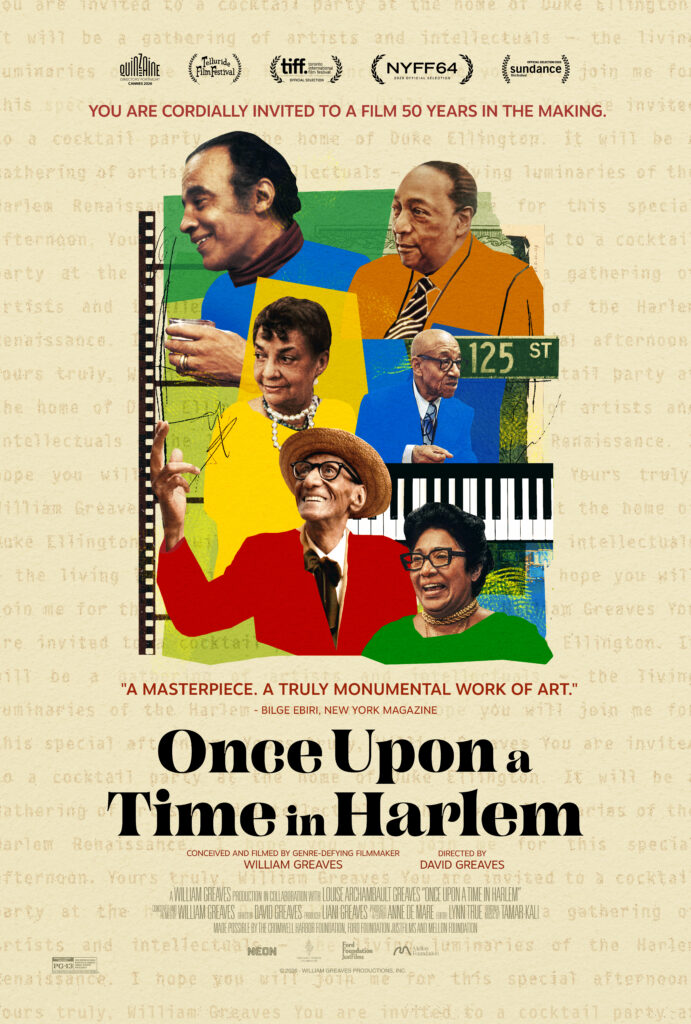
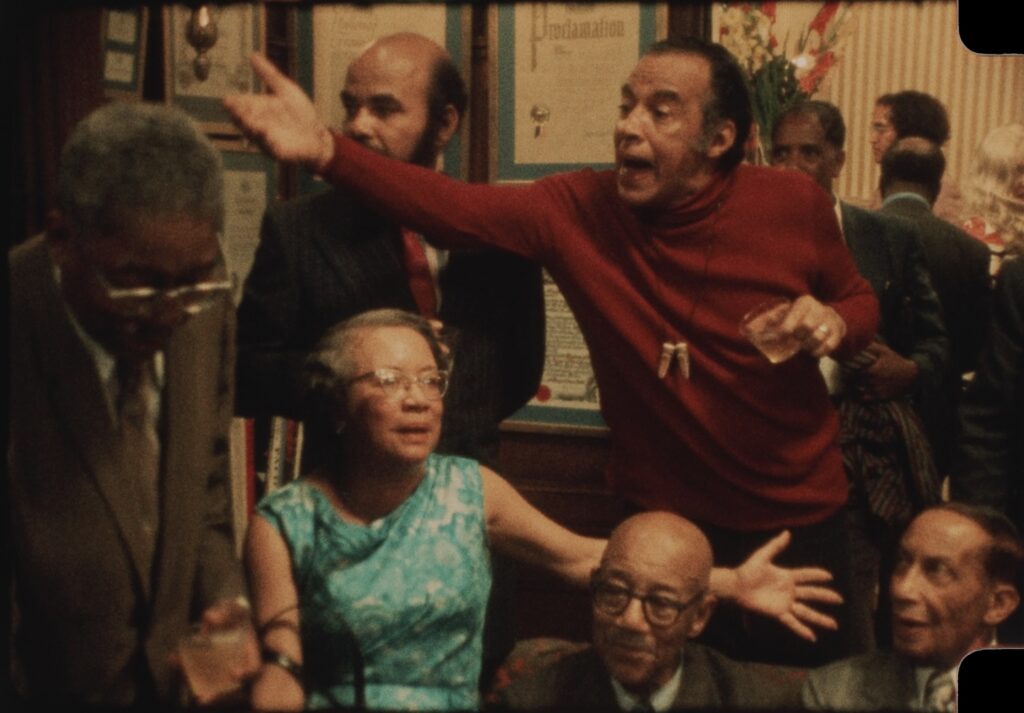
Documentarian William Greaves answered the question, who would you invite to your dream party? through the documentary Once Upon a Time in Harlem. In 1972, Greaves brought the period’s luminaries (including but not limited to) writer Richard Bruce Nugent, Countee Cullen’s widow Ida, painter Aaron Douglas, actor Leigh Whipper, and photographer James Van Der Zee to a cocktail party at Duke Ellington’s house. Friends reunited. Some have light disagreements. Despite their differences and degrees of relationship, all participants ruminate on legacy and uplift each other’s work by showing up for their community on the precipice of the Black Arts Movement.
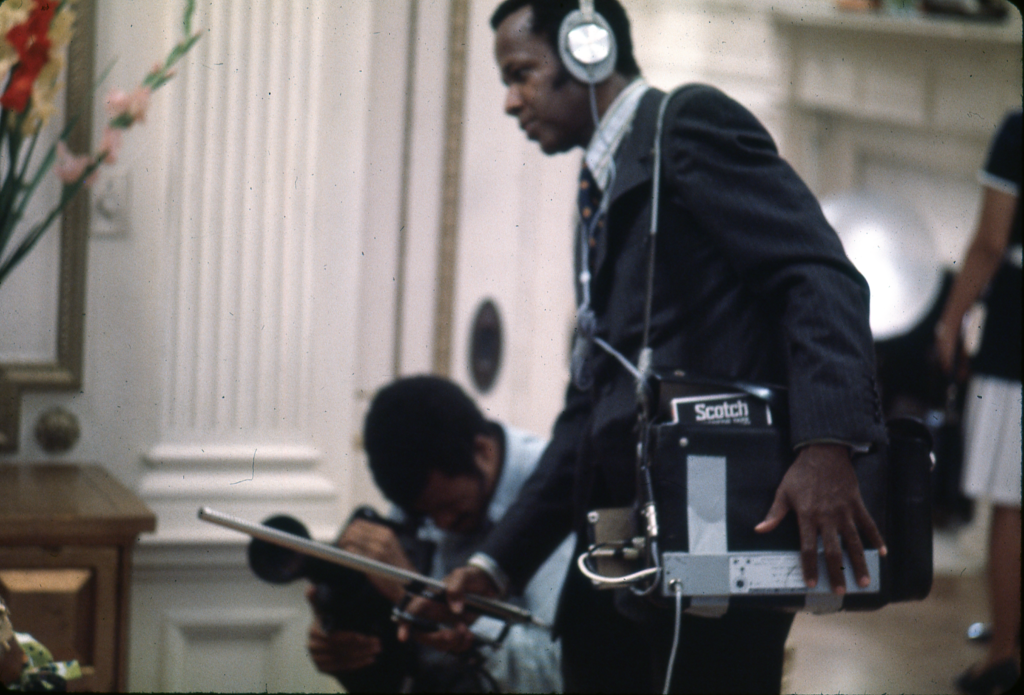
Kinship is embodied in the film’s on- and off-screen DNA. Greaves’ son David was one of the film’s camera operators, and granddaughter Liani is one of the children present in its ending montage where Greaves narrates his poem “Deep In the Quiet Wood.” When Greaves passed away in 2014, his spouse, Louise, prioritized completing the film before she died in 2023. Then David and Liani picked up the mantle and are credited as the film’s director and producer, respectively. After work-in-progress screenings at The Met in 2024 and MoMA in 2025, Greaves’ descendants received the funding to finish the film and delivered the ultimate hangout documentary we needed.
Ahead of its hometown premiere at the New York Film Festival, INTERLOCUTOR caught up with David and Liani at the NEON offices to unpack the film’s 54-year journey, its interdisciplinary elements, and their time filming with William.
Once Upon a Time in Harlem opens in theaters on October 16. Film Forum will also host an accompanying retrospective on the Greaves’ patriarch from Oct. 23 – 29 on his centenary.
Edward Frumkin: Let’s start off with the whole beginning: 50 years ago. How did William organize all of this? Did he personally know any of the luminaries beforehand?
Liani Greaves: Who did he know before?
David Greaves: He certainly knew Richard B. Moore. He knew Eubie Blake.
LG: And he worked with Leigh Whipper. He was then introduced to most of the people by Regina Andrews and Jean Hudson, who were the librarians at the Schomburg Center, so they kind of helped put him together. They had this big Rolodex of people and helped him put together the party with people’s phone numbers and addresses to invite them.
I got a chance to see a cut of Once Upon a Time at the Met two years ago. When did you continue finishing the film following its Met and MoMA work-in-progress screenings in 2024 and 2025, respectively?
DG: We got the money for the film after the Met screening. That was a rough screening for folks who just wanted to familiarize themselves with the material.
LG: And that was a 20-minute screening. So, in terms of timeline, we started working on the actual film after the Met screening.
What was the timeline between 1972 and the [2024] Met screening?
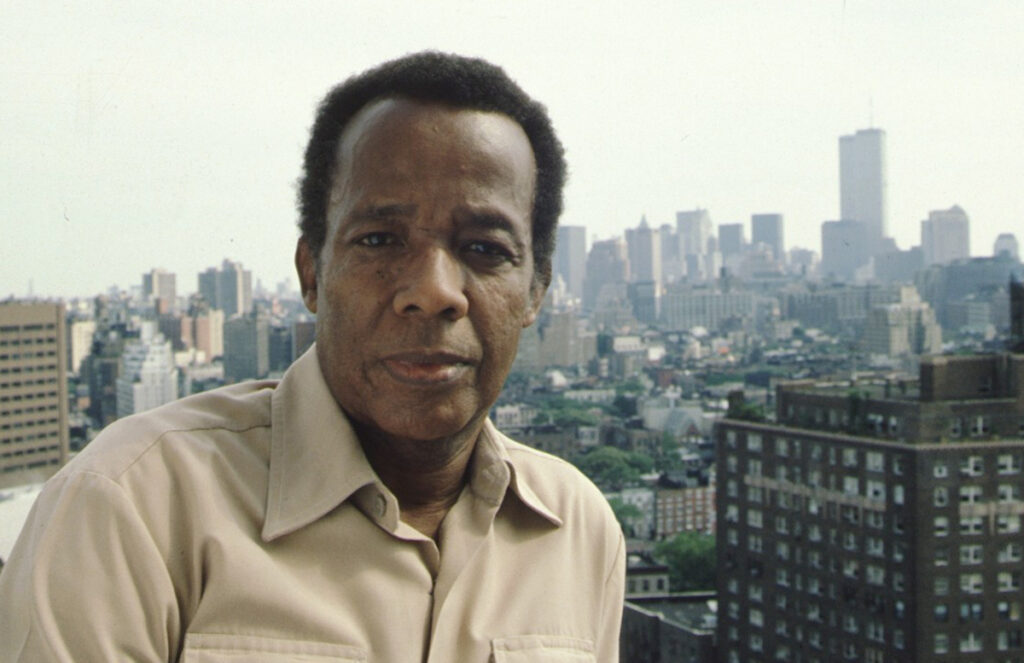
LG: Well, we started in 1972. That’s when my grandfather first shot it. He kept going back to the film over and over again, but never really could figure out how he wanted to present it. So he was shooting on video in the ‘80s, in the 90s, and the early 2000s. He was shooting interviews with a lot of people, trying to find out if he could see the effect or significance of the Harlem Renaissance in more modern times. So he was doing all these new interviews, and it wasn’t really working. When he passed away in 2014, my grandmother Louise Greaves’ mission became to just restore the film, all of the footage that we had. When she passed away in 2023, that’s what we received: all of the footage restored. At that point, that’s when we decided to just make a film first with it.
What I love about Once Upon a Time Harlem is that the party itself serves as a space for reflection because many of the people, like in the [19]20s and ‘30s, were not thinking so much about legacies. They were preoccupied with their lives.
DG: Yes, as Bruce Nugent says in the film, “the time is the now. You don’t think about what it means until later on.”
LG: So much of it is about reflecting, and also I think what’s useful in the film now is it makes you think about the work that we’re doing right now, right? In the present, you start to think, well, they didn’t realize they were making history. They weren’t focused, like you said, on legacy at that moment. They were just doing what was important at that time. Whether it was their social activism, creating art, or being in community. Those were the things that were important for them at that time. So it does make you reflect about the work that we’re doing and being conscious of that.
The gathering took place in 1972, during the Black Arts Movement. What were some similarities and differences you saw between the Harlem Renaissance and the Black Arts Movement?
DG: It’s so funny that I saw a quote from Ishmael Reed during the Black Arts Movement, where he said that “we are the revolutionaries. We are the artists, etc.” So if our film had come out at that time, they would have had a chance to react, “Oh, wait a minute! These were the revolutionaries.” As a matter of fact, Richard Brody said that had it come out at that time, it would have changed the course of history of that whole movement. So it came out at the right time, right now, because it was made for the future, and here we are.
I know that several of the people have various degrees of relationships, such as James Van Der Zee. He’s entangled in many of their lives. He photographed Marcus Garvey and Ida Cullen and her spouse, Countee. What’s it like to see some of them being together throughout these times?
LG: It was interesting in the film to hear Van Der Zee say, “I see Mr. Whipper there. I haven’t seen him since I photographed him in 1915, 16 and 17.” To see those long-standing relationships and to imagine what we don’t see on film. Like those conversations that you would have with someone that you knew 50 years ago. That’s when they knew each other.
One of my favorite participants in the film is Professor Nathan Huggins. He talks about how history’s measured, and it may not necessarily respect the artists. I’m very curious how artists were treated within the group, as they didn’t receive proper dues.
LG: Romare Bearden and Ernest Critchlow are over there, and they kind of take him to task for not recognizing that. I think what’s most interesting about that is that they are disagreeing with him, but in a very civil way. And so it’s nice to see that.
DG: He took it very well. So everybody was on their own best behavior.
I love that you edit both stuff from the party, as well as the artistic works of several of the luminaries who were no longer with them at the time. What was it like to integrate that element into the edit?
DG: The poetry really allowed us to do that, you know, to bring them in, to bring in like Zora Neale Hurston or Countee Cullen, his type of rendezvous with life. It reflects on both the time and the artists. You can see how the artists were really geared into that time with their craft or with their artistry. And Zora’s quote about not going to be considered a suffering person, that she sees the world, and she’s going to sharpen her oyster knife. With those things, you get a feeling of the poet, the writer that isn’t there, but their work is there.
As well as your father and grandfather’s poetry. Can you talk about William as a poet and a writer?
LG: Yes, that’s right. The original poem is from a film called Wealth of a Nation (1964), and he narrates it at the end of that film. It’s essentially about creative expression, and we wanted to end it with this one because we feel like so much of the Harlem Renaissance was about that personal expression. But also, my grandfather was a writer and a poet. There was a lot of philosophical writing, and I’m hoping one day to find a publisher to put it into a book and share it with people. So I think it would be very useful. Some of it will be in the book that NEON is preparing for the film – a coffee table-style book.
DG: Somebody out in California just asked, “Where’s this poem at the end of the film?” So it’ll be in the book, I’m sure.
LG: So we definitely have plans to share some of his writing more.
Some websites say that David and William co-directed, while the poster says “Conceived and Filmed by William Greaves, directed by David Greaves.” Can you explain how you were crediting Williams’ work, David as a director, and Liani as a producer? I feel like it’s all a film by, or directed by, Liani, David, and William.
DG: [William] says in his concept, “The shots in the verite, the director doesn’t know what he has until you get into the editing room, and that’s where the film is made.” We used his brilliant imagination to create this thing, and we’re able to say thank you very much and go through it and pull out the things that were the most evocative of the time and the people. That’s the work that I did along with the brilliant editors…
Lynn True and Anna De Mare.
DG: So that’s why it’s conceived and filmed by William Greaves, absolutely, and directed by David Greaves. And if they say William Greaves and David Greaves, that’s fine with me. You see him on screen directing.
LG: It’s a beautiful collaboration, ultimately. It speaks to the Renaissance. The time was one of collaboration. Working together to bring this forward does feel very alive. He was in the room in some way with my dad, myself, and my grandmother as well in terms of what needed to be in there.
I understand David was working at the party. How does each visit to the editing room give you more space to remember the party itself and your working relationship with William?
DG: When I go through the footage, I don’t remember specific moments in the room because I was working at the time. But looking at the raw footage, I see myself in the mirrors or in other cameras. I remember that. Then it starts to come back in. I remember John Henrik Clarke talking about Casper Holstein. I remember Leigh Whipper. That just comes back to me once I see it on screen. In terms of the moment at the time, I don’t recall that.
Did you have any personal relationships with the participants or were you just filming with your dad?
DG: I was just filming with my dad. The only ones I met were Richard B. Moore and Jean Hudson. She was our advisor on From These Roots (1974), so I worked with her on that. She came up to the editing room, and I did get a chance to speak with her. I knew her, frankly, from the library. She allowed me to put a tripod in the library. I said, “I can’t shoot Aaron Douglas’s mural.” And she said, “Put the tripod on the table.” I was like, “Whoa! Tripod on the table,” making sure you know that was very special. I remember being able to film this huge mural. That was a big part of the film.
Liani, you were one of the children featured at the end. What do you remember about that day?
LG: Nothing. I was probably three or four years old, so I have zero recollection of that. I wish that I had, but it was really fun to see that when it was in there. It was a surprise that my dad and Anne De Mare put that in. It was part of the film that came to be as part of the restoration, and I’m pointing at my father. So it’s kind of cool. He’s the camera person, and so I’m pointing at him. And to be making this film now, it feels great.
DG: Yeah, when she does do that point, and I look in her eyes and say, “Oh yeah, that’s what the look meant to be.”

Be the first to comment