
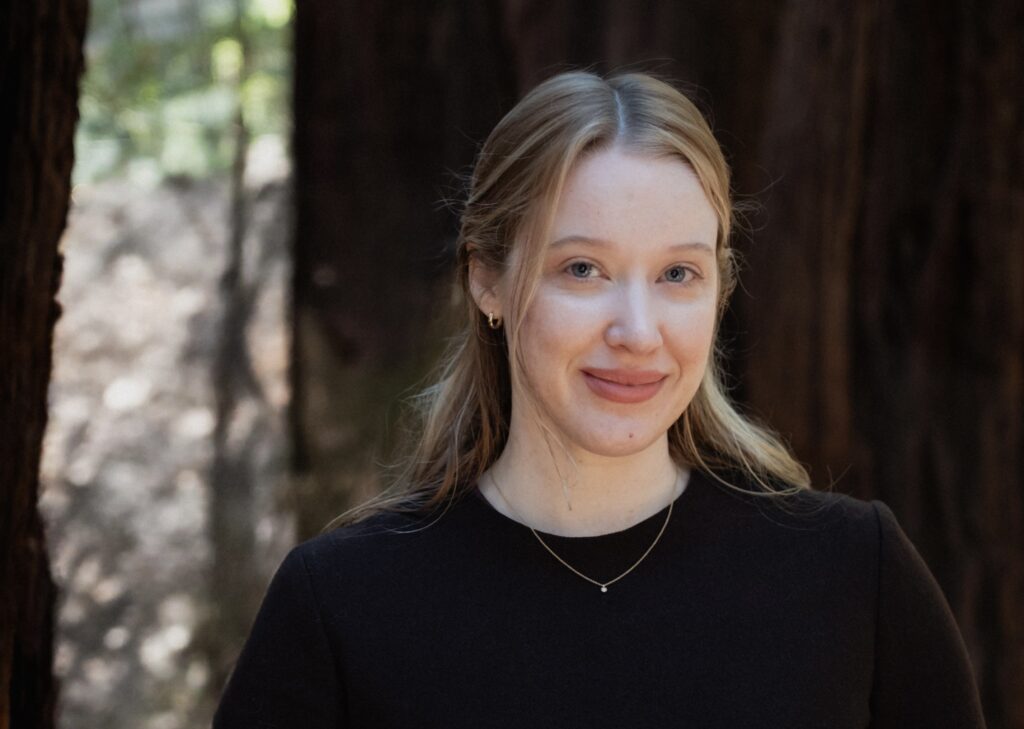
Chloe Benjamin is the New York Times bestselling author of Under Story, The Immortalists, and The Anatomy of Dreams.
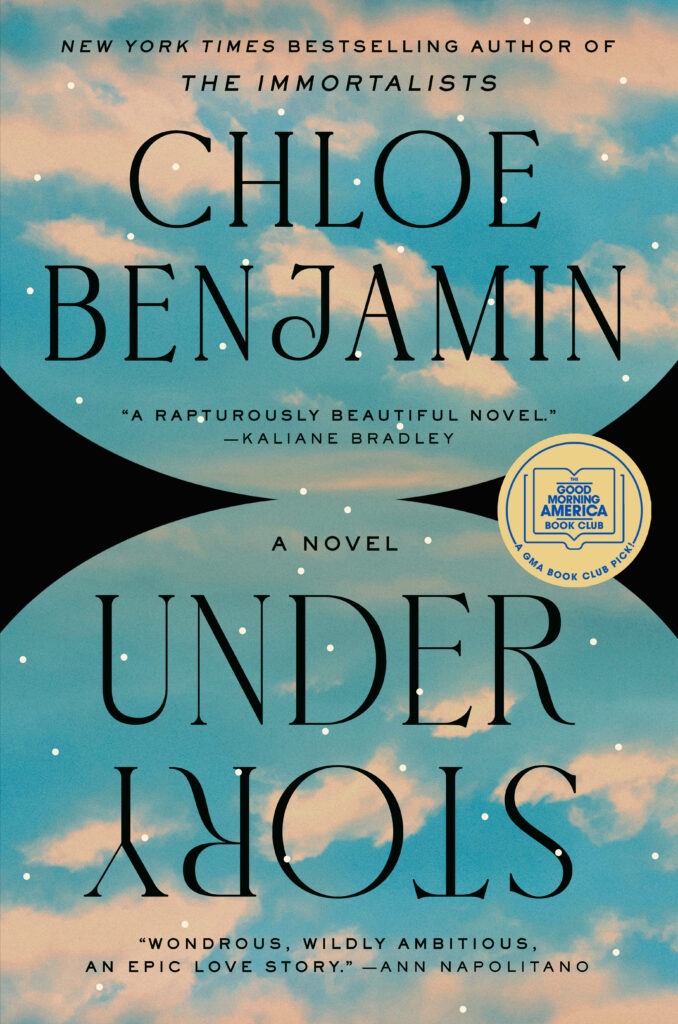
A Good Morning America Book Club Pick for September 2026, Under Story was also an Indie Next selection, a Barnes and Noble Book Club pick, and an Amazon Editors’ selection. The Immortalists—a Barnes & Noble Discover Great New Writers selection, LibraryReads favorite, and #1 Indie Next pick—was named a best book of 2018 by NPR, The Washington Post, Entertainment Weekly, and others. The Anatomy of Dreams received the Edna Ferber Fiction Book Award and was long listed for the 2014 Center for Fiction First Novel Prize.
Originally from San Francisco, CA, Benjamin is a graduate of Vassar College and the M.F.A. in fiction at the University of Wisconsin. Her work has been translated into over thirty languages. She lives with her husband and two Maine Coon cats in the San Francisco Bay Area.
There are so many facets of Under Story that are so well researched and fleshed out — about life on McMurdo Station in Antarctica, apple trees, fungi, neutrinos, and so much more. Where does learning come into your writing? What does research look like for you, and what was your favorite part in researching Under Story?
There’s an adage to write what you know, but I tend to be drawn to writing about what I want to know. That doesn’t mean that I’m not also writing from personal experience–the emotional undercurrents in my novels are undeniably my own, channeled through fiction. But there is so much I’m curious about, and fiction also gives me the opportunity to diverge from my own life, explore fascinating rabbit holes, and broaden my perspective. As a result, I tend to choose quite research-heavy projects, but the process for Under Story was unique. In the past, my research was mainly reading-based. Under Story took me out into the world: I interviewed physicists, clockmakers, and scuba instructors; shadowed scientists studying fungi in caves; attended a women’s mushroom conference (!) and a conference on psychedelics; and became close with the family that runs Door Creek Orchard, the real place that inspired the Salters’ family orchard in the novel. It felt more embodied and experiential than anything I’d done before, and it made the world come alive for me, which I hope also makes it more textured and tangible on the page.
As for my favorite part of the process, I think that would be connecting with the people I interviewed and got to know, from a former dishwasher at Antarctica’s McMurdo base to the family that runs Door Creek Orchard.
I’m curious to know how you invent from the research — where did you feel freedom to make things up, and where did you feel beholden to reality? Was staying true to the research (or the science, specifically) important for you with Under Story? What was that process like?
I wanted the world in Under Story to feel as convincing as possible, so I took real scientific research as far as I could before inventing. Crosshatching the real and imagined was exciting because it helped me to believe in the world of the book, too. That said, there were times when I had to make choices in favor of the story, or my ability to best tell a story. I settled on the idea that macro elements like aging and entropy move backward, but cause still comes before effect in smaller ways. It was a constant process and a symbiotic one, the relationship between reality and invention, not unlike the relationship between the novel’s two universes.
This is kind of a related question, but I’d love to hear what you think! You’ve mentioned in an interview that science and spirituality are interesting to you for “exploring or engaging with mystery” in different ways. Your books all engage with this idea, but in such new and exciting ways (they remind me very strongly of Brit Marling’s work, especially The OA!). Both science and spirituality are so very much about the unknown. To you, what role does fiction play here — what do you feel fiction allows you to do in that space of mystery?
I’m honored by the comparison, as I love Brit’s work and relate strongly to it; The OA is a particular inspiration. Much of the reason that I’m drawn to write about uncertainty is that I struggle with it–especially the fact that we have to go through life without knowing what will happen to us or the people we love. I am always trying to find new reframes, more acceptance, and perhaps each of my novels is a different thought experiment on that subject. On the other hand, I think mystery is where so much of life’s joy and enchantment lives. Surprise, delight, coincidence, intuition, fiction itself–all of these sprout from the unknown.
In some ways, fiction is appealing to me because it offers the illusion of control: narrative corrals randomness into story. In other ways, though, it gives me a way to sit more healthily with mystery, marveling at and appreciating what it has to offer.
Your novel takes us into the anti-universe, which is characterized by this really hypnotic, fascinating notion of time. I read Under Story in one day, two sittings — and when I put it down in the middle, I found myself so totally disoriented and dizzy, like the book’s ideas of time had completely influenced how I saw the world around me (it didn’t wear off for a while!). I was wondering, what was it like, experientially, to inhabit the world of the book for the time you took to write it? How (if at all) did living in and creating this world impact how you looked at our universe?
I’m delighted that the novel lived with you that way! Because the writing process was so lengthy (about 5 years for a first draft, almost 7 in total), it was very immersive for me, too. When reading and writing, I love to feel that I’m living in another world for a while. I trained myself to think in a backwards-moving way so well that I often had to remember that September comes after August instead of the reverse!
At the same time, creating the Duoverse also made me look at the real world with more awe. In many ways, all I did with the antiuniverse was to offer a mirrored version of life as it is. The reversal of the life cycle is one example: in the novel, the beginning and end of life might seem mind-boggling, but all I did (trying to avoid spoilers here…!) was to flip life’s source and method. I think that real birth and death are totally mind-boggling, and that we’ve just become accustomed to them. In writing an inverted version, I hoped to help readers to see this with fresh eyes.
On the topic of the anti-universe’s experience of time: something I found so fascinating was the way Laurel and Eli engage with a world that for them, and for the reader, initially feels like it’s basically regressing — technology simplifying, for instance — but the world is also reknitting itself from climate devastation, for example. I loved the worldbuilding — there’s a line about the “new iPhone 6” that made me laugh out loud. What was the actual planning and worldbuilding like for the anti-universe? The things that struck me the most were how the anti-universe requires the reader (and Laurel and Eli) to re-frame ideas of progress and parenting.
It was quite a mental challenge. I told myself that roughly, the worlds are in a similar state at any given time, and my task was to figure out a way to explain why people in the anti-universe would choose to move in a direction that seems regressive or backward to us. I actually feel that similar thinking is happening now, in real life, as people feel inundated by technology that might not actually enhance our lives, or might have major consequences (for privacy, politics, the environment, etc.). Progress isn’t always linear, or perhaps the better way to put it is that continuous/linear progress is not inherently or necessarily valuable, let alone ethical. Indigenous cultures, for example, have long understood and practiced how to be in healthier, more balanced and reciprocal relationships with the environment, and many of their practices can help to reverse damage now. If more “progress” means more damage, then is it really progress? I don’t want to fall into the trap of simple nostalgia, but I also don’t want to lose the wisdom that the past has to offer.
Hilma af Klint plays a not-unimportant role in Under Story. What drew you to her as a figure, and how does she serve as an inspiration for this book?
I can’t remember exactly when I came across af Klint’s work, but it might have been when researching surrealism. Surrealist art is one thread in the novel, and af Klint is one of several artists whose work particularly inspired me, including Frida Kahlo, Remedios Varo, and Lee Miller. Part of what I find interesting about surrealism is that it emerged in the period between World War I and II, as though realism were not enough to adequately express the horror of that point in time. I think that we’re living through an enormously difficult, uncertain moment right now, and I wonder if that is related to the fact that genre-blending art is emerging once again. It feels like science fiction and fantasy are modes that many of us are drawn to right now as we try to make sense of the present and consider the future.
To circle back to your question, though Hilma af Klint is considered an abstract artist rather than a surrealist, her work has a mythic, cosmic component that, to me, evokes the universe’s mysteries and potential logic. When I look at her paintings, I feel that perhaps I’m asking similar questions as they are.
(This is a spoiler but: the very first thing I thought of toward the end of Under Story when Laurel finds the device is the alethiometer from His Dark Materials!) I know you’ve always counted that series as an influence. Can you talk a bit more about what that series means to you, and if there were other influences on Under Story you’d like to mention?
Absolutely–His Dark Materials are my favorite books, and have inspired me hugely when it comes to subjects like consciousness, imagination, and worldbuilding. Other influences from childhood include A Wrinkle in Time (Madeleine L’Engle), The Giver (Lois Lowry), and The Chronicles of Narnia by C.S. Lewis. Books I’ve loved in adulthood that combine a high concept premise with literary execution include Ted Chiang’s Stories of Your Life and Others, Marina and Sergey Dyachenko’s Vita Nostra, Jeff Vandermeer’s Southern Reach Trilogy, Vandana Singh’s Ambiguity Machines and Other Stories, Mohsin Hamid’s Exit West, and Susanna Clarke’s Piranesi and Jonathan Strange & Mr. Norrell. I also love good old realist literary fiction, especially for exploring psychology and relationships. Some of the writers who have influenced my work there include A.S. Byatt, Virginia Woolf, Andre Aciman, Annie Proulx, and George Eliot.

Be the first to comment