

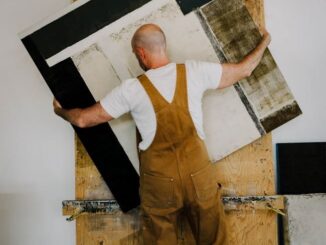
Barry Ginder (b. 1963, Lancaster, PA) is an architect and artist whose paintings reshape and deepen perspectives on urban landscapes.
Drawing inspiration from mid-Atlantic cities, his work emphasizes geometric shape, color and meticulous layering to explore the balance between translucency and obfuscation. While rooted in his background as an architect, his cityscapes are less literal and more emotive explorations of the spaces that people inhabit and are interconnected by.
He studied at Temple University and his exhibitions include solo and group shows at The Demuth Museum and Lancaster Museum of Art. His architectural work has been recognized with numerous awards throughout the years.
What came first for you, architectural studies or visual art? Or did you study and develop these disciplines simultaneously?
My architecture studies came first. I was always interested in the fine arts, but it was during my time at Temple University that I engaged in painting classes through the Tyler School of Art. From that point forward, the two disciplines were often blurred. Both are what I consider creative endeavors to document what I see in the world and how I then translate that, whether into either art or architecture.
Architecture is no doubt a foundational aspect of my paintings. In both, I think there is a contrast between precision and suggestion, between articulate profile lines and the hazy insinuation of what lies just beyond.

Your work has been described as “carrying forward the spirit of artists like Diebenkorn.” When did you first discover Diebenkorn’s work, and what qualities of his style immediately attracted you?
I first discovered the work of Diebenkorn through my colleague Suzanne Brandt, who had actually studied his work and how they relate to architecture.
Diebenkorn had a unique ability to create frontal paintings that had incredible depth through layering of line and geometric forms. I think his Ocean Park series are the best examples of this approach. His paintings consistently allow previous layers with lines and geometric shapes, corrections, and pentimenti to show through, providing depth and a luminous quality to the paintings. They reflect a meticulous, draftsman-like quality with both exact and figural line work, which is something I’m quite drawn to in my own work, while of course exploring my own subjects and processes.
What I really love is how his paintings feature broad, flat planes of color, balanced with linear, often diagonal or vertical bands, reminiscent of a view from a window or an architectural, aerial perspective. The view from a window is something I’m always exploring, whether in the painting or even how it is framed and presented.

What do you most often use as references for your works (e.g., photographs, visiting spaces in real time, etc.)?
It’s mainly observation. As I move through my day, it’s best for me to see the landscape and experience it in the moment. I often encounter moments where light is washing over the surface of a building, and that might spark something within me. I try to remain open to seeing the ever-changing and unique qualities the city can offer if you pay attention.
I will usually draw my interpretation of what I see and experience in my sketchbook that I always have with me. I also photograph unique moments in the day that I then crop and study to use in the creation of paintings. This process is constant and continuous. I see something, draw or photograph the event, and then interpret it into a proposition or painting.

How do you approach the manipulation of color to achieve the variegated blendings seen in your works?
I employ techniques of both accumulation and erasure to transform the translucent surfaces of the paintings into thin layers. It’s a classical under-painting with complementary colors in the background, which creates a vibrancy and depth of surface, scored with architectural linework reflective of underlying geometries and profiles. I sand and rebuild pigments, which alters the surface while revealing apparent aspects of earlier figures.

You draw visual inspiration from mid-Atlantic cities. What elements about these particular cities inspire you, especially in the sense of their geometries and color tones that lend themselves well to your layering style?
At the moment, my paintings are definitely centered on the Philadelphia cityscape and landscape. I’m most inspired by the full expanse of vertical and horizontal forms in the city, the recesses and line connections that form. Several of my paintings are from a specific view facing east to the city from the 11th floor of the office. Looking from this same vantage point provides the opportunity to see the scheme change between sunny days and overcast days, bringing into focus different unique characteristics that embody the place.

In what ways do you try to comment on built spaces and architecture that gesture towards palimpsesticism, especially in the sense of historical preservation, urban renewal, and adaptations for reuse?
I actually don’t think my work is an attempt to comment directly on built spaces but instead provide a sort of window view, as I mentioned earlier, that opens up different ways of seeing the world. Whether the viewer brings into that view their own experiences and interpretations of particular spaces and built environments is up to them.
Who is an architect that you feel works with built space in a way that is also palimpsestic in technique?
Carlo Scarpa, whose modern architectural interventions into historical sites allow both to exist in harmony. He had a mastery of details, creating jewel-like designs crafted with traditional materials of wood, stone, metal and plaster and resulting in iconic and timeless expression. His approach to design with poetic materiality and precise details set within historical structures to focus the occupants on a sensory experience, is something I probably respond to the most in my painting practice.


Be the first to comment