
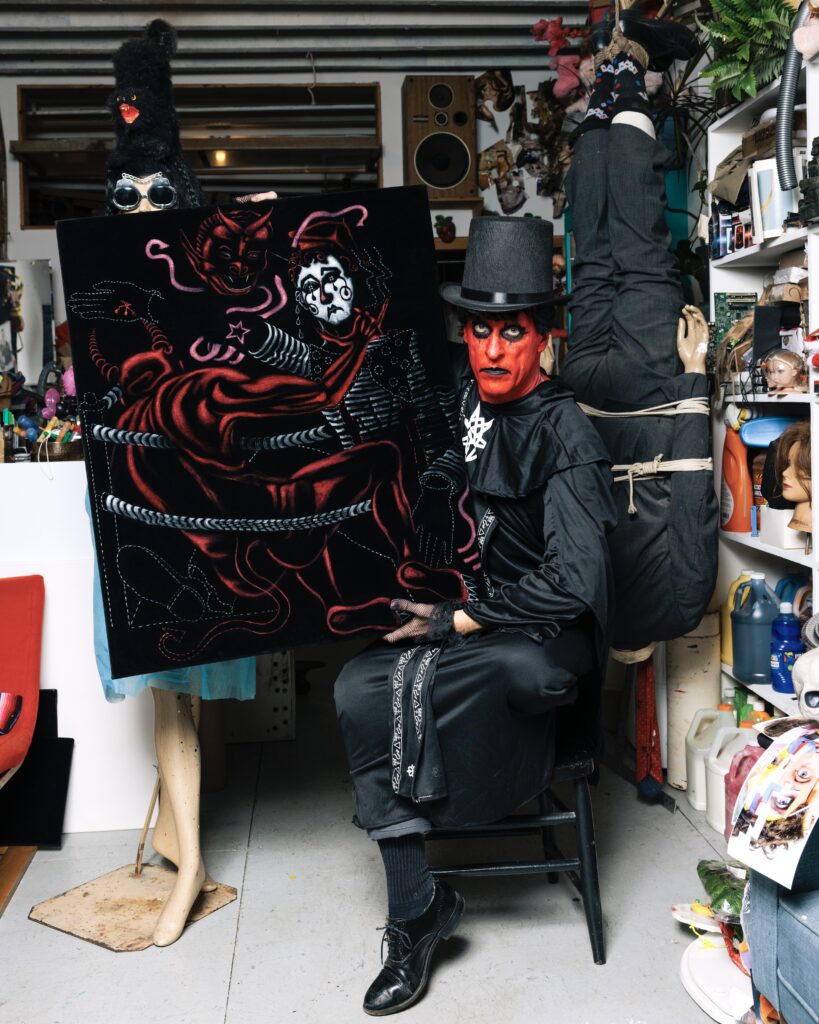
David Henry Brown Jr. is an Interventionist/immersionist performance artist and sculptor who works in diverse mediums, often placing his physical body into the work. Frequently riffing off of the dark side of American popular culture, he has been showing his work since the early 1990s both in the New York art world and as a renegade underground figure and as a collaborator.
On May 14, 15, 16, and May 21, 22, and 23 from 12-6 pm, he will be presenting the solo show “The Adventures Of PaintoMime” at Satellite Art Show, with an opening reception on May 14 from 6-10 pm.
His Deep Fried Objects installation is part of the Belle Chase group show curated by ProblemChild Advisory at Sitting Room Gallery, which runs until May 24.
(This interview has been edited for length and clarity.)
You’ve done all kinds of performance art under the conceptual umbrella of a persona that you refer to as Fantastic Nobody. Is PaintoMime another aspect of Fantastic Nobody?
Fantastic Nobody really means you’re always yourself, but you’re able to change your appearance like a shapeshifter. I would liken it to Cindy Sherman on PCP, just because of the fracturing of having many identities. It’s not like my identity changes. I’m interested in how I’m perceived in different situations. I’ve basically changed my appearance for my work and been in character as much as the band Ween, [as if] I I did a country album, a heavy metal album, and I kind of like it in that way. So PaintoMime is definitely another Fantastic Nobody character. The mime is a recurring theme.
You’ve had this long period of pretty much only doing performance, and now you’ve decided to bring back the black velvet paintings into your repertoire. What was the catalyst for wanting to get back into painting?
Some artists really respond to an internal dialogue, and I have that too, but I respond more to the zeitgeist of society and my situation. I really like to bounce off things. When I was studying in school, some people were good at just imagining things, but I was better at looking at still lifes or models and improvising from them.
I think a lot about Trump’s second term, as someone who has been quite political at times and self-damning also. I’ve definitely been highly hypocritical, and in performances, I like to wear the dilemmas of society on myself to see what will happen or to create a character that will infiltrate celebrity culture or something like that, too, because I don’t understand it.
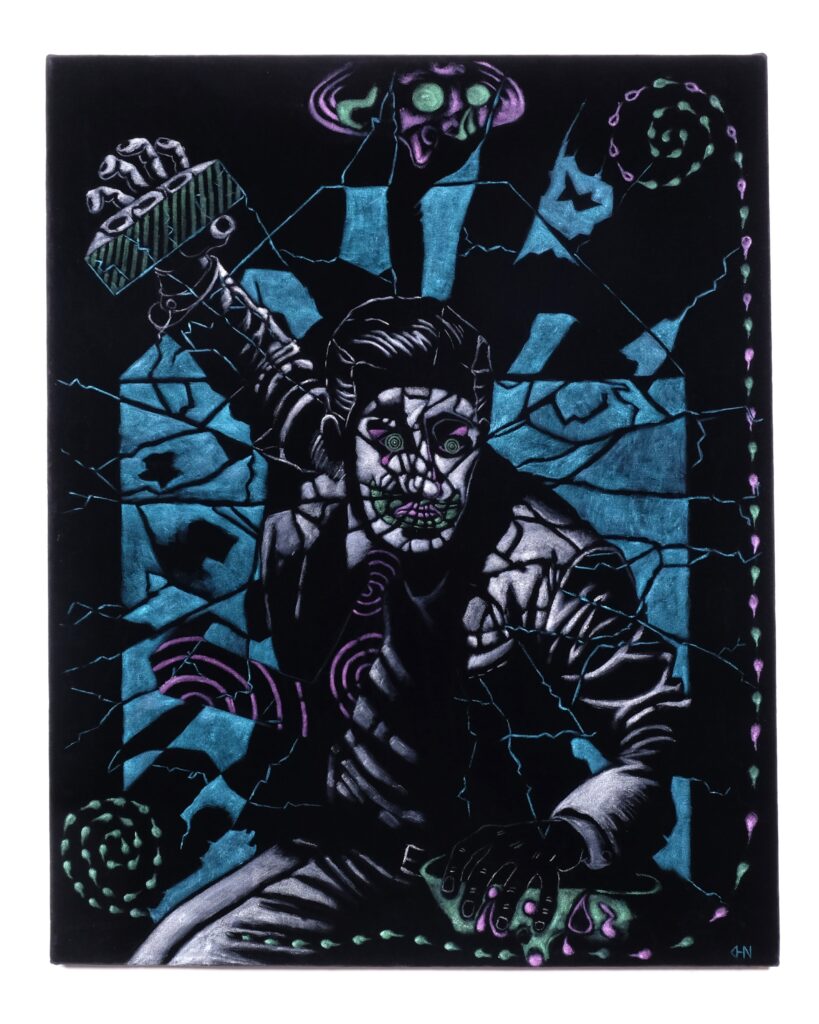
Painting on velvet takes a lot of layering and patience. You can’t easily wipe away or erase. You really have to do a lot of planning. I guess I’ve just been up for the challenge. There’s no doubt that the market has also changed because of Trump 2.0. This is a time of brutal economic reckoning for all of us. I certainly needed another stick in the fire because I’ve been selling NFTs and digital art to make a living off that. 2021, ’22, and ‘23 were very good, and it’s still going, but it’s a lot more [effort] to sell the work over there, and I’m thankful for my collectors.
And some of those collectors have been buying a black velvet painting, which is cool. So, it’s a combination of political zeitgeist and economic conditions. I made so much fucking performance in the last decade as my solo work. I’m not giving up on performance, I’m still making some videos, and there’s going to be a performance aspect at the show. But I think for some reason I’m really drawn to painting right now. Maybe I just don’t want to look so much at society and go inside myself a little bit more. Maybe I’m ready now.
What are some other elements of black velvet painting and returning to painting that attract you to it?
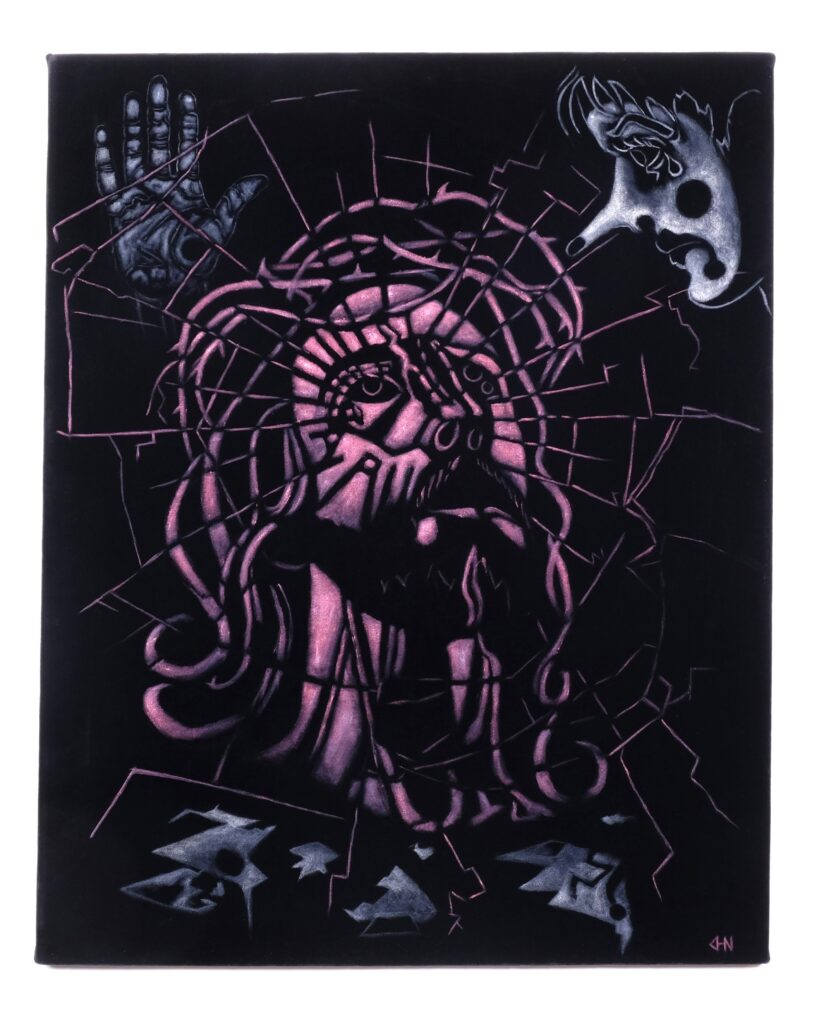
It’s so meditative. It’s wonderful. It feels good. You really let go of everything around you, and you can go on with a painting for like eight hours; it’s beautiful. I would also add that I grew up looking at a couple of weird black velvet paintings in my dentist’s mall office. I would come out loaded on nitrous oxide as a kid and trip out at the paintings. I love how it was always frowned upon in the art world, but I could really love naive outsider black color paintings. I think they’re super funny and really, really fucking weird. So I’m definitely drawing on that tradition.
What’s happening with the figures in the paintings? You’ve said that they’re all situations that you’d like to see yourself in?
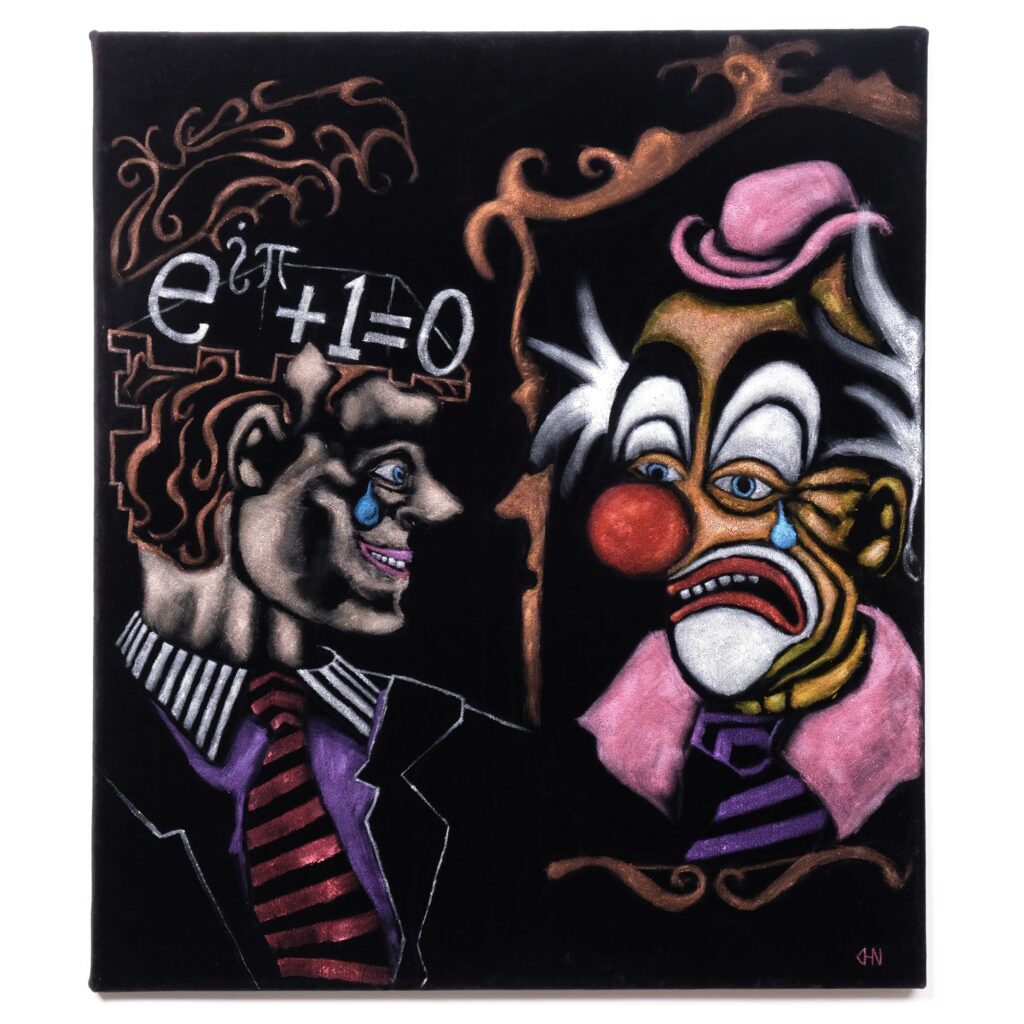
I think we live in a time where the nature of how we project ourselves into images depends upon one’s disposition. But I say that I’m probably projecting myself into my paintings. When I look at the mime and the cage with the collar and the dog food, that looks like a funny performance to me, like a situation I’d love to be in, and I’ll laugh my ass off. So, you can let your imagination run and make paintings about something you can’t [make into] a performance right away. Like imaginary plans for things or spaces or states of mind that I’d love to get to.
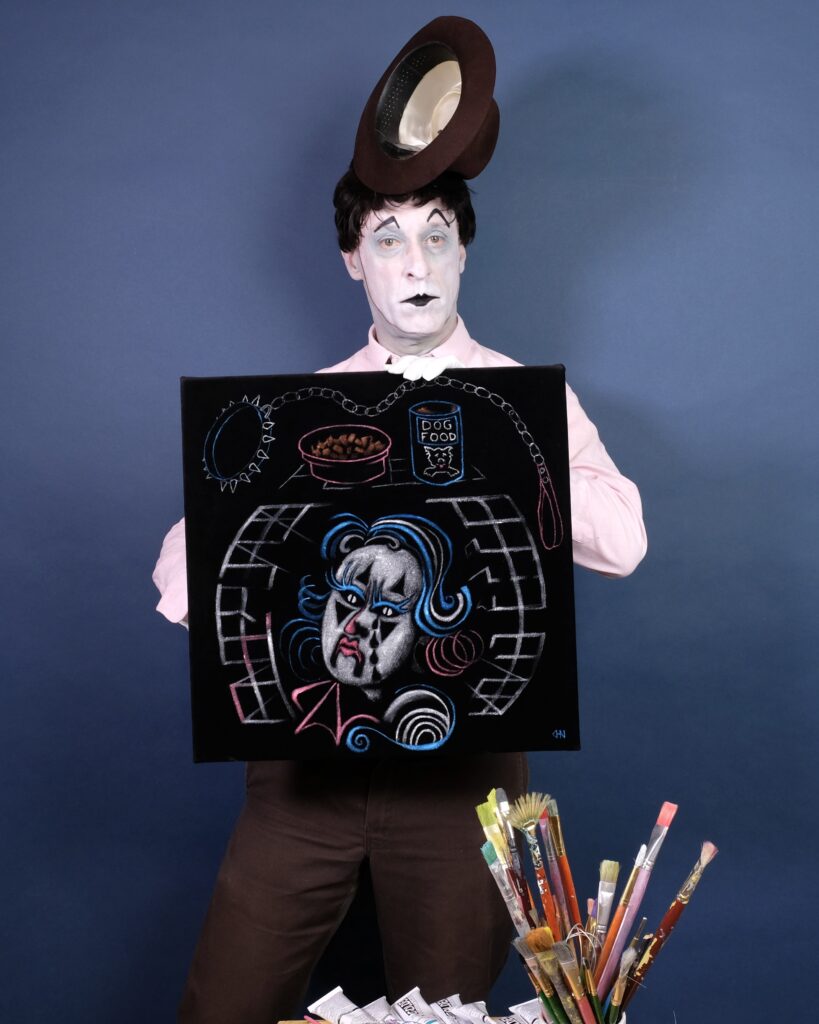
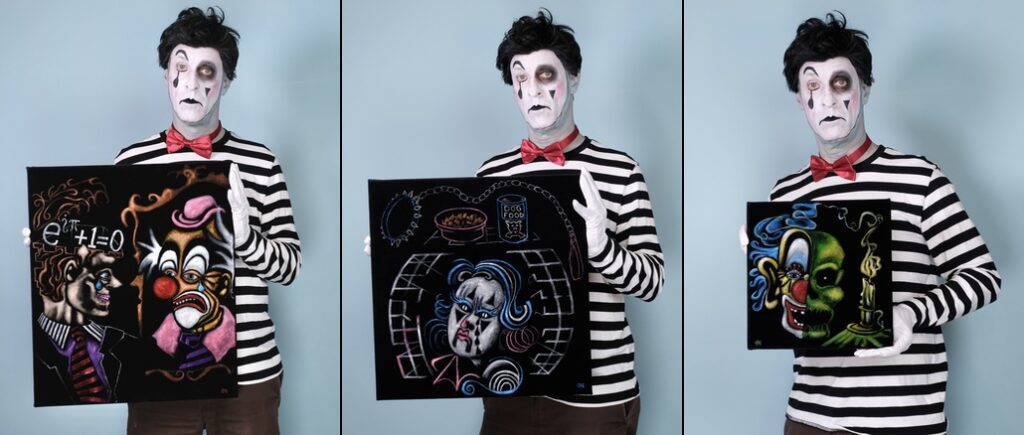
On the performance videos where I’m in the work and they go superviral and people are scrolling, I noticed in the last decade that people don’t see me, they see themselves. I think the internet is a place of very, very, very deep projection. It is beyond anything we’ve ever experienced. People really like projecting themselves into mediated images, hardcore. I was interested in celebrities like in the 1990s because I also felt they are pretty boring actually, but it’s [as if] through mass consciousness, people are literally beaming themselves into these people and animating them.
The internet is a similar thing. That’s like classic Marxist deconstruction, Slavoj Žižek and Guy Debord. All those consumerist psychological projections exist in virtual reality. And I kind of wonder if that’s carrying into painting now. I know it’s happening in video and photographs. I’m very sure that people don’t see me; they see themselves because I sort of loosely think, without being a philosopher, that somehow your reptilian self, which knows it’s being heavily surveilled…the internet’s the first medium that looks into you more than you look into it. That’s unprecedented.
Art is closer to music now because of the internet, because it’s really all around you. Music used to be the only medium that was only all around you. Now art, you’re getting surrounded in the art of everything. I think a lot of unanswered questions about this embodied work, the pieces of the puzzle, are going to get checked off at the exhibition because the work resonates more in real life than it does in photographs. There’s no doubt.
I like what you’re saying about the internet and how it’s this massive self-reflection on a scale that the world’s never seen, and it’s just so overwhelming.
I’m interested in this area of life that comes from Fluxus, where it’s about mixing art and life, where art drops off the canvas into reality, because that’s the real frontier. It’s really the unknown. With the internet, it is art and life mixed in simulation and through algorithmic code, basically. Now, when you take in all this imagery, you carry it with you into your life. Because my work is predominantly behavioral, I’m interested in how it just affects our behavior. We are really way more immersed than we used to be.
I feel like when I talk to my Gen Z friends, I think they see reality like a screen. Now, some of them don’t like to hear that. That’s very disconcerting. I have a lot of Gen Z friends. I really jive with them. They love my work. Some of them are like 25, they grew up seeing me since they were 15, and they moved to New York. But I noticed when I did this test, where I pointed something in front of them, and I noticed that they followed my finger. Now, for us, we’re like Gen X, right? We don’t do that. We know that someone is gesticulating, but they think it’s a cursor. I was like, wow. And I also feel like Gen Z and some Gen X too, people basically surveil each other as if you’re on the internet, and you’re having a conversation that is like written in stone in some way. There’s a lot going on with all this kind of stuff. I don’t know how this relates specifically to the black velvet paintings, but this is definitely where I’m coming from.
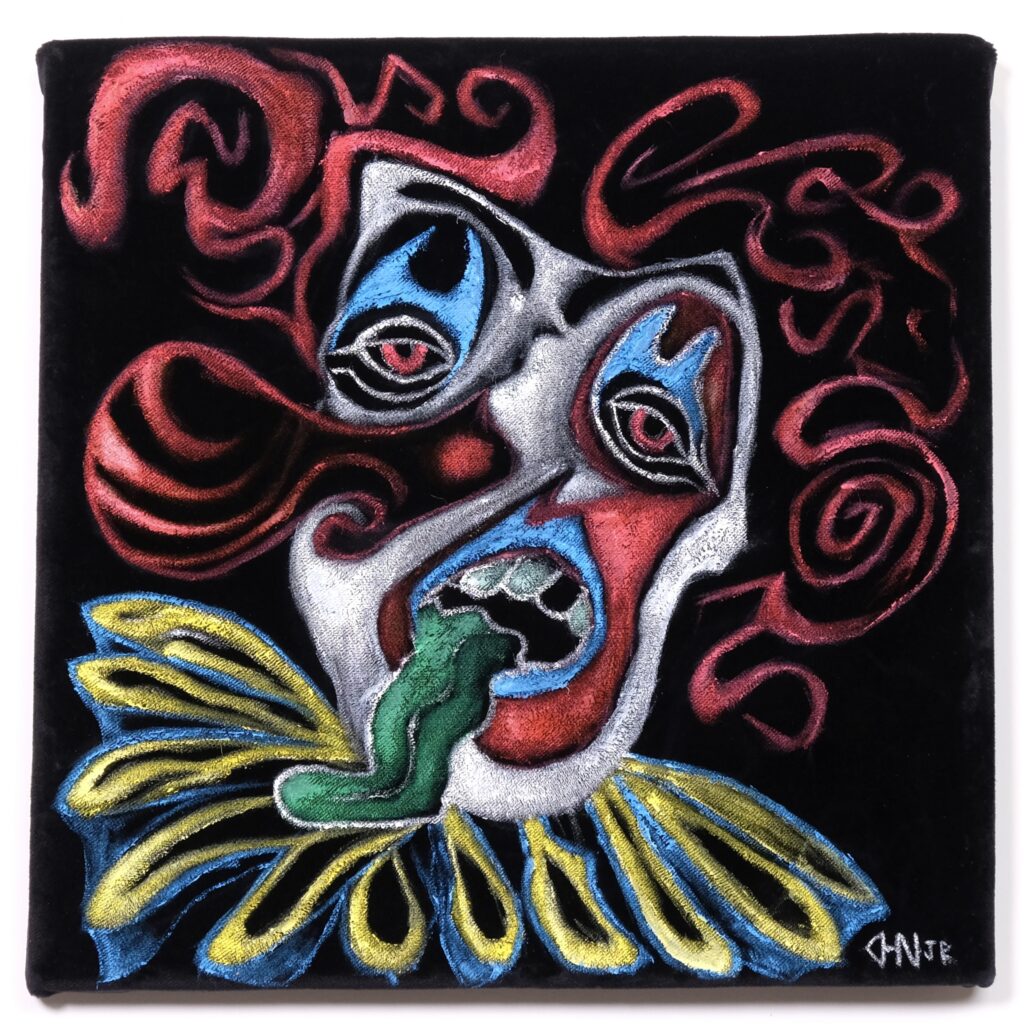
Clowning has always been present in your performance work. And in one of your reels that I recently watched, you said that you remember looking at adults and thinking of them as clowns. What was the clownish aspect of adults to you as a kid?
I was a class clown in school. I was a really creative kid. I would really fuck with the teachers a lot. I did not like authority figures at all. And I remember being a little kid, and I thought that they looked like clowns basically, like silly and cartoonish. Their authority was silly, I thought.
Clowns are both good and scary things. They have very dark references. Clowns and mimes are part of our subconscious and our primordial reptilian self; they haven’t really reconciled in a sense. I think with my performances on Instagram, the characters are like inside-out people.
And when I look at Basquiat’s figures, they look like inside-out people. And when I look at a clown and a mime, it’s like an exaggerated exterior self that is basically an inside-out person. Is it really them, or is it like some idea of ourselves? I don’t really know.
I mean, clowns are funny, we laugh. They’re psychedelic. I did acid when I was a kid, and I still smoke weed, and I don’t drink, and I don’t smoke constantly, but I have kind of a little bit of a psychedelic view of things. I mean, I think [of clowns] also like the image of the jester, the figure that’s like the performance artists Matthew Silver or Crackhead Barney, they’re like clown-like in a way. I mean, Barney’s very seriously political, but I think they engender these characters that are sort of clownish that can kind of speak truth to power in a sense. Clowns and mines, to some extent, cut through oppression and depressing ideas about society in a sort of safe way.
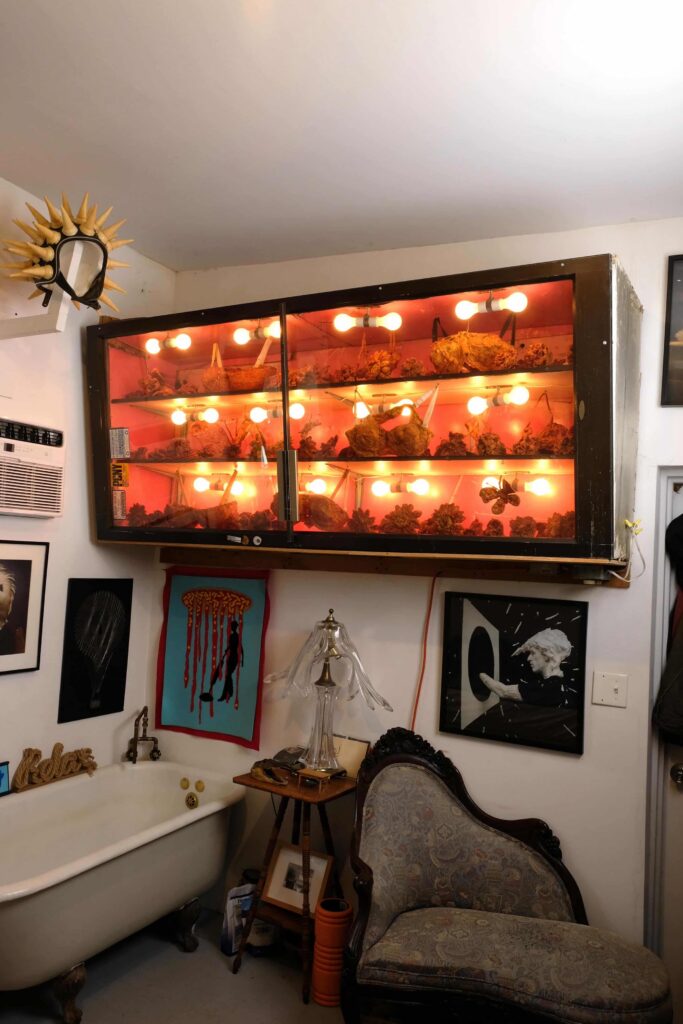
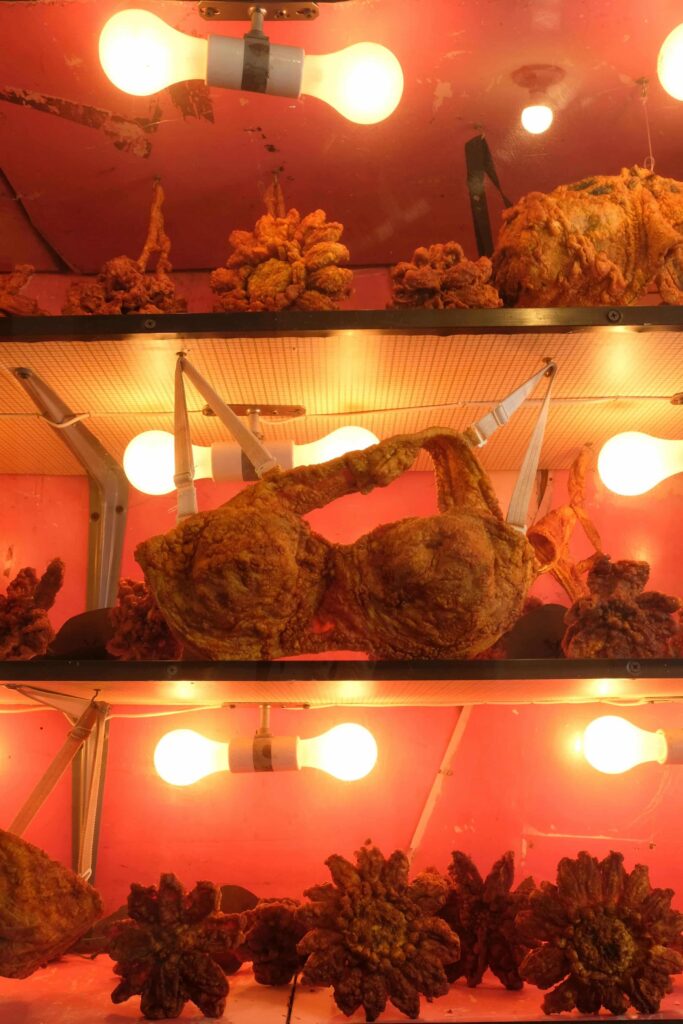
Let’s talk about your Deep Fried Objects. These go back to 1994, and so it’s incredible how they’ve hung on for this long. 32 years later, and they’re making, as I’ve read, their greasy and triumphant return in great condition! You were originally inspired to make this work by Puerto Rican displays, right?
Yes, cuchifritos. Which is like pork rinds, and they usually have these circus lights. I made it in 1994 in my first couple of years in New York. I started collaborating with this English artist, Dominic McGill, who really got me really into Americana. We checked out Puerto Rican cuchifritos, and I was already kind of really interested in all the different cultures in New York. I was just walking around, and a friend of mine, who was kind of a fellow drunk, I feel like I must have quit around that time, but I knew him from the bar scene in Max Fish, where I used to go and get loaded in my early 20s.
He was like, ‘Hey man, I’m going to organize a group show at Max Fish and want you to put something in.’ Most people put in like a painting they made in 20 minutes, [but] I really started to go really hard on every single thing. Someone would invite me to do a group show at a cafe or a bar. I would do the most hardcore piece I could possibly think of. I was so hungry to make art and flash. The drive was very strong. I couldn’t really try taking my slides around galleries, and I got rejected all over the place, and I was very impatient. I’m not going to wait for some rich person to sweep me off my feet. So, I started making art wherever I could. I got the [fried objects] idea from walking around the city.
I was like, ‘I don’t think anybody’s done that before.’ I mean, maybe Joseph Cornell or someone like him did that. So my mom sent me a photocopy, or maybe I went home and got her Joy of Cooking book, and I used a batter recipe with a lot of salt in it, and I got like a big cheap aluminum pot, and I boiled, I don’t know what…kind of like canola oil or something, shitty oil of some sort, and it’s pretty dangerous. I had it on a hot plate. I don’t think I even had a stove at my place because I was in Dumbo. I lived illegally in my thousand square foot $350 a month place, and I boiled oil in there, and I experimented.
I used kind of cheap stuff that you could buy at the dollar store. I’d take flowers and a big brassiere and feminine imagery or whatever. There are baby shoes in there, so it’s got a sort of breeder imagery. And then some 1950s metal cabinets that I found in the garbage because there were massive piles of fascinating garbage all over the place.
You can see there’s stuff like garbage pickup stickers on it and shit. In Max Fish, it was quite a hit. I heard that Kiki Smith saw it. There were a lot of druggies in there, like heroin addicts and stuff, and it was back there on the pool table, and I do remember that I kept going in and seeing if the piece was doing okay. I was worried about it there, and it was unplugged, and I realized it was because it was too bright. I put the dimmer switch so it could be turned down to a nice, sleazy glow, and then it was on all the time. It was probably a vibe killer back there [without the dimmers]. Loungey heroin. I was never into heroin, but there was sort of a 90s lounge sleaze kind of vibe to it…subversive.
On May 14, 15, 16, and May 21, 22, and 23 from 12-6 pm, David Henry Nobody Jr. will be presenting the solo show “The Adventures Of PaintoMime” at Satellite Art Show, with an opening reception on May 14 from 6-10 pm.
His Deep Fried Objects installation is part of the Belle Chase group show curated by ProblemChild Advisory at Sitting Room Gallery, which runs until May 24.

Be the first to comment