
For the last twelve years, former LA Weekly film editor and critic Karina Longworth has been setting the bar for deeply researched film podcasts. Each season of her series, You Must Remember This, provides a blend of history and analysis worthy of a book on any subject she sets her sights on, from the antics of Kenneth Anger to entire decades’ erotic film landscapes.
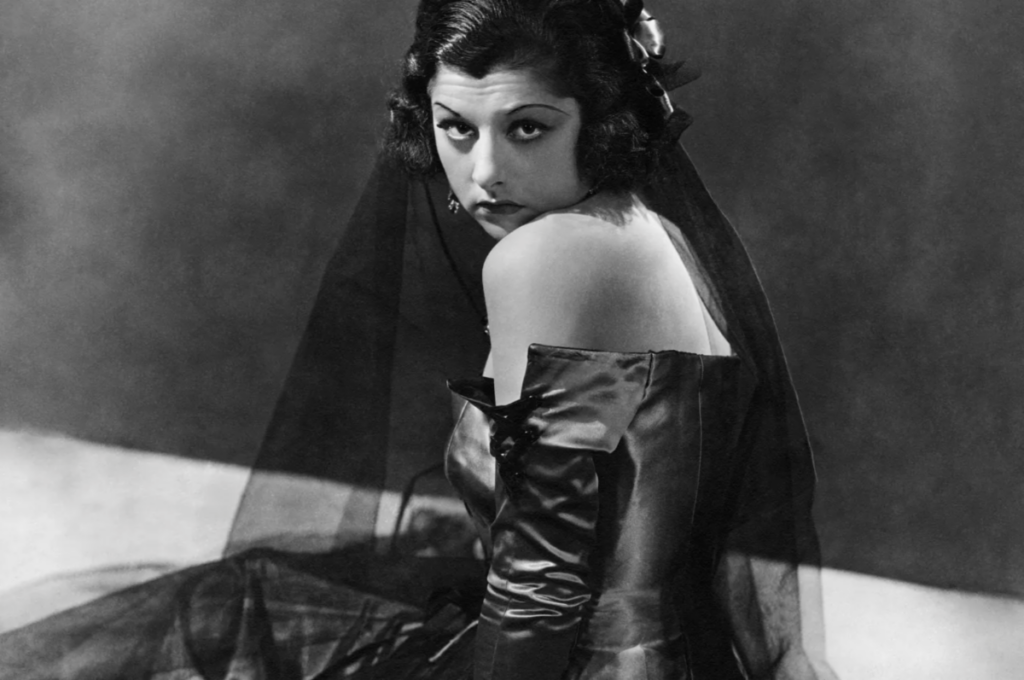
This fall, Longworth turns her eye to the scandalous life of Libby Holman, Cincinnati-born torch singer and prominent tabloid figure of the 1930s. This racially ambiguous, openly bisexual party girl, friend to the likes of Tallulah Bankhead and Montgomery Clift, made headlines after the sudden death of her first husband, Smith Reynolds, heir to a vast tobacco fortune, in 1932. Immediately smeared in the media, in part on the basis of her Jewishness, Libby’s life became a public spectacle akin to something straight out of Chicago.
Over the course of The Bisexuals, Longworth explores her story from the perspective of race as well as sexuality, digging through decades of biographies, primary sources, and the films Holman’s life inspired. In anticipation of the season’s release on September 15th, Interlocutor joined the critic to discuss her process.
Payton McCarty-Simas: You say at the outset of this new season that Libby Holman is something of a curious choice of subject for a podcast that’s typically focused on film, since she was never in any films herself. The show takes on this hybrid structure where you’re dealing with a lot of different elements and kinds of media as a result. How did you settle on this subject and that structure?
Karina Longworth: I’ve wanted to do something involving Libby Holman since 2020 when I first discovered her story. It was the pandemic, and I was spending a lot of time in my backyard reading. I remembered reading about her a long time ago in Patricia Bosworth’s biography about Montgomery Clift [Montgomery Clift: A Biography, 1978] and it had been a long time since I had revisited that. The first thing I did was buy Jon Bradshaw’s book, Dreams That Money Can Buy (1985), and because I had so much time at my disposal, I gave it a really close reading where I was writing questions in the margins sparked by the way he phrased and framed things.
Because nobody had written about Libby since the 1990s, it felt like there was a lot of stuff to talk about and reconsider in terms of the way that she encountered issues of race and sexuality; I just got really excited by her story and it got stuck in my head. Then at some point in 2025, I realized that what’s actually interesting about her in the context of my podcast is that there were so many movies made about her. I’ve never encountered a figure who never appeared in a movie as a performer, but who had all these major and not-so-major stars playing versions of her. Then, of course, you get to do a dual biography of her and Montgomery Clift because of their relationship.
This feels almost like a meta-series on historiography. Can you talk to me about your process, your sourcing, and constructing this historiographic narrative?
I’ve always been interested in historiography, and I think that it is an element of a lot of the seasons in different ways. The Hollywood Babylon season obviously is about the way these stories were written about by Kenneth Anger, and then in the erotic ’80s and ’90s, I often interrogate the way magazines covered stars and films. With this one, because so much of my initial understanding of Libby’s story was through feeling like the framing of her was unkind and out of date in terms of sexuality and race, it felt really important to me to make sure that the listener knew that I was reacting to the way things had been written in addition to sharing the information and analyzing the films.
I think we have this idea that the past is a completely foreign country, and actually–– especially when it comes to the ebb and flow of attitudes towards sexuality–– things were more progressive in the 1920s than they were in the 1960s in some ways. It’s always interesting to me to try to bring a modern lens on the past while at the same time not allowing that to misread the past. It’s a way of making what’s now ancient history to a lot of people seem a little bit more current. It’s not something I’m able to do with every aspect of every story, but when I am able to, I think it helps.
This is such a spicy subject, too, in terms of its sexuality. When you’re talking about all of these different salacious books about a queer person and a murder trial, how do you personally balance questions of editorializing and supposition and drama, narratively speaking, with the project of rectifying the historiographic record?
I think it’s intuitive. It’s a question of figuring out when it’s time to interrogate a certain author’s way of doing things, and when it’s time to get people to feel empathy. Libby Holman is a difficult person to empathize with in a lot of ways, but I wrote a whole book about Howard Hughes, who’s a pretty despicable figure [laughs]. It still moves me that after everything, he died alone. I think there are ways in which you can be critical of a person’s behavior and also understand that they’re a human being. Ultimately, I want to tell stories in the way that’s going to be the most understandable intellectually, but also emotionally.

So, what was your entry point into Libby’s story emotionally speaking?
I think initially for me it was this feeling that she had this true crime moment early in her lifespan as a celebrity that stuck with her entire life, even as she tried to do other things. There’s this image in John Bradshaw’s book of her at her country estate, Treetops: She has a hallway where she has these photos of all these men in her life, her two dead husbands, her dead son, Montgomery Clift. There’s something so haunting about that, the idea of a woman who has this reputation of being a black widow from very early on–– somebody who men encounter and then they die.
You can’t dispute certain facts of her life, a lot of people she knew died, but it’s very interesting. I see her as sort of a Courtney Love figure, you know? Somebody who has always had this question hanging over her head. You can’t defend every single thing Courtney Love has ever done, but I still think of her as a great artist and somebody who was really important to me growing up. So, that was my way of starting to understand Libby.
All right, let’s talk about sex.
[Laughing] Okay!
The title of the season, The Bisexuals, is a provocative historiographic thing, right? What bisexuality means has evolved, and you give one definition that’s grounded in the ‘20s. There’s also the way that it was used to connote transness once you get to the ‘50s and ‘60s. When you’re telling a story about sexuality, which you do all the time, how would you describe your ethos or our approach to these questions of context?
I thought of the title of the season as a little bit of a joke because there are still people who believe that bisexuality doesn’t exist. I think that as much as we’ve evolved–– or at least some of us have evolved–– and are able to accept multiple kinds of sexual identities and practices and types of relationships, even very progressive people will still say, joking or otherwise, “Bisexuality isn’t real.”
From my point of view studying Hollywood history, where there’s always a public face and a private life, bisexuality is sort of more real than being openly gay to me in that context because so many people had to have a straight marriage or the illusion of straight relationships while they were having queer relationships behind the scenes.
In terms of sapphic culture in the 1920s, there’s a lot of writing about this scene in Harlem that I didn’t want to just repeat. I wanted to interrogate it because a lot of that writing frames this Black community as a place where white people could find their inner “animal sexuality” in a way that’s obviously racist. At the same time, it was a safe space for these white lesbians and white queer people to do a kind of sex tourism. In the case of Libby and her friends, it was a way for them to be free in their sexuality away from the prying eyes of the Broadway media.
That brings us to another big facet of this season: These evolutions of racial performativity and Jewish identity that get more complicated as the story progresses. As you were researching these evolutions, was there anything that you found most challenging to articulate?
All of it is very complicated and challenging. From the fact that Libby’s distant uncle made Confederate monuments for a living–– was a Confederate Jew basically–– to the way that Libby herself could be seen as rejecting her own Judaism at certain times. She certainly was a victim of anti-Semitism, especially in the South, and especially in the way she was written about in the New York media when it came to this murder accusation.
I am a Jewish person, and it’s a difficult time to be Jewish in terms of trying to grapple with increasing anti-Semitism and the reasons for increasing anti-Semitism vis-à-vis Israel. So, I’m really fascinated by the role that Jewish people have played on stage, and in music and film, in terms of being an oppressed people that also tend to be involved in very racist depictions of Blackness. Al Jolson, for instance, is the face of the transition from silent film to talking film, and that face was covered in blackface. This isn’t easy stuff to talk about, you can’t always paint an attractive picture of it, but it’s so important to the foundations of our popular culture.
Let’s talk about the movies. Were you familiar with these movies about her that you’ve mentioned before you started researching? What was your approach to seeking out these films about her life, and which ones would you recommend people check out?
The only film about her that I had seen before was Written on the Wind (1956), and I didn’t know that it was based on her. That’s probably qualitatively the best of the films about Libby, but I really love Reckless (1935), which was directed by Victor Fleming, who is the credited director on Gone with the Wind (1939) and The Wizard of Oz (1939). His career beyond those films is really interesting too–– he’s a great stylist. Jean Harlow gives this performance as the Libby character that’s very vulnerable; her husband had recently died when she made this film, so there’s a little bit of a meta-textual quality to it. That’s the one that I would suggest people seek out, and that one is available. There’s another one called Sing Sinner Sing (1933), which isn’t. You can find a terrible bootleg version of it on the internet, but I wish there was a good print of it that I could show somewhere because it’s not even a B-movie, but there’s something about it that feels the most authentic in terms of telling the story.
Was there a detail or an image that didn’t fit into the season, either narratively or for questions of time, that you would like to share?
Part of me wishes I had a lot more time to do shoe leather reporting on this. If I’d had an extra couple of years, I might have been able to track down more information about Libby’s death. In the final episode, I talk about how there are some questions about her manner of death. I wasn’t able to get the autopsy report, but I also talk about how I’m not sure the autopsy report was accurate based on what I know. So that’s something for you to look forward to.


Be the first to comment