
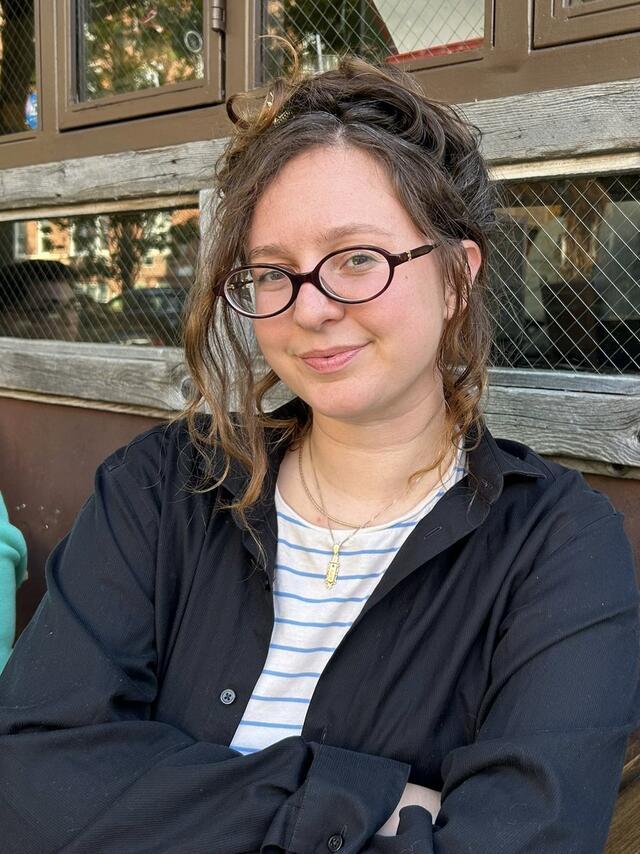
JOELLE MAXX MILMAN (b. 1995) is a writer, poet, and translator of Modern and Biblical Hebrew. Repartings, her debut book of poetry, was published in 2026 by Ben Yehuda Press. Joelle has worked extensively in activist spaces, notably as lead English writer at Breaking the Silence. Joelle has lived on the mountains, in holy cities, and by the sea. She lives in New York. joellemaxx.com
Sivan Lavie: Your book is dense, cyclical, mystical, religious, sexual, sensual, and at once ancient and contemporary. It’s an exciting, niche mix. As someone not well-versed in religion but interested in the cutting-edge element of your writing, can you give us a layman’s account? To start, what does Haftora mean? What is the Book of the Prophets, when are they read, and in which ways are these biblical texts significant?
Joelle Maxx Milman: Dense, cyclical, mystical, religious, sexual. I’m so happy to hear these words as an immediate collection around the text because that means I’ve succeeded – and because I think they apply to the ancient text of the books of the Prophets, which Repartings is based on.
The books of the prophets are a collection of texts in the middle section of the Tanakh, and they feature the leaders – the prophets – who lead the Israelite people from the time period when the Jews entered the holy land after leaving Egypt up to the expulsion of the First Temple, a time period of roughly 820 years. There are all sorts of prophets in these books, from warmongers to mystics to judges, all of them relating differently to the patch of land they sit on and the time in which they fall. The prophets are kinky and miraculous, writing in stunning language that haunted me to read – a doe skidding across the shambles of the sea, the tumbling brush under the fig leaves and olive trees. Importantly, they most always stand in opposition to the corrupt powers of the time, and call for a vision of justice.
In my late twenties, deep in the world of solidarity activism in Israel-Palestine, I saw the words of the Torah used all around me to justify unjustifiable violence against Palestinians. Understanding the depth of this violence was a process and a heartbreak, one that led me to recommit my life to solidarity. It was from the depths of this work that I (re)discovered the Books of the Prophets. The injustices of that time – as ours – were plenty: poverty, corruption in places of religious authority, religious infighting, lack of faith. The prophets were especially disturbed by the lack of faith and misinterpretation of biblical commandments. As I was myself in the rocky land where the books took place – witnessing all these sins around me, justified in the same biblical language – these texts spoke to me directly and gave me a way to, at minimum, understand and at maximum respond to the cycles of biblical time.
The haftora, then – as some readers may know if they’ve had a bar mitzvah – are selections from the books of prophets read aloud in synagogue every week. I grew up orthodox, so I never did this – reading aloud in public was for the boys. So when I came to these texts as an adult, enmeshed in a lived reality that mirrored the environment of the text, I felt very free. I was free of the structures of a bar mitzvah, free of a rabbi telling me how to read them, free of anything except my own exact interpretation. Following the weekly Haftora structure entirely on my own accord was such a cool way to engage with these texts – free of dogma, pure to my own reading, and immensely powerful. Repartings is what came out.
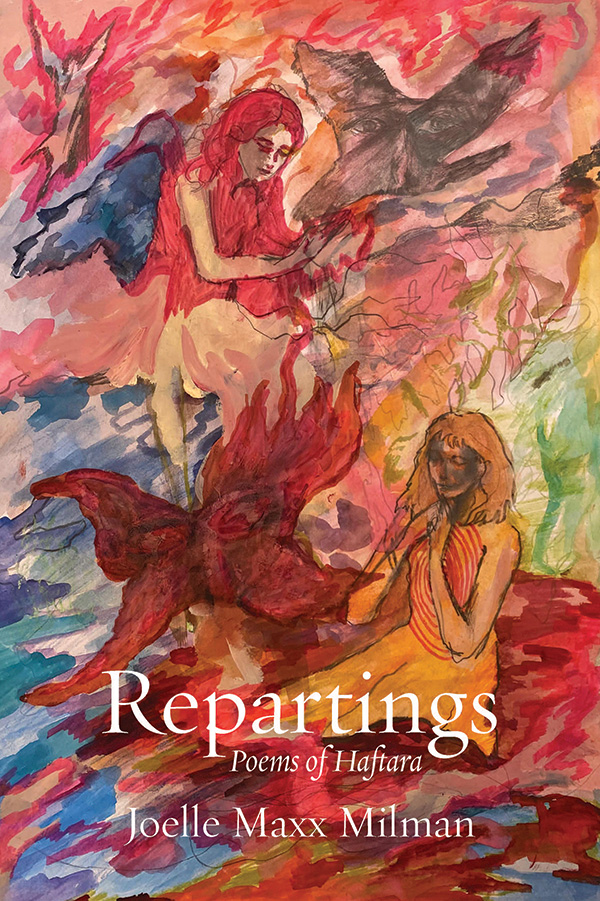
Every poem is your intuitive take on the weekly Haftora portion from the Book of the Prophets, and on the opposite page is your original translation of that same Torah portion that inspired the poem. What was the process like of free-translating biblical Hebrew? What inspired it?
Free-translating the Bible is letting God in your body and letting her rattle your organs. It’s such a primordial series of sounds, Hebrew, guttural and honest and immensely punishing if not approached with a little bit of romance. Like the best and most toxic of romances, biblical Hebrew will fuck you, caress your cheek, go deep in your throat, send you presents, show you how every thought you’ve ever had is connected to the heavens, leave you out to dry. God, I loved to translate it, and I loved translating it free.
Two interesting technical things to know that may appeal to the casual reader (from a lover, not a scholar):
1. Hebrew is built on a maximalist system of “shorashim,” or root words: these are typically 3 (occasionally 2) letter words that have a core meaning that can be refashioned again and again into different words that exist along the same lexicon. One example of this that I love is P.R. Ch., “perach”, which means “flower”; the word “Preiccha,” which is that root in an alternate noun form, means “bodily rash.” The first time I translated the word Preichaa, in a poem by a writer I can’t remember, I was so struck by the image of a rash sharing the same root as flower: of a rash of a field of flowers, of the rash blooming across a body, of how beautiful the rash became. Free-translating biblical Hebrew, I noticed these repetitions again and again, and oftentimes they made the sentences more sensual/explicit in their nature than my childhood rabbis would ever admit – God touches us like water quite a bit! Sometimes I’d make a choice about a root interpretation in one place and then replicate that translation in another place, even if it was less correct and changed the meaning. This was so much fun.
2. The Hebrew bible is written alternately in poetry and in prose. If you want to go deep on this distinction and how it works, treat yourself to a Robert Alter translation (btw I don’t have a copy yet if anyone wants to sponsor me!) I wrote everything with some poetry in it, also for ease of formatting, which was fun for me, playing with the enjambments. But the more prosaic bits did then inform my poetic translation in my own personal, secret way. I encourage the reader to do a reading, trying to identify where it’s poetry and where it’s prose. Let me know because I was so possessed in and by the project while translating that I probably forgot where it happens!
Can you describe your process for writing poems based on Haftora portions? How long did you spend studying these texts, and what was it like to have your poetry born from them?
I wrote free. I did not study them at all. This was the best part.
I grew up in an environment where approaching these texts took tons of advanced knowledge, where to truly approach and offer commentary you had to be a boy, be wise, blessed on the head by a rabbi, bar mitzvah’d, and also the smartest kid in class. These texts were very scary to me to approach for many years because who was I, just a girl – impure – not learned – I went to public high school, even – -who was I to write about these things with gravitas?
When I was asked to write the poems, I was free. Of course, I come from a background in modern and biblical Hebrew, and I know my fair share of Talmudic and Taanitic references, so I didn’t come in blank. A fun caveat of this is that the Haftora portion (that bit read aloud weekly in synagogue) doesn’t follow any specific order. The Haftoras are random bits of the books of prophets tacked on to the primary weekly readings for reasons alternately apparent and obscure. Thus, by reading free – and choosing a shul-sanctioned but somewhat random selection of text every week – I was able to approach these texts somewhat devoid of their own context, too. It’s not like I was attending shul, but this became my shul.
But the absolute freedom I gave myself in reading and interpretation was most fun and joyous and gave me the texts back to myself. Then I realized they had always belonged to me. I highly recommend it.
Could you talk about the work’s looping, cyclical nature? Each poem is incomplete, feeding directly into the next one. There’s also a lot of walking, rolling, spinning, curling, swirling, and gyrating, a sense of perpetual circular motion. Why this interesting choice?
I find biblical texts to be deeply embodied and very sensual. Very sexual. It’s a known thing that Songs of Songs, an erotic poem, is taught to children and the ultra-religious as a love story between God and the holy land, which de-sexualizes it, but … c’mon. Read any sentence. We know what this is!
Writing Repartings was a way for me to enjoy this very much, to get deep into the language and sensuality of the text and play in there, play freely and frankly. Many of the prophets are kinky, too – God ties them up, pulls their hair, flies them through the air, chases them into the sea, promises to open them up like water.
While I think one potent way to read the text is through the political angle of the prophet – which is one of the main ways we understand prophetic texts – I hope this text resonates for anyone involved in embodied mysticism, too. I think these poems also follow the moon cycle, the menstrual cycle, in their rise and fall through the seasons; the poems deeply interact with the moon; the spiral in and through time.
Your poems beautifully synthesize your contemporary surroundings with the ancient. The poems sound like prophetic prayers. Can you say more about the symbologies of the ancient and present day? Nature and city?
In my deepest wish, these poems function as prophetic prayers, so I thank you so much for the reading, though – as I’ve mentioned above – I couldn’t consider myself a prophet. I’m a woman, and I’m unmarried as of yet, and thus I am impure, so God let me write free.
I think of Louise Bougouise’s spiral, the spider, circling; I think of the Hebrew calendar, making loops in circles around itself; I think of the cycles of time, of Jewish time and world time, and how often we repeat ourselves. I think of how much we are all obsessed with “storytelling” these days, but I’ve always found that a bit of a cop-out to real life, to real experience. Narrative only ever comes later; it’s only ever the overlay we put on in the aftermath to understand what happened to us. The circle, the cycle, the spiral, is a lot more like life, a lot more like how we move through space and time. In these days, 2026, I recognize where I am in my own spiral times, the patterns I’ve made before and the very real ways this time looks different.
So are the ancient and present so different? I don’t think so. I think a lot of the binaries that the world tries to put on us – nature vs city, old vs new, then vs now, good vs bad – break quite quickly as soon as we look at it a bit closer. I hope Repartings – by engaging genuinely with an ancient text and owning so fully, so embodied, in our time – can help the reader understand that all these binaries are just binaries. So much more is happening all at once.
I know that you originally wrote these poems for a Los Angeles synagogue’s [Der Nister] newsletter, in 2022. How did that opportunity come about? How did a synagogue community receive your scandalous, raw, sexual, sometimes queer poems? There’s a lot of begging God to fuck you in there.
This whole thing was such a blessing, all made possible through Rabbi Zach Golden of Der Nister – a talented writer, Yiddish translator, cultural spacemaker, and thinker in his own right who is dedicated to building an alt-space for contemporary Yiddish culture in DTLA.
Zach and I struck up a friendship in a funky time in both of our lives, right as we were both rebuilding. I was lucky to get to know Zach and Der Nister at that stage. At the time, I was very afraid of publishing, and Zach asked me to be the poet-in-residence at Der Nister.
I can’t speak for every synagogue member, but I think it was received pretty well! I know there were some particularly risque moments that Zach had to push for, but everything was published uncensored. Two different publishers approached me to publish the series based on this newsletter, so I can guess it was well received. I’ve done a few readings for Der Nister on the topic (one you can listen to here!) and it was particularly special to meet the readers who had followed along on their own accord.
What is the importance of Repartings today? Are the poems trying to create some sort of magic? They read as ecstatic, prophetic prayers or spells.
Ugh, thank you. It’s funny to have written such a mystic book, a spellbook, and to promote it a few years later – my alters now look different than the alters I held when I was writing this.
But Repartings comes with her own alter. It is a table of red velvet, with black and blue silk; on it is milk, blood, pomegranate, wine, and the rough stones I’ve picked up from the hills outside of Massafer Yatta. I want anyone who has ever enjoyed and screamed at God about blood to know these poems are for you. In my deepest wish, I hope Jews who support the ethnic cleansing of Palestine read it and realize they have gravely sinned. The thing about the prophets is that, canonically, they are ignored. They are exiled. They are hated, spat on, forgotten, because who is going to tell the man in power that the way they are doing it is wrong?
Since publication, Repartings has been meeting her readers. I receive emails from people who’ve read it and understand it. One reader in Los Angeles wept behind me onstage as I read them aloud. To meet these readers is a gift among gifts, the whole point of this entire exercise of writing and exorcising the work of my throat. I hope the poems encourage their readers to come into the tent and strip naked, touch body, touch fruit, touch God, and remind us we can live differently, if we so choose, if we so make it.
I hope every reader knows that these biblical texts belong to us all. No one owns the land. By this I also mean God. God is all of our inheritance.


Be the first to comment