
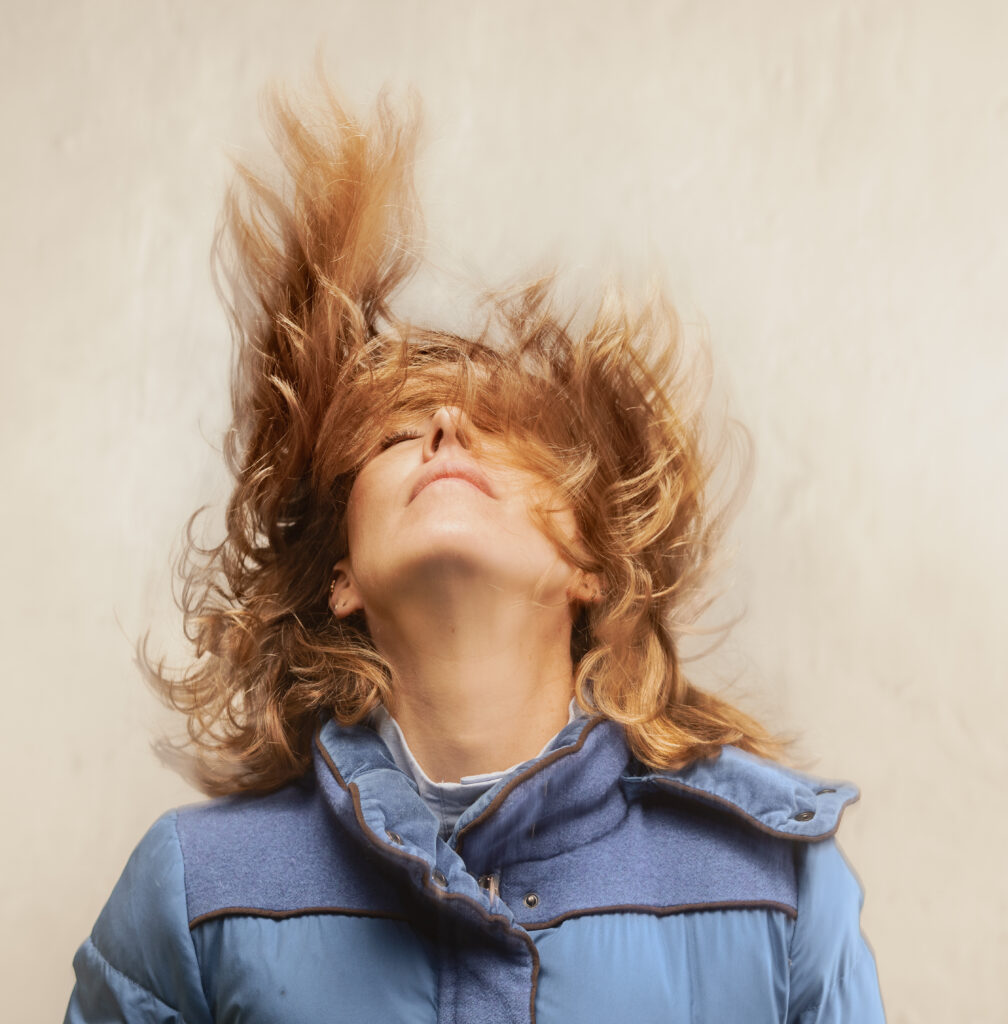
Ana María Caballero is an award-winning Colombian-American poet and multidisciplinary artist whose work explores embodiment, memory, care, and the literary implications of emerging technologies, while reimagining the book for contemporary, digital worlds. She’s written eight books, five of which received major literary prizes. She’s exhibited or presented her multimedia poetics at leading venues worldwide, including the TATE, V&A, MoMI, Times Square, and Fundación March. Her debut novel, /Cuts, received the 2025 Clay Reynolds Prize from Texas Review Press. The Francisco Carolinum Museum in Austria is currently presenting her first institutional retrospective, Read the Room.
A cut is, for the most part, a permanent action; you allude to this in the epigraph of the novella, “measure with care because / you can only make / a single cut.” Though a cut cannot be undone, it can be mended. Could you please tell us about the opportunity for art to mend, to connect?
I believe in the transformative power of language. Not in the sense that writing can undo lived experience, but in the sense that it can change our relationship to how we understand and relate to our histories, to our days. We can’t revise our lives the way we revise a poem. But we can rewrite the stories we tell ourselves about those lives.
Lucía, the main character in /Cuts, turns to writing as a way of grasping her past and reinventing her future. The book wagers everything on literature’s capacity to affect that which we call “reality.”
In “itinerant’s itinerary,” you write, “This book says—to you who sharks it with your hands—read me, create me, as you want.” How do you think about the role of the reader in the “creation” (to use your term) of your work? How do you feel about giving/relinquishing a work to the public?
No two readers experience one book in the exact same way. In this sense, readers co-create the work along with the writer. As readers, we bring our personal histories to the page, shaping how we interpret it. I term the creative relationship between writer and reader analog generativity. It’s something I’ve become increasingly interested in through my work with generative technologies, which have, ironically, made me more aware that the written word has always been generative.
In /Cuts, the act of co-creation between reader and writer is explicit. The book invites readers to move through its fragments in whatever order they choose or to treat each one as complete. I’m not relinquishing the work. I’m acknowledging that the way someone will experience my book was never within my control to begin with.
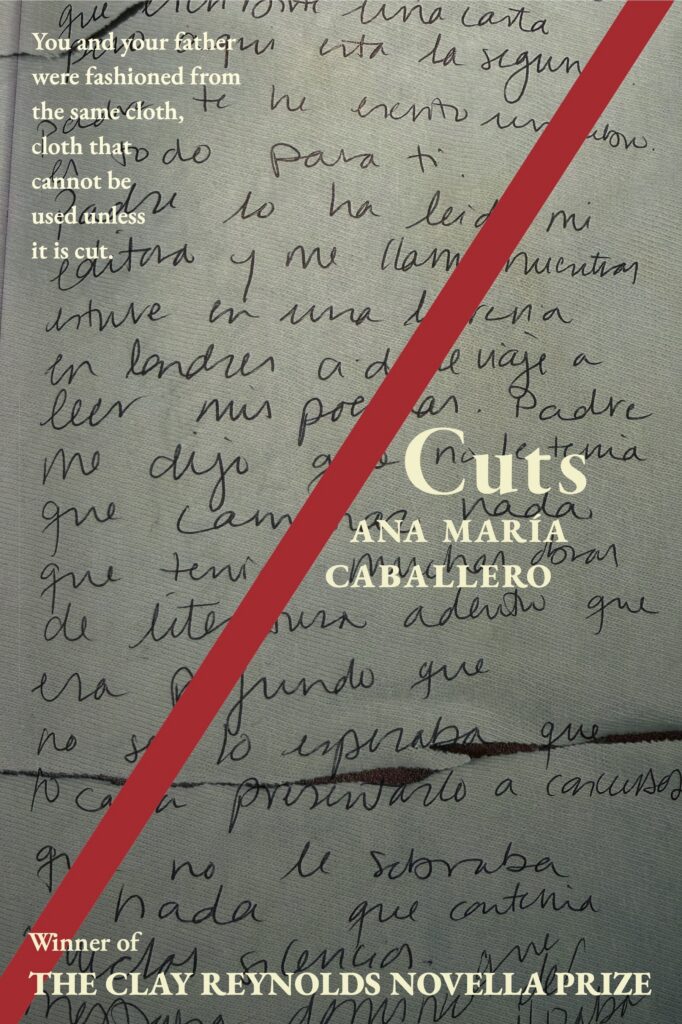
There are many allusions in this book to other authors. For example, in “/33,” the speaker declares, “I stole this matter of alternating narrative view points from Clarice Lispector, from her magnum opus Agua Viva.” Whose work do you see yours in conversation with? Would you call those writers influences?
Julio Cortázar is the most obvious presence. For a long time, I wanted to write a book in conversation with Hopscotch, particularly its radical invitation to the reader to construct the text. Clarice Lispector is another important influence. I love the way she allows the whims of consciousness to move through language without feeling obliged to justify herself.
I’m also devoted to Anne Carson. Reading her taught me that the boundaries between poetry and prose have more to do with our need to classify than with literature itself.
The literary references in /Cuts aren’t about naming influence. These writers populate Lucía’s inner world. She understands her life through the books she’s read. Literature is her biography.
In “/3 / The fact of having children,” you’ve composed an accumulation of phrases following the formula, “The fact of + [verb-ing] + them.” How does accumulation inform your work? Why call these actions facts? What is important about the distinction between fact and action?
You hit the crux of the matter: the instability between fact and action that makes this poem necessary. We do things that we can easily file as “done.” We feed our children, bathe them, comfort them, discipline them. But what does it mean to have “completed” these tasks?
The repetition of the phrase “the fact” introduces a certainty that the actions cannot provide. We care for our children, but how do we know we’ve cared for them well? As parents, failure is implicit in almost everything we do. There’s always something we could have done differently. The list could go on indefinitely because the work itself is never finished. It’s never enough.
Belief comes up frequently in this book—in religious and secular contexts. For example, in “/9,” Lucia ponders the relationship between the Holy Spirit, God the Father, and Jesus. In the same chapter, she thinks about teaching her children the difference between story and fact. In “/65,” you write, “Writing a book is an act of absolute faith.” How are faith and art related for you?
Writing requires faith. You spend years working on a book without knowing whether it will amount to anything, whether it will be published, whether anyone will read it, whether you’ll say what you hoped to say.
I’m interested in the relationship between religious belief and literary belief because both depend, in different ways, on language. Prayer and writing are both forms of beseeching, of reaching into the unknown in the hope of receiving a response.
I find that the response, when it comes, emerges from within, through the very act of writing. This is the process at work in /Cuts, both for me as its writer and for Lucía as its protagonist. But the reader is also implicated.
By choosing how to move through the book, the reader participates in Lucía’s search for an answer. Lucía, the reader, and I work together with language to find salvation. Salvation of the self, through the naming of that self.
There are a few mentions of the Internet in this book. You write about emerging technologies for Forbes and other publications, and co-founded the digital poetry gallery theVERSEverse. What drew you to digital poetry, and why did you decide to publish /Cuts in print?
I became interested in digital poetry because I wanted to explore what a poem could become beyond the printed page. I’ve worked with sculpture, performance, video, installation, and generative technologies, but the poem always comes first.
Working with technology has prompted me to revisit the printed page as a sophisticated technological site, one that allows the reader to shift through time, redraw the past and construct meaning.
I think of /Cuts as an analog algorithm, generating new iterations of itself with every encounter. The reader moves through the fragments in any order, establishing connections that may not exist for another reader, even for me. Each reading is a generative act.
/Cuts is a lyric novella with many formal shifts throughout. For example, in “/13,” there is a shift to second-person for the first time. In “/14,” you go back to third-person. How do you think about the relationships between the chapters? The speakers?
In /Cuts, the boundaries between Lucía, the narrator, and the reader are fuzzy. Sometimes, Lucía is observed from the outside. Other times, the narrative voice moves so close to her that the distinction between narrator and character collapses.
The chapters operate as independent fragments, and their relationship changes depending on the order in which they’re read. A detail that seems incidental in one chapter becomes important later on. This structure resembles the way memory works. We don’t remember our lives chronologically. Memories arrive in fragments, often unexpectedly, and their meaning evolves.
The fragmented novel mirrors contemporary life. Our days are interrupted, our attention constantly redirected. We move between competing demands, rarely experiencing anything as a continuous line. Fragmentation isn’t a literary experiment; it’s a response to how we live and think. I wanted the reader to assemble the story, much as we assemble and reassemble our own lives.
There is special attention paid to the concept of dependence in this book—children’s dependence on parents, people’s dependence on alcohol, and even dependence between the Holy Spirit, God the Father, and Jesus. Where did your idea to focus on the concept of dependence come from?
We accept that children depend on their parents, and that familial love creates forms of mutual dependence. But other dependencies are often viewed as failures, even when they arise from equally human needs.
Lucía is trying to understand her dependence on alcohol in the context of a family where drinking has been normalized across generations. Meanwhile, she’s a mother whose children depend on her. As a writer, she depends on other writers, on language, on faith.
These relationships complicate any simple distinction between independence and vulnerability. We tend to think of independence as a virtue. But dependence is fundamental to being human. Even our sense of self develops through our relationships with others. The question is not whether we can free ourselves from dependence, but how we can distinguish the forms of dependence that sustain from those that harm.
The Holy Spirit introduces a kind of dependence that Lucía finds baffling because it’s presented as sacred. Religion asks us to depend on something beyond our understanding and view it as a source of strength. It’s a wonderful contradiction.
In /Cuts, the naming of vulnerability is a prerequisite for salvation.
You may also be interested in:
Mohammed Zenia Siddiq Yusef Ibrahim discusses BLK MSM
The persuasive intuitions of ANNE CARSON
The roles of language in ritual & tradition: Anne Waldman on her new book MESOPOTOPIA
kathy wu discusses their debut book SHE WILL LAST AS LONG AS STONES

Be the first to comment