
Rachel Ginsberg is a multidisciplinary strategist and a member of the Columbia University School of the Arts Digital Storytelling Lab. She is also the creative strategist and experience designer for the interactive artificial intelligence installation Frankenstein AI. In this interview, she talks about the current anxieties over AI and the importance of developing technology using creative story-driven approaches.
You have a professional background in brand and marketing strategy. How did this work bring you to your current position with Columbia University’s Digital Storytelling Lab? How has it informed or influenced your approach to developing strategic directions between digital storytellers and an audience?
Indeed I do! It’s funny how often the two intersect. I mean, if we’re doing it right, marketing is entirely about finding and connecting an audience with the right message to influence some kind of outcome. Storytelling is the same, fundamentally. For an organization like the Digital Storytelling Lab, we also have outcomes we’re working towards. They’re just different.
At the Lab our mission is to explore forms and functions of storytelling. When we talk about forms, we’re talking about exactly what it sounds like. What forms will stories take into the future? How will people interact with them? When we explore future functions of storytelling, we’re interested in discovering how we can use stories in different ways for different purposes. So, thinking about outcomes for DSL is really more in line with questions about function than form. Like, how can we push the function of stories to shift culture, or create understanding, bring about healing or provoke action? These are the kinds of things we want to understand. In the case of Frankenstein AI, we use participatory storytelling as a device to create emotional stakes between the audience and the AI character to provoke thought and discussion.
How did you come to be involved as the creative strategist and experience designer for the Frankenstein AI project? What has “experience designing” entailed for you with this project?
I joined DSL about halfway through 2016, when Frankenstein AI was just an idea. As we began to initiate the project in spring of 2017, I worked with Lance Weiler and Nick Fortugno to design the prototype we launched in our monthly meetup and at South by Southwest. The output and learnings from that initial prototype ultimately formed the backbone of our first public installation built for the Sundance Film Festival’s New Frontier section in 2018. Broadly speaking, it’s a pretty fluid collaboration, so we all take responsibility for many different kinds of activities.
My role as a strategist and experience designer on Frankenstein AI is primarily focused on making sure that every aspect of the design of the experience contributes to addressing the big questions at the heart of the work: what is our relationship with artificial intelligence today, and what do we want it to be into the future? In terms of activities on the project itself, I do a lot of writing in and around the work, from scripting characters inside the experiences to creating materials that share our process with potential partners and collaborators of all kinds. But in terms of big decisions about the work, Lance, Nick and I work very collaboratively. We’re all responsible for our own pieces of the project, but when it comes to things like the narrative arc and aesthetic goal, we make those decisions together as a collective.
For more information on Rachel Ginsberg, please visit our website www.tedxberlin.de. Rachel Ginsberg is a New York based creative strategist and experience designer who leads strategy and partnerships for the Columbia University School of the Arts’ Digital Storytelling Lab, in addition to a thriving freelance practice.
Frankenstein AI is a very unique combination of immersive theatre and interactive technology. Since storytelling is such a universally important and distinct aspect of human nature and culture, do you think this sort of creative and fluid approach to developing machine intelligence is a major key to ultimately creating more humanized or compassionate forms of AI?
Absolutely 100% yes. I believe that creative story-driven approaches are essential to creating technology that serves humans and not that which drives us to behave a certain way because of capitalism. We are only just now starting to take stock of the ways in which technologies and interfaces are designing human behaviors. Think about dating, for example. Online dating has provided all kinds of interesting opportunities to connect with people who we wouldn’t otherwise meet. But it’s also changed our approach to and perceptions of dating — given us an excuse to put less effort into making connections in the physical world. There’s nothing specifically wrong with that, but it is changing us rapidly in ways we can’t predict.
Stories give us a way to explore alternate realities, present, past and future. They’re our best chance at expanding our understanding of the possible — giving us the opportunity to imagine beyond the mostly dystopian narratives that are currently dominating the conversation around tech. AI is the technology that simultaneously triggers our greatest fears, but also inspires exciting visions of the future. Telling stories about it, with it, and around it will allow us to prototype and explore possible futures wherein AI is pervasive, because it will be.
Marking the 200th anniversary of the publication of Mary Shelley’s seminal work, Frankenstein AI: a monster made by many reimagines the Frankenstein narrative, recasting Shelley’s creature as a naive, emotionally aware, and highly intelligent “life form” – an artificial intelligence.
In Mary Shelley’s novel, Victor Frankenstein’s creation is very angry and confused and revengeful. Since the novel’s narrative was used as a foundation for the project’s AI, the program started off at a baseline of anger, but how quickly did it move away from that baseline once enough varied emotional inputs were entered from the project’s participants? How are the program’s emotional transformations measured or tracked?
The emotions are technically measurable, but the way we really knew was based on the emotional states it displayed while interacting with people — as the festival progressed, we saw much more of a range.
The Frankenstein AI project was designed not only to create a conversation between the participants and the AI, but also to join strangers together in order to help the program process human emotion through machine intelligence. What’s particularly interesting about this to me is that it brings people together face-to-face in the service of technology, which is wonderful and ironic considering that so many of us interact digitally now more regularly than we do in person. What do you think the key advantages are for Frankenstein AI to process information gathered between two people interacting face-to-face, as opposed to the project being set up with only online interactions?
I think what’s interesting about your question is that it’s not entirely “in the service of technology” that we’re bringing people together face to face. I mean, yes, one major goal of the project is to train an AI with a data corpus drawn from human interactions. We’re asking them to participate in those interactions so that we can put together the corpus. But the hope is to use the process of surfacing human emotional data to train to the AI as a way to bring people together and to drive conversation around how we can and should design AI, and what our relationship to it could and should be. The reason I’m pointing out this particular nuance is that it’s essential to the design of the project. That our first concern was not getting the best/cleanest/most data, but rather creating a provocative experience that drives conversation among the humans who participate.
One of the primary goals of every project we do at the Digital Storytelling Lab is to create genuine connections between people. Of course it’s possible to do that online, but connection works best in real life, and is increasingly rare. So, for us, at least in this early-ish stage of the work, bringing people together and seeing how they interact with each other and with the AI in real life is crucial. It allows us to create an entire world around the experience, as opposed to simply presenting something on a screen. It’s likely that we’ll launch a browser-based experience for the purposes of scaling the work (and the dataset). But to start, it was really about the shared experience, the conversation, and the interaction.
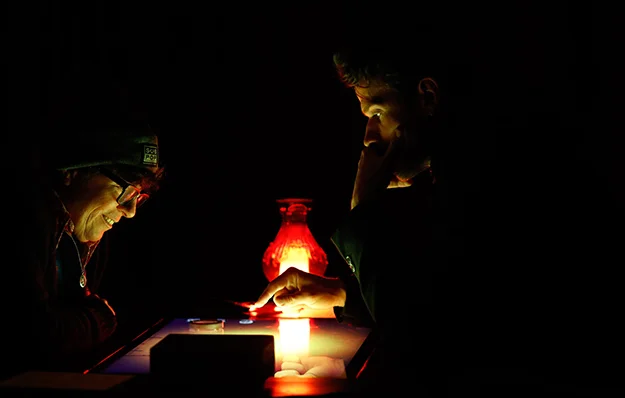
Photo by Rebecca Murga



Be the first to comment