
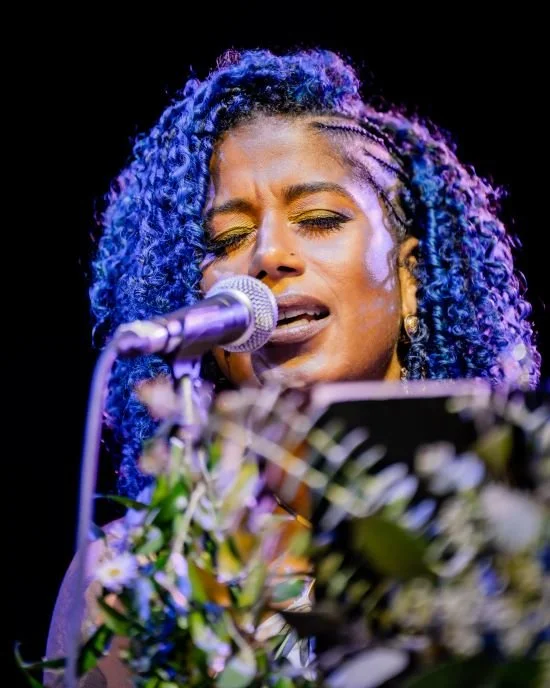
Photo by Dervon Dixon
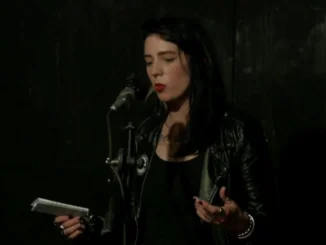
aja monet is a poet, lyricist, writer, and community organizer from Brooklyn, now based in Los Angeles.
Her debut studio album, when the poems do what they do, was released in 2023 to acclaim, and it has earned a GRAMMY® nomination for Best Spoken Word Poetry Album.
Let me start by congratulating you. You’re up for a Grammy for Best Spoken Word Album for when the poems do what they do. How are you feeling about that?
I don’t like to get excited about things until they have come to pass…I hope that it leads to more people taking the work seriously and that the resources that are needed to span the vision and the execution of the work is made more possible, because these sorts of awards really matter to people in order to legitimize one’s craft, so to speak.
I’ve been doing this for a very long time, and it feels surreal to be nominated for anything. I don’t believe I’ve been given much acknowledgement by big institutions that people respect in a global way. So yeah, I’m grateful. I’m also anxious about it.
On this album, you name-check artists and poets who have inspired you—Sonia Sanchez, June Jordan, and others. I think there’s an element of what you’re doing that’s like teaching. People may learn about or access those histories through you.
Yeah, I mean, that’s the hope. There’s a whole vast, vibrant history of people who used language musically and deepened our relationship to the social-political realities of who we are and how we identify in the world, to make truer the narratives that we come from. All the people that we know who are making records now could not have existed without the steppingstone of so many of these poets.
And it’s important to say poets. Poets made it possible. A lot of poets made it possible for Black music to exist in the world as it does and had to be intentional about the strategy of how we would share our music with our people in a way that would uplift and encourage rather than denigrate or destroy or delegitimize or devalue our existence. And it feels strategic that so many of our – how do I say – architects have been erased from the public narrative. And they really need to be taught so we can have a fuller story about who we are here together.
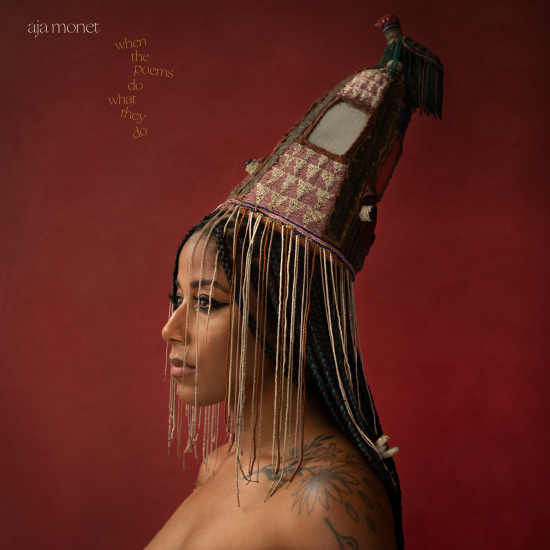
when the poems do what they do – drink sum wtr
And not just the history of poetry and music, but also African spirituality, which was literally demonized for centuries by Europeans. You explore African spirituality on several of these tracks, especially the Yamaya track, which is very beautiful. And on your album cover, in the photograph by Delphine Diallo, you’re wearing a Yoruba crown.
It seems like a lot more Black artists are embracing African spirituality nowadays. I think for so long, people who grew up in those traditions practiced them in secret, right? But there’s been a resurgence of people openly wanting to get back to those roots. I was wondering if you could talk about your own relationship to spirituality.
Yeah, I don’t know that it’s so much that it was in secret. I think that whenever mainstream media is unaware of something, it presumes that everyone orients the world from that lens. And it’s just not true. The white gaze, the white perspective, is not the way that most people exist in the world. And so there’s a lot that people don’t know, because they assume the center and create and mandate based off of that perspective.
I will say that many of us have been brainwashed or conditioned to not love ourselves, our origin stories, and how we came to be. So, there has been a resurgence in people doing the work to further interrogate that sort of colonization of the psyche and of the interior world. Once we got the chains up off our wrists and ankles, we had to spend centuries trying to get the chains off our minds and spirits.
And I think that that is perhaps what you’re noticing, or contending with, is that there is a concerted effort for people to really understand who we are and how we came to be here and what our connection is. Because certainly the way of the West, or of the mainstream, is not helping human beings de-escalate harm and violence and war and racism and oppression. So, we are seeking to return to a way of being that honored our presence with one another and valued the love shared between us, and other forms of allegiance that are not just tied to our individual gains. And I think that that is what’s so beautiful about it.
For me, I grew up in a household that was always African in the function of how we talked about spirits and people in our families and the politics of the time and the ways that ancestors show up in divination. Of course, when I went off into the world as a child being schooled and indoctrinated into the ways of the Western school, I didn’t always feel seen or affirmed, but I knew that there was something else that they weren’t telling us. I always knew that there was another way of looking at the world that was not being introduced or invited into the conversation.
So, part of the power of our spirituality is also in its—I don’t want to say invisibility—but in its ability to remain an engaged witness and not so much a dictator of other belief systems or other ways of being. I think the power of African spirituality is that it remains rooted in bearing witness to the way of nature and the cosmic awe of our presence here together, rather than the idea that one has to proliferate or campaign for followers or believers. I think that when one lives out their life and comes to the truths that African spirituality reveals, eventually they will always have to go back to the source.
That’s beautiful. Everything you say has so much beauty and wisdom and precision. Now, at one point there, you brought up war and racism. In addition to being a poet, you’re a committed activist. You’ve done work on various issues, but one that’s close to your heart is Palestine, which you visited over a decade ago. Can you talk about your activist work and how it commingles with your poetry? And if you want to talk about what’s happening in Palestine…
Yeah, I think what is most important to note and delineate is that many people identify in many ways these days, but I do not take credence to the title “activist.” And it’s only because I think it’s inaccurate about what I do and how I move in the world and how I see what I do. I’m more invested in the deepening of relationships and connections in our lives that are necessary for us to assess how we govern this existence here together, how we navigate, how we restore relationships, how we de-escalate harm. Those are very specific questions that I am contending with, not just in my poems, but in the real relationships in my life.
And so, to me, that’s a tradition rooted in more of a community organizing practice than an activist tradition where people kind of come in for an issue and respond to the issue and then there’s not a real committed effort to anything beyond the response.
So, when it comes to Palestine, my relationship to Palestine, my orientation, my work, my commitment to Palestine is rooted in deep, real relationships with people who I am invested in, and their vision and voice for a liberated people. I’m invested in understanding why my friend Tahani Salah wrote poems about the demolition and displacement of her people from their homes. I’m invested in trying to be more aware of how her listening to my struggles as a Black person in this country can deepen my ability to show up and understand her struggles. And therein, over the years, seeds have been planted where I’ve become more aware of systems of power and colonization that are at play, that work themselves out in deep, personal, intimate relationships where people have lost family members, have lost lives, and have literally been incapable of living decent, dignified, loving sort of lives.
That sort of engagement is really about deepening your relationship to the people around you and realizing, well, actually, solidarity is not so much about whether or not I can see myself in your story and your struggle, but it’s about how we share visions around our self-determination, around our joy, around our values for a life of dignity.
And so I say that Palestine is an extension of many concerns in my life, as a person who feels deeply, who seeks to examine my own convictions, who is invested in beautifying and observing the world and the vast abundance of resources that are available to us and how to make it so that all of us can live with dignity and live out our lives, loving the people we love and enjoying the people we enjoy.
And if that makes me an activist, I mean, I don’t know how you could be anything else as someone that grows in the world.
Well, I feel like nowadays a lot of people in the world are very alienated and isolated and lonely, and there’s been a loss of community in a lot of places. In some ways I think that being able to build community the way you’re describing is itself a political act. I feel like there’s a reason why, for some political leaders, it’s convenient to have people just go to work and come home and watch TV and not have a strong network of other people.
Oh, yes, yes. Well, what you’re discussing is something that is contextualizing what I’m saying, which is that we exist in a society that is hyper-capitalistic, individualistic, and betting on our lack of care and consideration for each other. And so, therefore, to create and co-create and collaborate and discover solutions to the real world problems we have together would seem, to the powers that are invested in our division, to be contradictory to that. But what we know to be true is that greed and power corrupts, and it does not lead to a more equitable, loving world.
It is in fact suicidal that those who have abused power, who are greedy and individualistic and who are more about attaining and attaining, and privatizing and privatizing—it is very suicidal that they keep dwindling resources away from the public and are trying to garner it all for themselves, because what do they think is going to happen, ultimately?
As human beings, we are behavioral, emotional, psychological, spiritual creatures. So, at some point, with all that greed, there will be a counter. There will be an opposition to that. There is. There always is. So, yeah, it is political. Anytime that one is invested in trying to think about how we facilitate and govern and redistribute resources…let’s be very clear, we live in abundance; this is a planet of abundant resources—anytime that we are trying to make that more equitable for all people, that is a political act.
If you’re concerned with clean water, fresh water, then that’s political. If you’re concerned with housing and how you’re going to keep a roof over your family’s heads, that’s political. If you’re concerned with education and what’s being taught to your children and things that you are concerned that they learn and that they know about, if you’re concerned with the environment and the planet and the trees and the birds and the bees and the fishes and the ecosystem that allows us to continue to live, I mean, those are all things that are political, certainly.
But what is naive or insulting about the people that seem in opposition to those things—it’s like, clearly you must be suicidal, because at this point, how can you exist on the planet and not be aware that the privatization, the exploitation of the land, the mistreatment of individuals will eventually lead to your demise? I don’t understand why some of us are singled out and made to seem exceptional for being human beings with hearts, for being feeling entities. I think that is the norm. It’s not the exception. They are the exception. And I think it’s important for us to re-orient ourselves in that way [and recognize] that there are far more people who want the world to be a place where people are safe and have access to their basic material needs and the ability to self-actualize themselves.
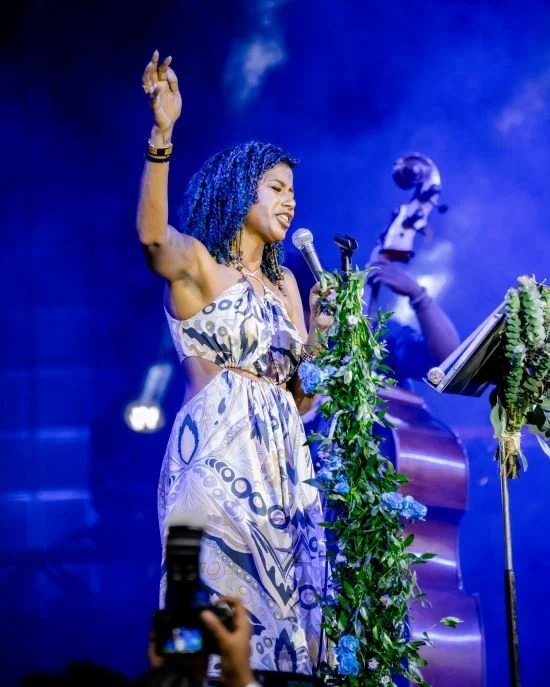
Photo by Dervon Dixon
We’re living in a time of increased censorship, and in my home state of Florida, in one school district, they just banned the dictionary…
[Laughs.] Oh, my God.
…along with over a thousand other books. The idea of banning the dictionary just seems so absurd. But what are your thoughts, as a person whose career is in words? And how do we respond to this moment?
Well, literature liberates, and we have very good examples. If I think of Florida, I think of the maroons and indigenous people prior who had to learn other ways of communication and inventing language around the reality of their lives, and who collaborated for the liberation of their people in Florida at a time when there was grave oppression and slavery across the country, across the states…
They’re doing this in the schools because they know that children have access to more information now. I think they’re trying to limit the information that’s available in the institutions that cultivate us and that train us up so they can make a more subservient and easily controlled public that can be swayed and dictated over and managed.
I think that Florida—the leadership in Florida, the politics in Florida—is invested in creating more zombies that can be walked into death camps. I think that that is clearly what Ron DeSantis is doing in his administration, right? He’s committed to and desires a people that is subservient to death and destruction, not to life and love and liberty and equality and justice—the things that this country claims to be founded on.
So, it’s a moment that all of us have to strategize. How do we all become grassroots organizers and invest in the love of community, the nurturing qualities of one’s neighbor, the dissemination of information that is true? What sort of schools need to be cultivated? I mean, Black people, we were segregated out of white schools. At the time, it seemed to be a horrific thing, but in many ways, it allowed us to understand what our power was—to teach ourselves, to organize for the ideas and the values that we have, and to learn about each other.
And so I think we have to respond to these moments sometimes by looking back to move forward, and to see how deep we can go. What do we decide to pay attention to? What do they want us to focus on, and what are we choosing to lift up and to celebrate and to give to the people?
How do you, as an interviewer, contextualize what you’re doing in this moment, in this time, to distribute the information and the truth that needs to be told? I mean, those are things that all of us have to come to question within ourselves. If we know a thing or two about the truth, then as we pursue it within our own realities, I think it’s our job, it’s our obligation, to remain committed to that pursuit and to help redistribute that information for others to make their own decisions for themselves. Everyone has a way to be useful, and we have to learn to value all skill sets that are in the effort of truth and love and liberation of all people.

Be the first to comment