
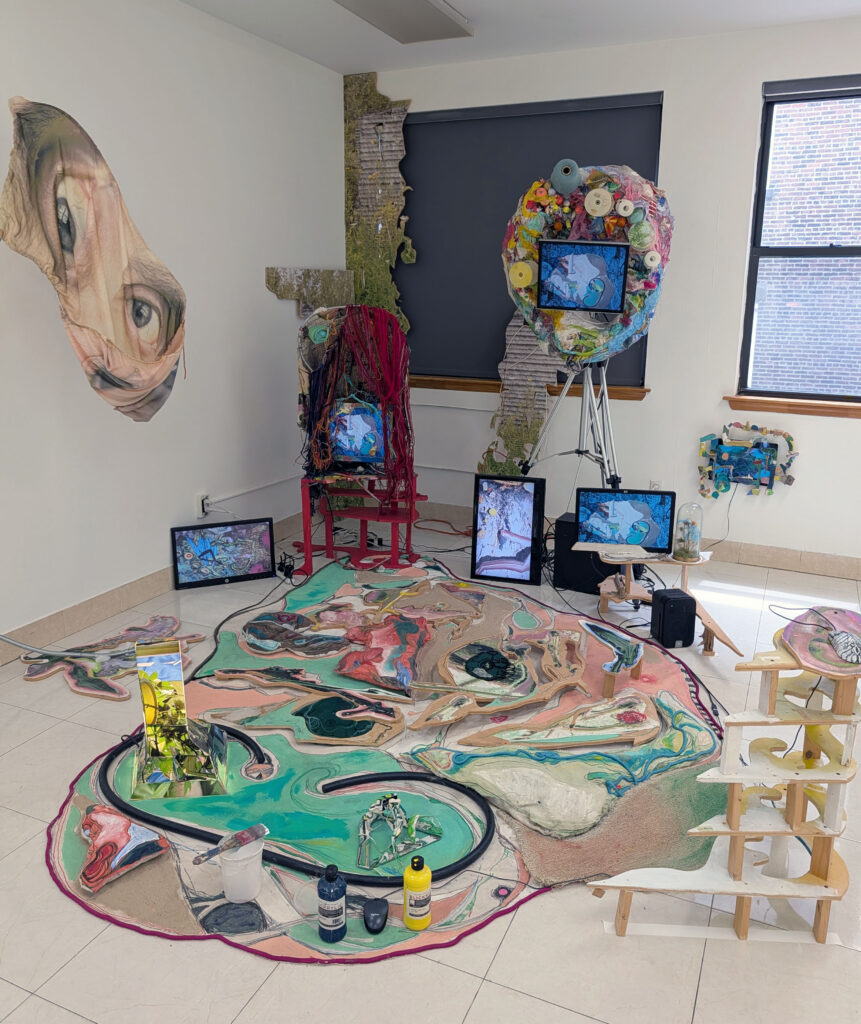
Brian Zegeer makes mixed-media sculptures and animations reimagining the relationship of humans to their lived environments. These works combine printed photographs and found objects into sculptures aimed at capturing the psychological resonance that charges a room, the history locked in a feature of the NYC geography.
Zegeer’s solo show at Underdonk Gallery is titled HEDONISTIC TREADMILL, which describes the human tendency to revert to a baseline level of happiness following extreme events in our lives. While understandable as a coping mechanism, this psychological trait calls into question our ability to calibrate our actions proportionately to elevating threat levels in our precarious age. Works in the exhibition set human agency against this gravitational pull towards complacency. This struggle is meted out within the systems of online culture that are optimized to exploit this rage/refresh algorithm. HEDONISTIC TREADMILL is up through August 2.
He also has work at the Skowhegan alumni group show OVERFLOW, at Gallery 198 in Brooklyn, guest curated by Andrew LaFarge Hamill. Overflow is a site-responsive exhibition that brings together 21 multigenerational and multidisciplinary artists inquiring into how we relate to the waterways that support contemporary city life. All participating artists are alumni or former faculty of Skowhegan, one of the nation’s most renowned art schools, located in rural Maine. Grounded in Skowhegan’s ethos of sustainability and shared inquiry, the exhibition asserts the artist’s role as an active agent in stewarding waterways. OVERFLOW is up through July 25.
Hi Brian, congratulations on the two shows you are currently participating in: your solo show Hedonistic Treadmill at Underdonk Gallery, and your large site-specific piece at Overflow at gallery 198. I’ll start by asking about your show at Underdonk. In its title, you refer to the contemporary hedonistic edging experience: being filled with adrenaline and perpetually returning to baseline, and its relation to the utopic-dystopic time we live in. Can you say more about this time we live in, and what comment this show is making about that?
We are all suffering through a gamified information ecosystem, the daily news cycle and social media algorithm, and are continually bumping up against the technologies that lock us into their loop. I read about this psychological tendency, the “Hedonistic Treadmill”, describing how we revert back to our baseline level of happiness despite the good and bad things happening around us. It got me thinking about the evolutionary value of such a disposition. Perhaps it contributes to the incredible resiliency of humans who manage to endure wars and natural disasters. It might be one of the qualities that allows us to redeem a quotient of joy from this insufferable world.
But on the other hand, I fear this reset reflex may be a factor in our complacency in the face of accelerating threats. The media ecosystem instrumentalizes our outrage to turn a profit, and trusts in our biological imperative for stability to preserve the status quo and deliver our attention to advertisers the following day. So carbon emission reduction commitments are scuttled with impunity, the empty suits we’ve conjured sign off on the next war, or on funding for the swarm of federal agents who abduct our neighbors in broad daylight.
The titular work in the show is meant to evoke the unending cycle between emotional peak and valley. Strangely, it started off in 2017 as a view of my open refrigerator, overflowing with leftovers and culinary experiments for a child who had just started eating solids. It was a tiled series of photographs on backlight film, illuminated by internal lighting, an elegy to the life support system for our little family pod.
Unsatisfied with the initial sculpture, I disassembled the work to reveal the wiring underneath, then over the following years built it up again with several papier-mache, organ-like structures amidst the exposed wires. I think the work evokes a kind of digestive system, filtering the daily load of biologics and information ruminants in a toxic mix of emotional peaks and valleys, endless limbic system cycling…
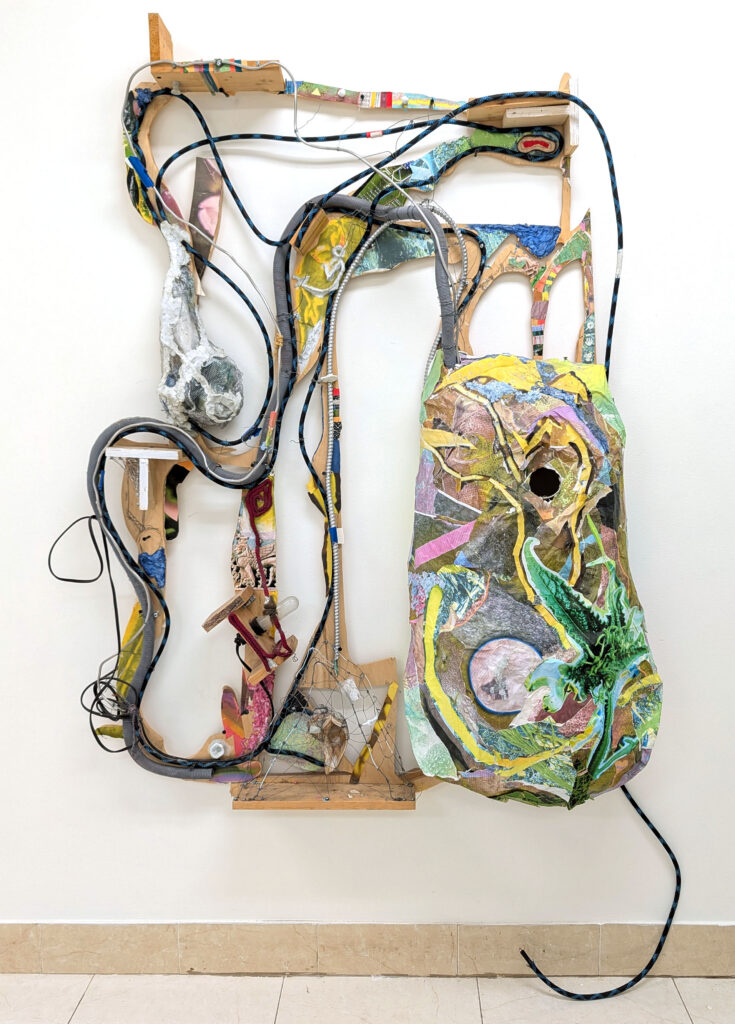
I’d love to ask you about the mashup of materials, styles, and visual worlds. As a start, your sculptures and paintings are beautifully eclectic bricolages. Here’s just one materials list for the piece Hedonistic Treadmill (2026): “pigment prints, papier-mache, galvanized steel wire, electrical and media cabling, vacuum hose, tempered glass shards, mixed media, lightning whelk shell, spool of acrylic thread, Magic Sculpt, domestic birch plywood.”
Please tell me about your material collection process. Where do you source these materials, and what attracts you to specific materials? Are there any particular combinations you’re looking for? How do you store them? How do you choose what goes together? Is there ecological or identity significance in the choice of materials, as in the message of your works?
There was a certain point around 2006-7 when I was squatting in an apartment in the East Village, a derelict place where the wood lathing was exposed through the crumbling plaster walls, and the place’s storied history imbued each scattered object on the floor with its own little aura. Also, the apartment was haunted.
I took a break from painting and began to make stop motion animations from the rubble in the apartment, literalizing the charge that these remnants possessed.
Rent may be unaffordable in NYC, but it is a perpetually blossoming archive of detritus that I think has inspired much of the best art of the 20th and 21st century. From the vintage bottles scuttling up from beneath the sand at Dead Horse Bay, to the Arabic records and curling pages of al Hoda living among the lizard tanks in Carl Antoun’s Little Syria Archive (which Karen and I helped document), to the infinite delights sparkling on street curbs on trash days throughout the city, there is little better for insight into a place’s history than the objects it sheds.
My work is an amalgamation of the limited set of material languages that I know (knot-tying, painting, papier-mache, stained glass, animation), combined with materials chosen for their personal significance or aesthetic appeal.
I don’t usually know what I am looking for, but the accretion of materials over time into a kind of formal cohesiveness is where I hope to land.
I use family photos, clothes that my daughter has outgrown, my own hair clippings, monitors found on the street. Materials for the Arts visits factor heavily into my process. I absorb castoffs from other artists on my studio floor. A Knights Templar sword, found in the hollow wall in my granddad’s basement after his passing, is like a 1000-watt bulb of aura that I don’t know what to do with yet.
I tend to break things down and cannibalize projects over time into new works. I’ve found a lot of energy recently in using cut pieces of plywood from old sculptures as templates to trace into new works, my own history becoming an archive to source.
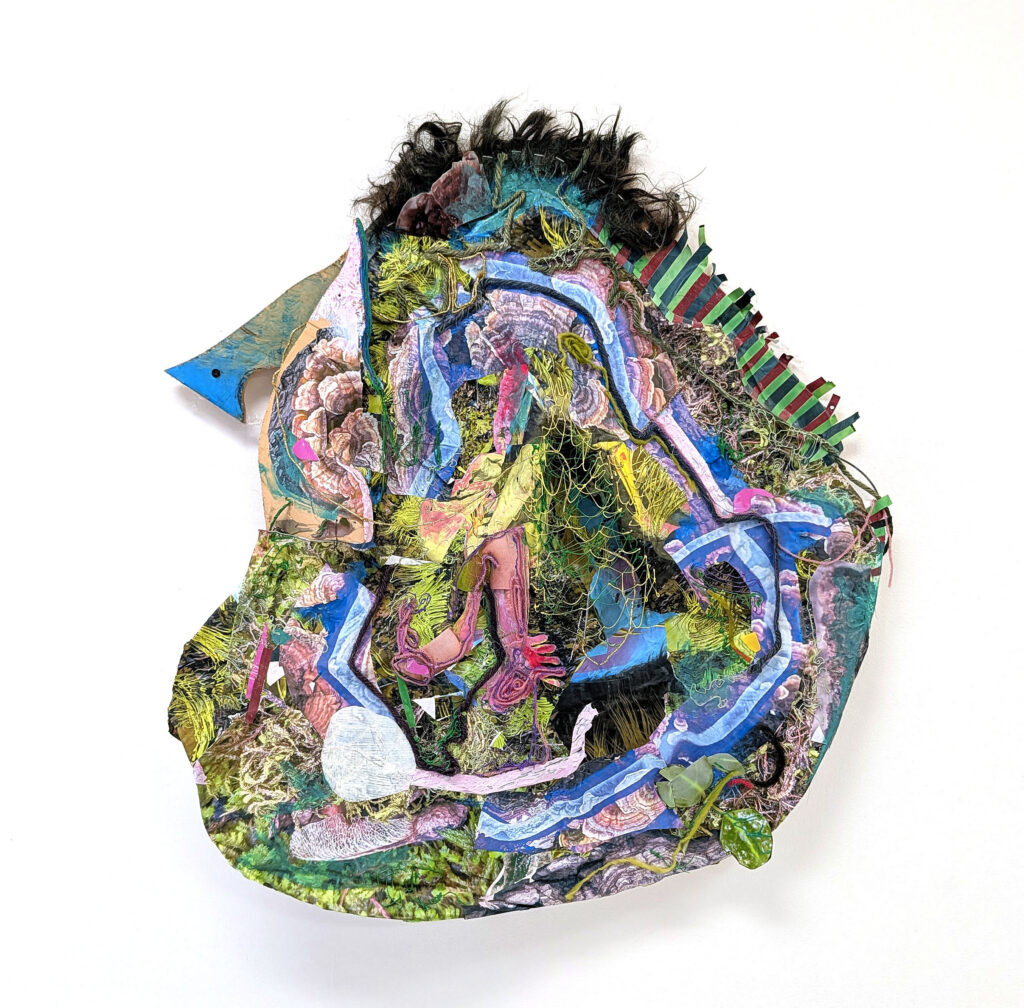
Your works are often a combination of makeshift lo-fi sculptures and paintings, with hi-fi psychedelic CGI, augmented reality, and 3D modeled video works. Can you speak to maximalism and oversaturation? Your work is an eye-catching layering of so many mediums, colors, and textures, like a glistening tapestry. How does this aesthetic serve the work, and why do you choose it? Can you say something about the way the lo-fi and hi-fi work together or contrast each other? Why do you need the hi-fi? What message does it send that the lo-fi does not?
I am predisposed to infill, allover, horror vaccui. I feel close to the geometric ornamentation of historical Arabic visual culture. The Alhambra x the Book of Kells, if aesthetic is somehow stamped by my Lebanese and Irish genealogy.
I grew up walking around in the woods in North Carolina, and the scrim of trees, the tremor of breeze-blown branches, the flash of the white tail of a startled deer–these experiences feed into my thrill at feeling immersed, and discovering rhythms in dense networks of detail.
When I’m in the studio, contrasts emerge in the different kinds of formal energies playing out in different areas, a flicker of animation in a field of draping yarn, the tension of a knot tangle versus a loosely-draped fabric. I want there to be continuity between different material components, parts weaving seamlessly into one another.
CG animation is too easy to make look clean and polished, greasing the friction of a critical eye until it recognizes only the familiar tropes of popular cinema. I try to work against this sleekness by using my own photos as textures of the 3D meshes, or colliding objects together in virtual space until the computational physics fails in beautiful fragments.
I make sculptures, then animate the sculptures using stop-motion techniques, scan the sculptures into CG environments, and print screen captures from the 3D environments to live among the physical sculptures. The continual translation between analog and digital helps to narrow the gap between these languages.
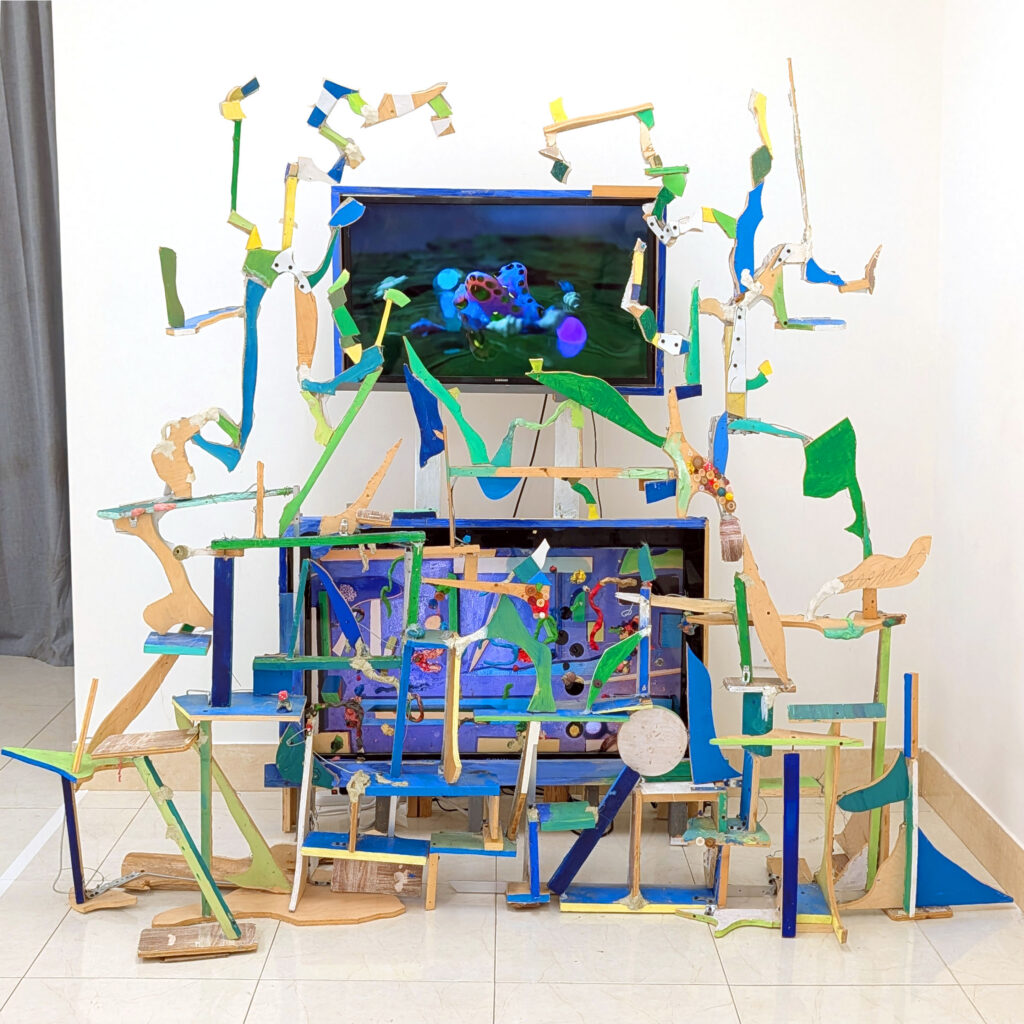
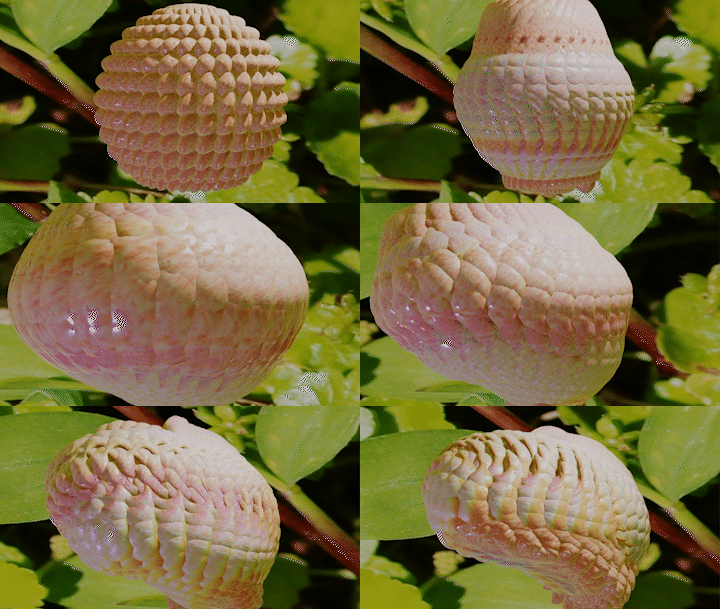
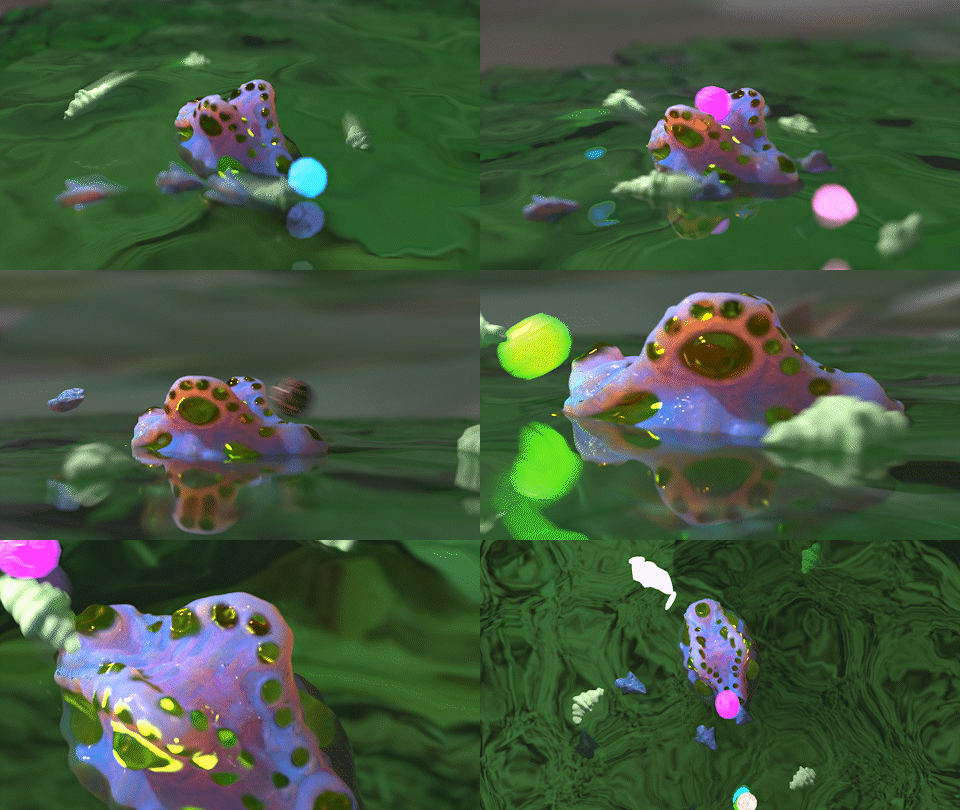
When I look at your work, I think mainly of Pipilotti Rist, Tony Oursler, and also of Frida Kahlo for the body-size, perspective-shifting surrealism. Which contemporary and historical artists are you looking at? Why? Can you recommend some Middle Eastern artists who’ve inspired you?
Rist and Oursler are big influences. Oursler’s outdoor projection on tree foliage, woot! I feel constantly swarmed by these influences, an imaginary circle of critics. I keep a list of contemporary artists I’m worried I will parrot too closely. But in terms of enduring influences, Saint Hildegarde taught me the notion that the body can be scaled down to navigate miniature worlds and up to embrace the cosmos. My relative Ameen Rihani gives me a model for interrogating Arab-American identity with his twin protagonists in the Book of Khalid. Sheila Pepe guides with infinite expansions in space through a drawn line; sculpture can be a kind of map of a social web. Janine Antoni, Tim Hawkinson, Arthur Simms for the object memory, an animistic worldview, body extensibility through materials. Walid Raad, who flips narratives of war trauma upside down to discover absurdity and some notion of joy within his critique. Wafaa Bilal, Jess Johnson, Ahmed Mater, Rashaad Newsome, Michael Rackowitz, Deville Cohen– shaping identity constructs into surprising combinations that feel freeing from the usual politics surrounding race and cultural positioning.
Overflow is a site-responsive exhibition that brings together 21 multigenerational and multidisciplinary artist alumni of the rigorous Skowhegan program that inquires into human relations to the waterways that support contemporary city life.
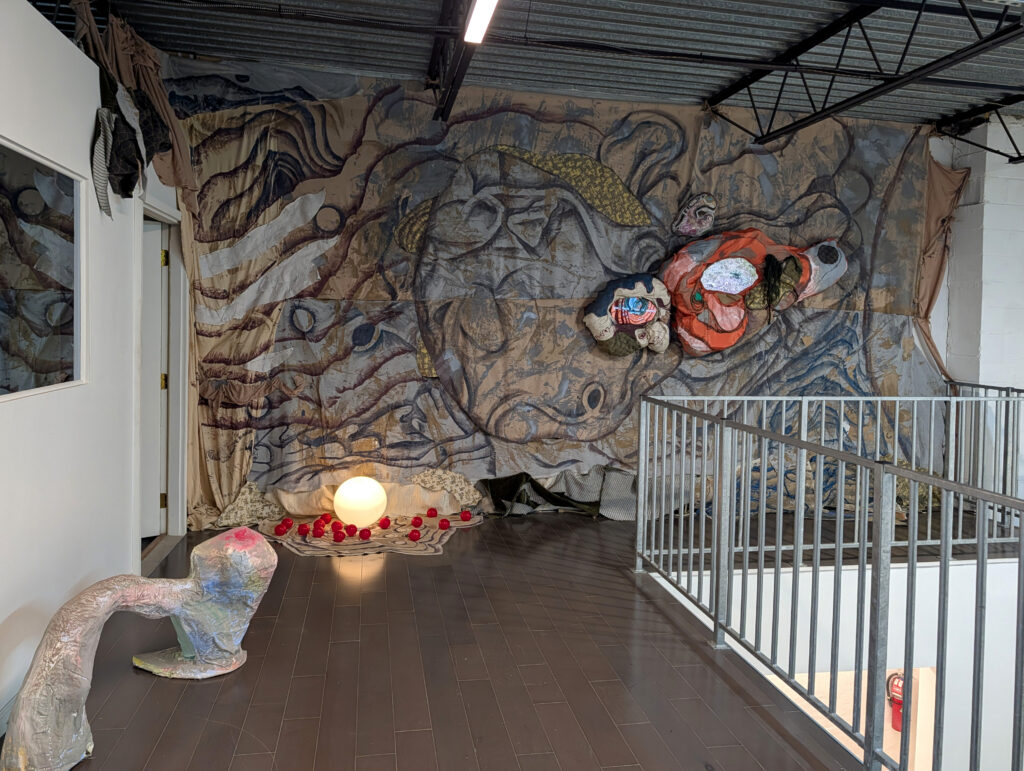
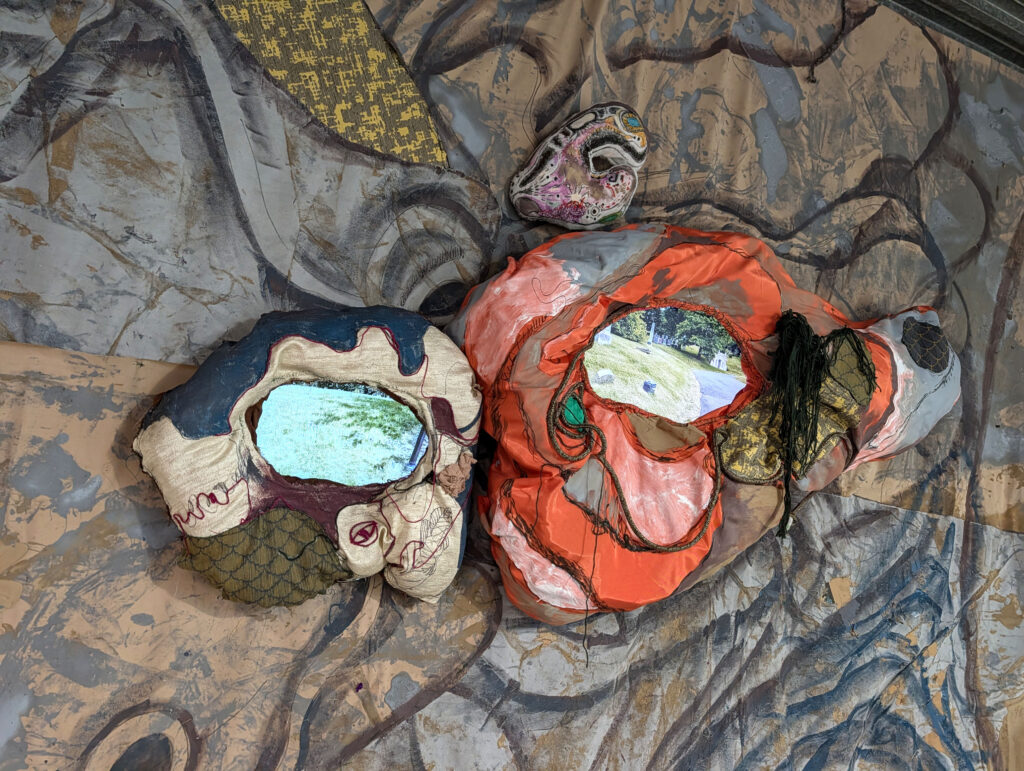
Your installation piece in Overflow at Gallery 198 is a response to the presence of ghost streams in the Sunset Park and Greenwood area. Can you explain what those are, in layman’s terms, and why you chose to make a work about it? What messages are you sending to the gallery viewers who come in contact with this work? What interests you when you bring ecological ideas into your work?
Ghost streams are the historical waterways that existed prior to colonization, prior to the big earth displacements that came from digging up subway tunnels, pouring concrete, developing the urban infrastructure. The buried waterways still flow down there, often reasserting their presence by destabilizing the ground in sinkholes and basement flooding.
My partner found a mention of this Parks Department mapmaker, Eymund Diegel, in our lovely local paper, the Sunset Post. Eymund is an expert on these underground streams, and lives directly across the park from us. He led me on a five-hour walk around the area, pointing out evidence of buried streams, flipping through historical maps that he brought with him in a giant roll. By following these streams, you can discern the footprints of First Nation people, as their hunting trails often skirted ancestral springs.
Eymund advises the city on these histories, helping to improve sustainability in the urban landscape, advocating to surface these freshwater streams, perhaps repairing some of the damage we have done to the local ecology, or at least ceasing to fight the geological forces that NYC has spent its history trying to pave over and forget.
The exhibition has a great digital map commissioned by curator Andrew LaFarge Hamill, which includes ghost streams and sites associated with other artists’ works. Diegel also conducted a ghost stream walk in the gallery’s neighborhood in conjunction with the exhibition on July 21st.
My installation in the show incorporates recordings of my walk with Diegel along with animations that visualize the layering of geological forces beneath the urban environment. All of this is placed against a painted backdrop meant to evoke the deeply rooted layers of our shifting ground.
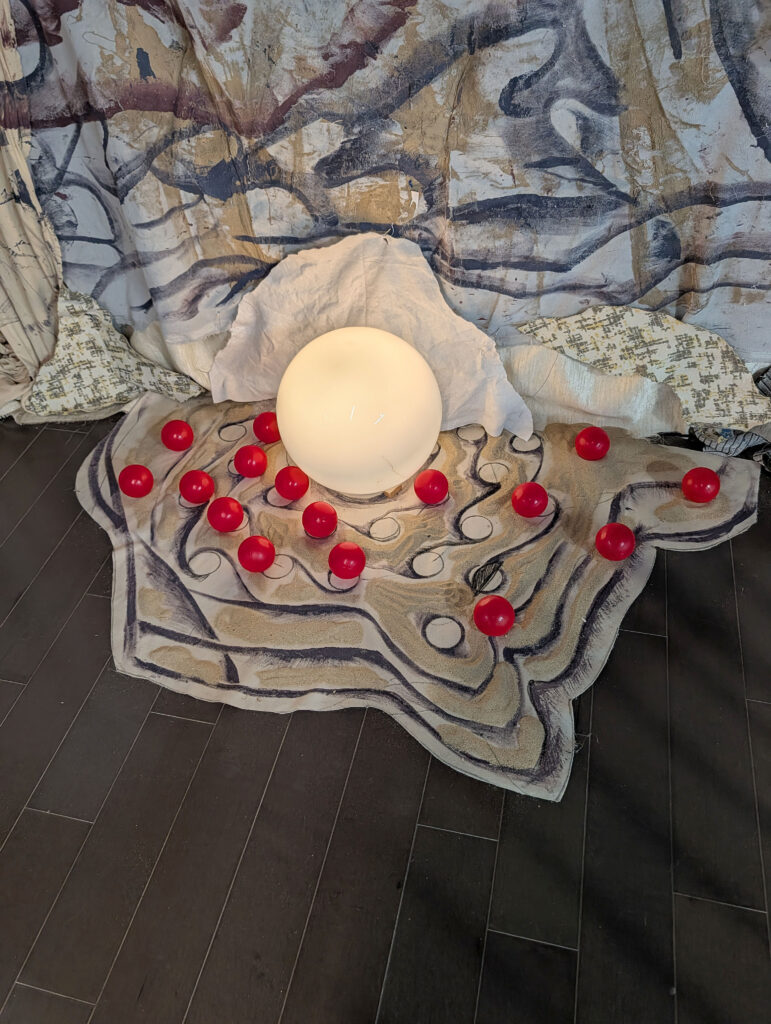
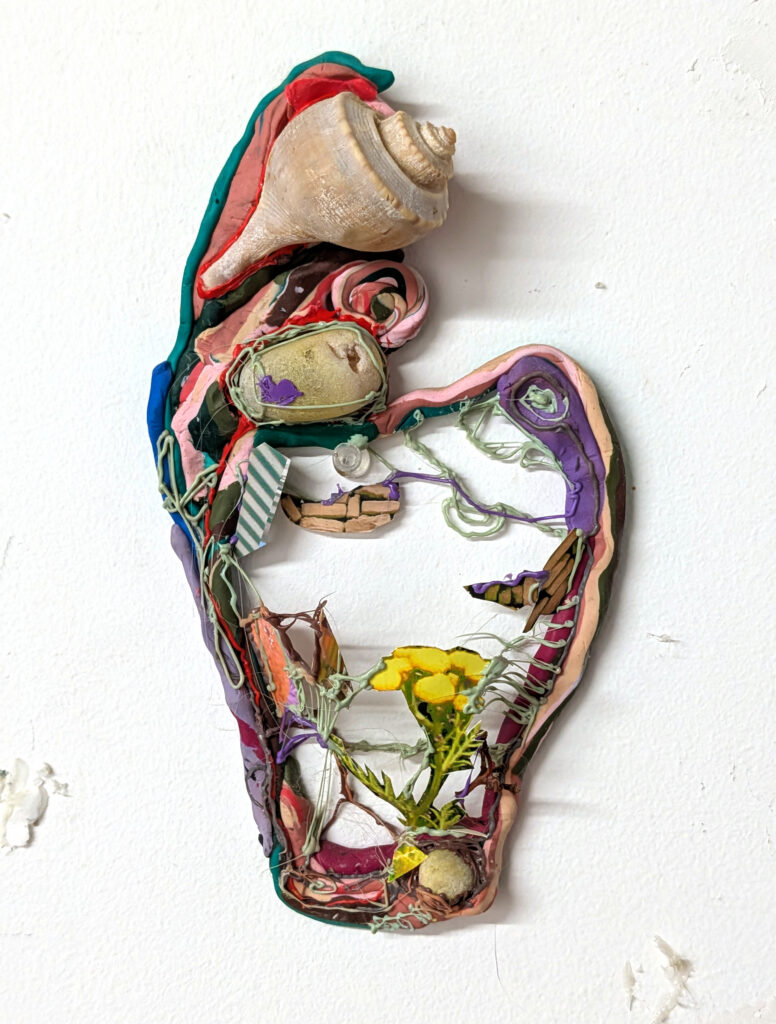
Can you say something about your time at Skowhegan and if any of the colleague artists in Overflow have influenced your work?
Skowhegan School of Painting and Sculpture is like a face plant into wet moss in the Maine woods, but for 9 weeks. Most of the artists and faculty there are urbanites and get deeply inspired by the sprawling, wooded landscape. Many make site-specific works during their stay, and themes of ecological stewardship are at the center of the program. So this subject resonates with our cohort of artists, who have in the years since their time in Maine turned their Skowhegan-sharpened eyes to their local ecologies.
Mary Mattingly and Lilli Chin were both in my year at Skowhegan, and both make work that engages the landscape in powerful ways. Mattingly is currently building up the next phase of her amazing project, Swale, an urban food forest built on a barge, offering free, healthy forage for urban dwellers living in food deserts around the city, and interrogating NYC policies that prevent food cultivation in public parks. Chin made a series of films examining the pollution of Rochester, NY waterways by Kodak developing chemicals, and has interrogated these technologies, which are foundational to our visual culture, for their collateral costs to our environment.
I am so impressed when artists are able to draw viewers in with the pleasures of the natural landscape while also educating folks about ecological issues in which we all have a critical interest.
How do site specificity and immersion dictate the work you make? The piece in 198 is a site-specific wall installation. In Underdonk, I don’t believe the work is site-specific, and yet there too, there are immersive and participatory elements. Can you talk about that?
The central work in the Underdonk show is called “Baal’s Garden”, an installation that has been evolving in my studio for the last three or four years. It’s inspired by the heritage site in Baalbek, Lebanon. Originally a temple to the Phoenician fertility god Baal, the site has been shaped by conquering armies many times over the millennia. Later empires have added to the site, instantiating temples to their own gods, imposing their own state narratives. But the history of former structures remains, comprising a heterogeneous groundwork of ruined statuary that is progressively destroyed and reshaped, perhaps the best homage to a polytheistic fertility god one could ask for.
The floor sculpture of this installation has various soft sculptures that are meant to evoke the scattered statuary of the site, or microscopic organelles. These soft sculptural elements are shaped by templates made from my previous sculptures, but also from tracings of Lebanon’s governates, and other historical maps of the Levant.
The installation is accompanied by a number of screens depicting stop motion animations made within the sculpture, and an interactive work that the visitor can operate.
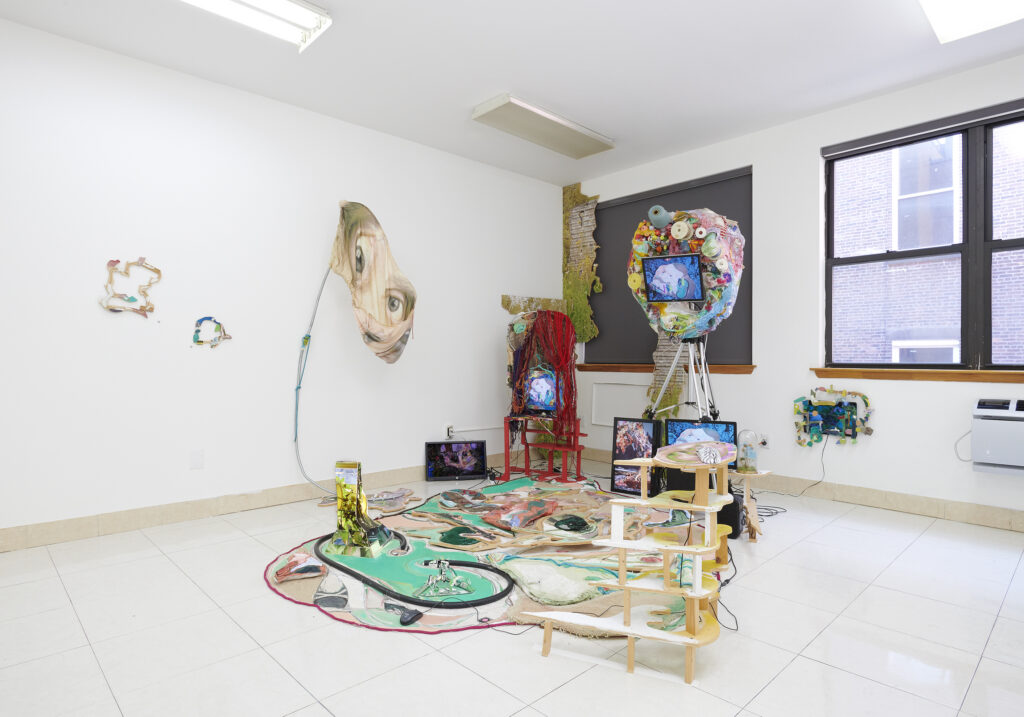
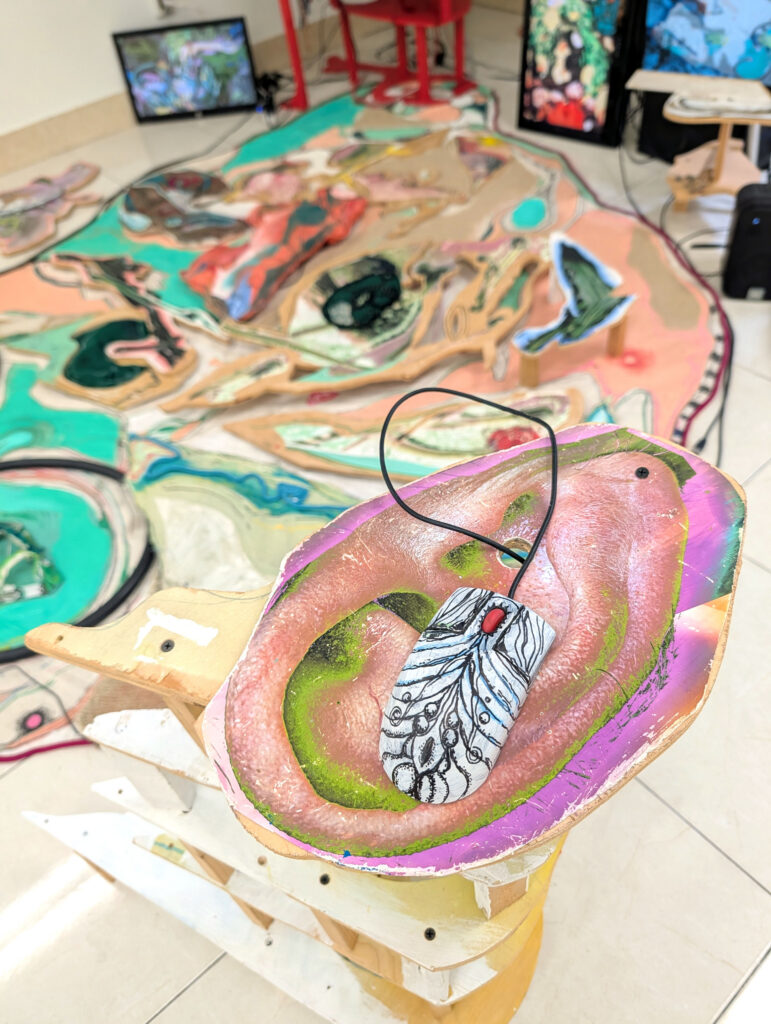
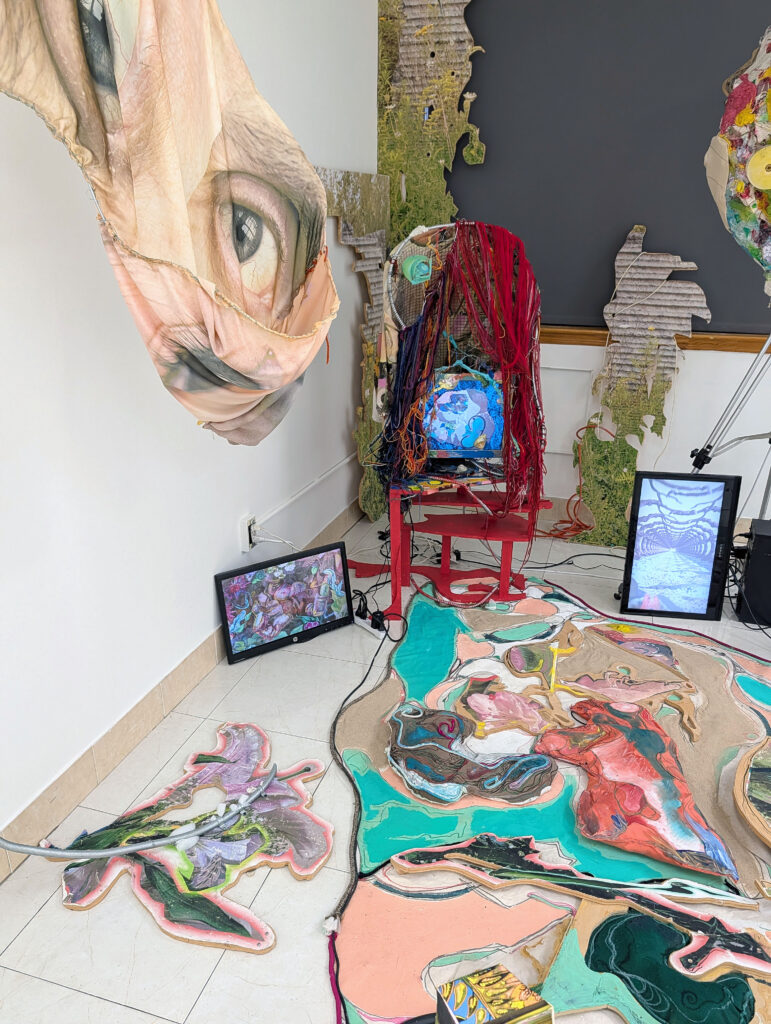
This interactive work is basically a game, allowing you to move digital copies of the installation’s soft sculpture forms, reorganizing the abstract map, an analogy to the nation-building campaigns in which the US is continually staked in the Near East. This game offers no winning, losing, or end state, only endless experiments in recombination that produce the sounds of friction and collision.
While Baal’s Garden evokes an aerial view of the human-scaled world, it is also meant to resemble a microscopic landscape, the organelles, bacteria, viruses that continually jostle for dominance in the cosmos that our skin circumscribes (thanks, Hildegarde). The movement of the organelles evokes the recombinations of proteins constituent in gene editing, the advances in science that promise the ability to reshape us as a species. As we attempt to cure disease, manipulate our physical traits, and transcend the limitations of our DNA, I see an analogy to the desperate attempts to broker domestic stability in the US by redrawing political lines in the Near East, or in the frantic rhythm of emotional peak and trough that cycles us through our minutes and hours of news that is always breaking like so many beach waves.

Be the first to comment