
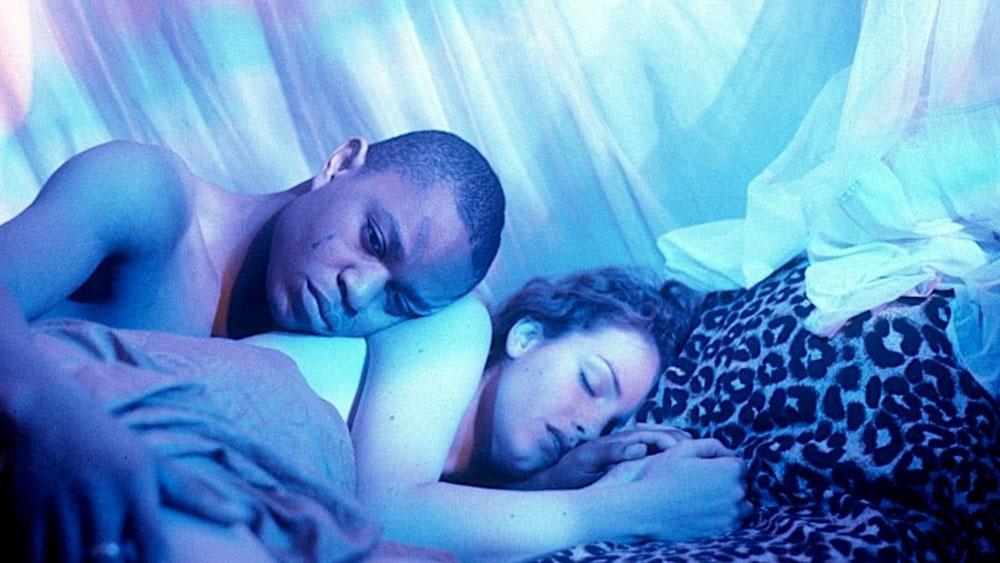
When Ngozi Onwurah’s radically feminist, Afrofuturist tragedy, Welcome II the Terrordome, hit British cinemas in 1995, she became the first Black British woman filmmaker to ever receive a theatrical release there. She also became the subject of massive controversy for her unabashedly polemical approach to depicting taboo subjects from police brutality to slavery to violence against women.
Named for the Public Enemy song, Terrordome tells story of three mothers from different backgrounds and generations–– Anjela (Suzette Llewelyn), a Black radical, Rosa Parkson (Cynthia Powell), a disaffected grandmother living in the same housing project, and Jodie (Saffron Burrows), a white woman pregnant with her Black lover’s child–– all trapped and struggling to find their place in the titular Terrordome, a bleakly dystopian, police-and-gang-controlled ghetto.
The film is located out of time, hinging on the legacy of a group of Igbo people–– played by the same cast–– who refused to be enslaved by a wealthy couple (one of whom is Llewelyn) and chose to drown instead. Their bodies float in between realms, positing the film’s events as a kind of purgatorial inflection point, a spiritual ground on which fights for justice and bitter struggles for solidarity take on cosmic proportions.
This summer, the previously challenging-to-find film is receiving a 2K release from Criterion and a limited theatrical run at BAM in Brooklyn from July 31st to August 6th. Interlocutor joined the director at the Criterion offices in Manhattan this week to discuss the film’s second life, its politics, and its continual power to shock.
Payton McCarty-Simas: I’ve wanted to see your film for such a long time, and it’s so exciting that this restoration means I finally could! How are you feeling? You must feel amazing.
Ngozi Onwurah: It’s great! I mean, for any filmmaker, to have a film you made thirty years ago get this whole new life? Criterion and Janus are doing a brilliant job of how they’re doing it as well. In a way, it’s gotten bigger as well, because it was incredibly low budget–– beyond low budget–– so when it had its cinema release, it had, like, one poster, you know what I mean?
It’s exciting and it’s sad, though. It’s exciting to have new people see the film and everything, but then one of the big reasons there’s been a resurgence with this film is because it’s still so relevant to what’s actually happening. Obviously, that’s not what you want. You would prefer it to be like a historical piece about what things were like. One of the big responses when it came out in England was this idea that it was too violent, too nihilistic, in terms of what it was saying. But now it doesn’t even feel that extreme anymore. During Black Lives Matter, you saw police on camera kill people. You’ve seen it, and so Terrordome is in that place.
Completely. I understand that, at the time, people were often comparing its politics to the radical films of the ‘70s. I was also thinking a lot about Born in Flames (1983) watching this film, and New Jack City (1991), actually, in terms of some narrative parallels. But with respect to questions of rage and violence, do you have a philosophy of political rage? Do you think your feelings on rage have evolved since this film?
My feelings have evolved, but I wouldn’t change anything about Terrordome. It was my angry film, right? I was furious, and I couldn’t believe that the world didn’t understand what was going on. It was naiveté that people just didn’t see it. So, I was asking, can they see what I see? I also was very into hip hop, especially Public Enemy. I don’t have solutions, but I’m angry and I’m entitled to my anger.
In England, when it came out, there was this idea that I wasn’t offering any solutions. People especially hated it when the Rosa Parks character said she didn’t give a shit about the Jodie character, right? They said it was extreme Black Nationalism, and where would that lead the world? There’s this idea that people who are victimized have to come up with the solutions to their victimization and their oppression, when the whole of the United Nations and all the countries in the world can’t do it. Like, before I get to tell my story, I have to come up with a 10-point plan about how to eradicate racism or to allow people to live in peace. [Laughing] I’m getting angry again. Anger is logical. Anger is justified, and I don’t have to keep it under wraps until I can offer a solution.
That’s so classic, right? The idea that marginalized artists of any kind––queer artists, Black artists, whoever––have to present solutions rather than just make art about their experiences. You don’t see people asking Quentin Tarantino or Martin Scorsese to solve mob violence. It’s ridiculous.
That’s exactly the thing. Then there was the added thing that I was a woman, right? I was a woman, and I’m mixed, I’m biracial. Biracial people’s role has always been as the in-betweeners, the go-betweens, the nice people in the middle. Then women are supposed to be the peacekeepers. We’re not the violent ones. So there was a lot there. The anger, the fact that it was British, and the fact that I’m a mixed woman was hard for people in England. American violence is much more overt.
So Terrordome is thirty years old. Could you set the scene a little bit for younger readers in terms of the cultural context of the film and where you were at as you were preparing to make it?
I’m of British Nigerian origin. My younger years were in Nigeria, then I came to England. My mum’s white, my dad’s Nigerian, and we ended up in her hometown, which is a place called Newcastle. There were no Black people there. We were the first, and it was incredibly racist. She was white, and people didn’t understand that a white woman could have Black children. They didn’t understand that was a thing.
It was an incredibly hard place to grow up, and I grew up not wanting to be Black. I slept with a nose peg on my nose, I put bleach on, all that, because there was no place to find yourself there, right? But as a teenager, I discovered Malcolm X and hip hop, and they led me to finding who I was. So I moved to London with this very complicated relationship to my identity. Then I went to film school, and Terrordome originally started off as a film school project. It was a 20-minute workshop about music and film.
Was that the one you worked with Isaac Julien on?
Isaac Julien was when I did my undergrad at St Martins, a very liberal, trendy art school with an entirely white faculty and only two Black students in all three years of the course. They brought Isaac on to be my guiding professor so that I would have someone to talk to. I worked with him on two of my films there, Coffee Colored Children (1988) and And Still I Rise (1991).
That’s so cool. He’s so amazing.
Yes, and you know, to be fair, it’s great that they did that. You don’t realize how centered everything is around white people until you finally know the center yourself. So Black Audio Collective and Isaac were huge influences on me.
In terms of England and setting the scene. Everything that happened in Terrordome was based on a true story, but it was spread out over maybe a five or ten-year period, I just made it happen on one day to give it urgency. These are all real things, but when they’re spread out over time, the urgency gets dissipated. I was in London, which has the biggest Black population in England, but it’s a much smaller percentage than in America and there were all these police murders of Black people. I was thinking of the [1993] Stephen Lawrence murder in particular. So that was the context in which the film was made.
Can we talk about maternity a little bit? In this film, I feel like these parallel mother figures–– Rosa, Anjela, and Jodie–– tie all the themes together. Anjela and Jodie’s stories together feel so taboo-breaking and beautiful in so many ways. One small moment that struck me on that score is that scene when Jodie and her lover, Spike (Valentine Noyela) are dancing together. Watching it, I realized: I’m twenty-seven, it’s 2026, and I had never seen an eroticized image of a pregnant woman quite like that in a movie before, just dancing and being sexual in a casual context. I’d love to hear more about your relationship to maternity and what you think that those three characters’ motherhoods bring to the film.
They were the foundational characters of the film, right? I had the idea of these two archetypal Black women characters, and then there’s the white woman. She’s still oppressed, but the history of white women in relation to slavery and Black civil rights is very specific.
Yes, and you highlight that complicity right off the bat in the opening scene on the beach with this woman watching the slaves being inspected, wanting to help, and ultimately doing nothing.
Yes, that idea that white women are definitely oppressed and all that, but there’s a point where they lean into their own privilege very strongly. So, Jodie was representing that, but she was also my mother, right? Mixed ideas about finding everybody’s place within the story.
That said, I was particularly interested in the two Black women. Black women, especially Black mothers and grandmothers, are the reason the Black race has survived with their humanity intact. Those women knew, when they were carrying their babies, that these were valuable, precious lives, no matter what anyone was saying. They knew that on an intuitive, absolute, maternal level, and they are the ones that teach humanity to the next generation. But also, because of that, quite often Black women have played the game more, put their heads down, worked all these jobs, and put bread on the table to make sure we survive.
I always think that when Black women’s rage turns outward, that will be the most dangerous, radical point in time. So that was the idea: This is a story about what could eventually happen to make Black women finally just turn. What happens if you don’t just want to be grateful, if you actually do want revenge in the end? That’s a very dangerous subject, and you’re not supposed to talk about that.
In terms of the reception you received at the time, I’m sure you were pissed. I read a couple of different reviews where you were misgendered––
Was I?
Uh-huh! I caught one where you were fully just described as a man.
[Laughing] oh my God! All right! I didn’t know about that…I mean, it makes sense I suppose, because nobody knows what “Ngozi” means, and then it’s a film that you could think was directed by a man, if you wanted to, in terms of subject matter? Though I don’t think that’s right, really, because it’s about the journey of these three women.
How did you feel about the reception in general at the time?
The response in Britain was explosive. I was expecting that from white outlets, but there was some pushback from Black outlets as well, especially Black academics. Paul Gilroy, for example. They were saying, you know, “We’ve come so far, films like this will take us back.” The idea was that you needed to work within the system and play the part the system wants you to play in order to advance.
That’s the luxury of being a white artist: You can have all these different lanes and genres, right? Whereas our genres were very clear. We had two at that time: comedies or urban gang films. We had some really fantastic supporters as well that came out and were in our corner with Terrordome, but it was a real shock to the system that some of that backlash came from Black folks. I’ve had a lot of subsequent emails where they retracted, though. In fact, one person wanted to rewrite their whole article! I guess that’s where the thing about it being a bit ahead of its time comes in.
It makes me think about the response to Derek Jarman and questions of queer respectability politics as well.
No, exactly! He’s become an icon subsequently––some people might even say he is part of the gay queer filmmaking establishment––but he earned that place by being so radical at the time he was doing it.
I mean, John Waters is a fine art collector now. The way time works… [laughing] it’s awesome. In terms of the long arc of history on this front, though. You were the first Black British woman to have a theatrically released feature film. It took a decade for that to happen again–– the next one was [Amma Asante’s A Way of Life] in 2004.
I think there’s only five or six, even now. Maybe I’m missing some of the younger generation, but it took a lot. It was ridiculous how long it took. Destiny [Ekaragha, who made Gone Too Far! in 2013] was actually my intern on Shoot the Messenger (2006).
How do you feel about that? When we’re talking about the politics of the film, there’s something similar there I think. It’s tragic because we haven’t moved forward as far as we’d like, and the numbers globally in terms of women filmmakers are deeply frustrating. But do you have any hope on that front?
I don’t know! The Venice Film Festival had twenty films in competition, and only one by a woman this year. It’s obviously better, but it feels like the major breakthrough hasn’t really happened yet. With Black film, you know, you can watch Sinners (2025), you can watch Moonlight (2016), there’s a range that never existed before, and it’s the same with women directors, they’re not as pigeonholed as they used to be. But things like Venice are still good indicators of the lay of the land. That said, the world is so fucked up at the moment, but I do really admire Gen Z.
What do you think Gen Z can carry forward from Terrordome?
You can’t lose the rage. The rage is the purest form and the purest response. You have to be clever, you have to be strategic, you have to be disciplined, but don’t forget the rage.

Be the first to comment