
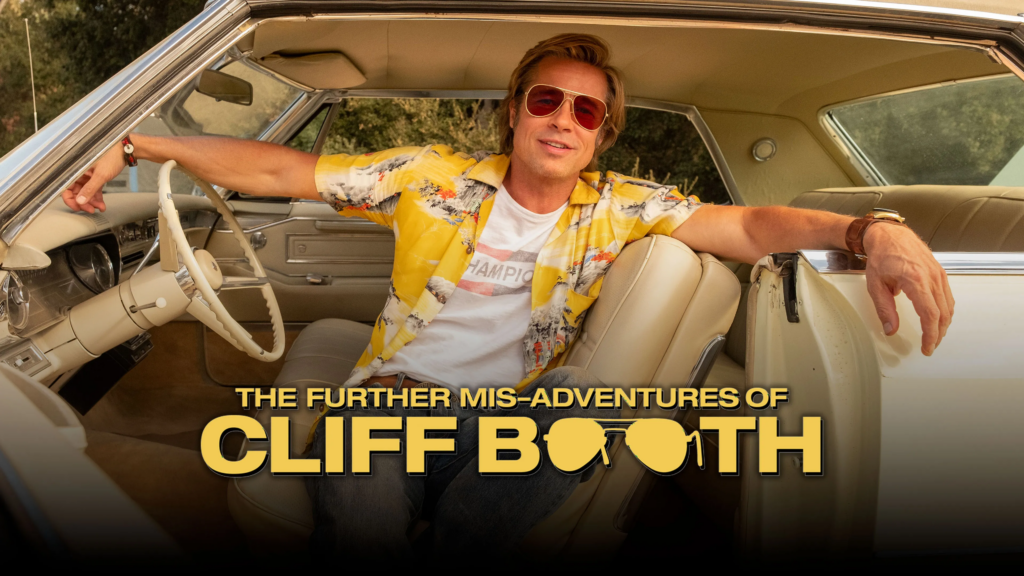
Whether you’re making a mean margarita or a big ol’ ice cream split, bananas have a tendency to get more than a little beat up in service of a good treat. Cliff Booth (Brad Pitt), the unsung stunt double to yesterday’s cowboys and the rumored savior of Hollywood’s golden years from Quentin Tarantino’s Once Upon a Time… in Hollywood (2019), is a lot like that. In the wonderfully strange and shaggy follow-up that is The Further Mis-Adventures of Cliff Booth, Tarantino’s brainchild with another ‘90s cool kid, David Fincher, he’s been around, he’s still around, and everybody thinks they know him from somewhere, they just can’t quite put their fingers on it. It’s 1977, and Sharon Tate is just another working actress, slingin’ Red Apple cigarettes on the boob tube. Hollywood is, as the film’s location titles that all include their relative distance from that hallowed ground attest, still the center of the universe in this laid-back alternate reality.
That doesn’t mean things are all peaches and cream for our self-consciously anti-heroic hero, though. Cliff works as a projectionist at the New Bev part time, shakes n shimmies up all manner of tiki drinks at a dive called Lucy’s where he expertly flirts with a sea of mud-wrestling, big-haired co-eds on a shit-load of mushrooms (labeled “sillysibin”) that he chomps while brushing his teeth, and does “favors” for friends if the cut is right and the cause is just. He’s a little worse for wear since the summer of ‘69––his shoulders are busted, he’s got a limp, his robin’s egg Le Mans is rusted a queasy shade of teal––but he’s undeniably charming and never lost the wry, bemused sense of humor that earned Pitt his trophy for the role. He lives with his beloved aging dad these days, keeping track of coupons for peanut butter cookies and cat food, watching a whole lot of TV. Shit happens. Times are tough, but hey, so is Cliff.
Like Tarantino’s Oscar-winning, conservative paean to the goofy good old days of yore when men were men and women wore gogo boots, Further Mis-Adventures is a glowing, wildly retro tribute to never-quite-had-its and has-beens who still got it––to manly men with straight morals that always come off looking more than a bit crooked. More than anything else, this is a collaboration between three men, Tarantino, Fincher, and Pitt, who all clearly adore this character, expertly crafting a gentlemanly ‘70s man’s-man who could’ve been ripped straight from the pages of one of John MacDonald’s Travis McGee novels. Cliff is a good guy, more or less, but it’d be pretty damn hard to tell just from looking at him. He’s a shameless flirt, a casual criminal, a part-time pornstar; he’s also the kind of guy who’ll drop everything to help anybody who needs it without thinking twice about bodily harm––and it goes without saying that he treats his women right. He’s truly old school, for good and bad (and there sure is a lot of bad, particularly in an early scene that takes the homophobic, paternalistic subtext of his hippie-bashing in the previous film to a far more overt place).
He doesn’t ever really help his own case much, either. People ask our jack-of-all-trades about his previous adventures and he consistently demurs, preferring to blend in with the background, scruffy good looks, impeccable style and all. What happened with those Manson kids, anyway? Weren’t you the guy who kicked Bruce Lee’s ass? Nobody ever gets a straight answer; Cliff puts up an affable, but clear front. A certain stand-out nondescriptness serves him pretty well, thank you kindly, if it means he can earn a couple thousand for getting stolen treasures back for a fading director on a weeknight and avoid unnecessary ass-kicking. The preening Rick Daltons standing out front may get all the glory, but they lose some ineffable toughness in the process––they’ll always need someone, to quote Cliff in the previous film, to carry their load. Top banana’s a funny phrase, one that comes up a couple times in this flick, because bananas are never on top in the desserts and drinks that bear their name; they hold everything together, casually unnoticed but delicious, the key to the whole damn thing.
More than a battle of auteurs, then, this movie reads like an amicable bull session between guys with similar tastes. There’s no top banana here either, really, it seems to be a collaboration predicated entirely on chill. Mis-Adventures talks like Tarantino and walks, for the most part, like Fincher affectionately walking like Tarantino. Like Cliff, Fincher’s understated and assured pulling off this maneuver, showing off his skills with a surprisingly agile camera like it’s just another day, tossing slick action into the cocktail shaker and letting it foam over. The end result plays like another one of the other director’s non-tenth-movie movies, and easily slides into Fincher’s canon, too, neither a productive friction nor a tense mismatch. It’s all the more pleasurably loose for the mix, an ode to surfing channels on TV or spinning the radio dial before putting in a request for someone you care about. It’s unsurprising then, that this is, first and last, a boomer dad movie supreme (depressing AI use and all), somewhere between meandering, plotless ‘70s comedies like Every Which Way But Loose, stoner-y ‘70s mysteries like The Long Goodbye (Cliff should by all rights be a private dick for everything else going on here), and self-conscious meta-showbiz flicks like The Player.
There is a plot here––it deals with an arrogant TV star, an old flame, a new flame, and a half-assed murder scheme––but it’s not really the point. The best Cliff moments in Hollywood were scenes of non-action: making mac ‘n’ cheese with his dog, getting high, drinking a beer and fixing a TV antenna, shooting the shit. The same is true here. Cliff’s spitfire upstairs-downstairs romance with Crosby (Elizabeth Debicki), a former movie critic (yes, Tarantino found something to do with that idea here) is deeply charming; “I don’t date men for what they can do for me,” she deadpans in an early flirtation. “Well you should definitely consider me, then,” he replies with a grin; eventually they strike up a romantic rhythm that nearly evokes old-school screwballs. She hits a premiere, he takes her to the demolition derby; he sweeps her off her feet, she slaps him in the face at his request. They’re great doubles partners on and off the court, and so are Pitt and Debicki. When Cliff tells Crosby “We’re doomed to be together, it’s obvious,” the crackerjack dialogue, made warmly alive by their strong and easy chemistry, rings comfortably true. The broader ensemble keeps things grooving in the right direction, too, particularly Scott Caan as the blowhard TV star and Peter Weller as Cliff’s dad, a gruff pawnshop owner who quietly cherishes painting model race cars with his kid in his later years.
Like the character the film is so dedicated to, The Further Mis-Adventures of Cliff Booth is a take-it-or-leave-it kind of a hangout movie, a Burt Lancaster picture your dad might’ve told you about once, but you can’t really remember. It’s not going to explain itself and it’s not going to tie things up neatly. That deliberately throwaway title winking at you from the poster says a lot on this score: this is an interlude, a week in the life, something you could just as happily walk into midway through or settle on while changing channels. It’s a no-frills treat; a banana split.
Talking to an ex-lover who’s casually wondering about the point of things, Cliff’s got this to say: “Weren’t good times had by all?” Talking to himself, looking out over the theater he’s accidentally turned into his own private kingdom, he’s got this to say: “It don’t mean shit to me.” When it comes to this zany, rambling throwback, you’ll have to take your pick. Cliff sure isn’t gonna do it for you.
You might also like:
“Fear and Cinema Are Inextricable”: Kiyoshi Kurosawa on THE SAMURAI AND THE PRISONER
David and Liani Greaves discuss ONCE UPON A TIME IN HARLEM
“You Can’t Lose the Rage”: Ngozi Onwurah on her film WELCOME II THE TERRORDOME (1995)


Be the first to comment