
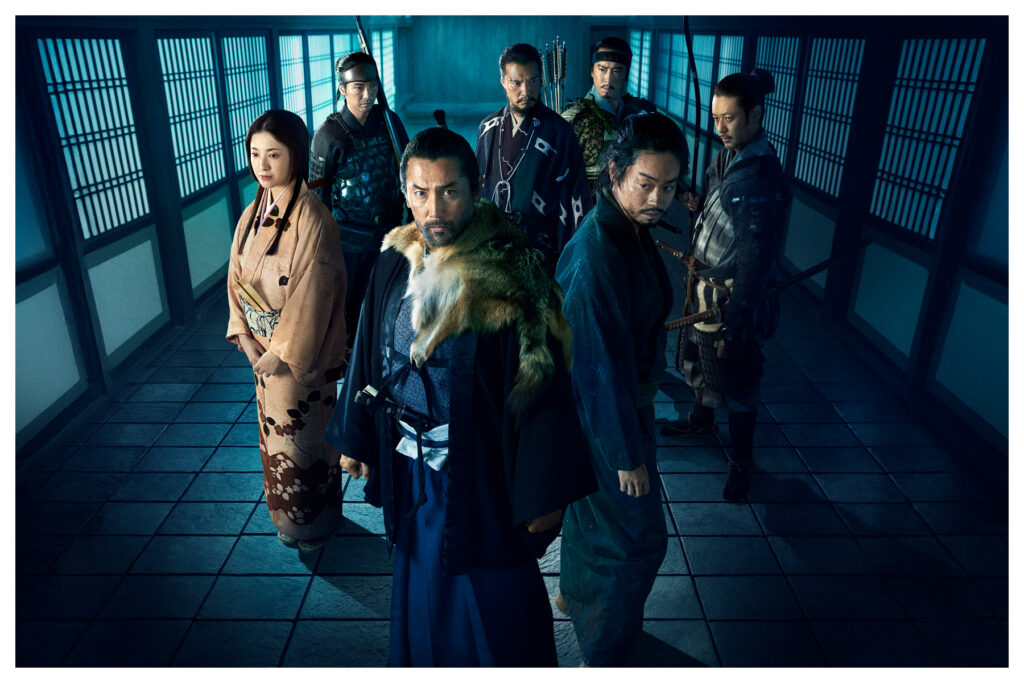
After plumbing the depths of modern alienation with classics like Cure (1997) and the terrors of cybercapitalism with thrillers like Pulse (2001) and Cloud (2025), this year, Japanese genre master Kiyoshi Kurosawa is looking backwards. The Samurai and the Prisoner, his latest, is a dryly comic, overtly existentialist puzzle box mystery wrapped up in a period drama the likes of which he’s never previously explored.
Set in 16th century Japan amidst a factional power struggle plagued by omens of karma gone bad, it follows a samurai, Murashige (Masahiro Motoki), who is no longer to kill unless absolutely necessary, a moral principle his men view as a dangerously samurai-code-breaking affectation. As his allies dwindle and unexplained violence strikes his castle, he takes an enemy’s wise and witty emissary, Kanbei (Cloud star Masaki Suda) prisoner, striking up a pas de deux somewhere between Throne of Blood and Knives Out.
Motoki delivers a nicely commanding performance shot through with bluster and naivete that plays off of Suda’s slippery, semi-satanic charisma. The plot is tangled and full of switchbacks, an exploration of ambiguities and political parlor tricks. Interlocutor joined the director in Manhattan this week to unpack some of the film’s thornier moral questions.
Payton McCarty-Simas: This is your first period piece! That’s very exciting and a huge contrast to your last film, Cloud (2025), which is very modern. You’ve said that you were nervous about working in the past on this film; I’d love to hear more about that experience.
Kiyoshi Kurosawa: I’ve watched jidaigeki [period pieces] my entire life and I’ve always had a kind of simple desire to work on one. When I thought about a period film, I was always thinking about chambara, which means a samurai film that involves a lot of action and sword fighting. When I received the chance to work on this project, though, the producer brought this novel to me. I read it, and it wasn’t a book that had much action at all–– the drama progresses through dialogue that takes place almost entirely in a castle. It’s a fascinating novel, but I was also initially confused about how I might be able to translate this into an interesting movie.
That being said, if I was brought a jidaigeki project based on a novel that depicted an extremely successful protagonist who ends up grasping all of the power and the authority in the end, I don’t think I would be interested in that story. What’s important about this story is that it’s about a person who basically discards his power and authority. That is very similar to Cloud in the sense that I’m not really interested in stories that end in the success of the protagonists or a kind of happy ending. I’m interested in protagonists that have to discard the sense of stability and peace that they want to experience and go forward even if the world ahead is very dangerous. So even though this takes place in a very different period from our contemporary time, the similarity of trajectory that the protagonist has to go through helped me to formulate a film that made sense to me.
That definitely comes through here. The Samurai and the Prisoner feels very modern in a lot of ways, not only in terms of how it flows, but in that the psychology is so sharp that it feels very accessible. Murashige is kind of a detective as well as a politician.
Something I wanted to talk about that came up a little bit just now is the idea of witness, evidence, and speech in this film. Each chapter is organized around instances of witness: you have characters explaining things, then Murashige writing everything down, and then the translative process of Kanbei interpreting it as evidence in the mystery. Even though this is a movie that investigates the act of killing on a formal level, it ultimately feels more like a movie about the way that words can kill and the politics of that idea.
That’s a very interesting thing that you point out, and as you said, the power of words is an important theme within the film. Murashige certainly moves through the story as if he is a detective; he wants to solve the murder and figure out the murderer’s motivation, and that is very much like a mystery novel. I think what’s most important to Murashige, though, is not solving the mystery, but rather how he is going to convey the solution to his retainers in a way that might satisfy them. What is most important to him is maintaining order in the castle and retaining what little authority he actually has. He is a figure that must lean on the power of his words in order to retain that kind of power. Then we encounter Kanbei, who uses words in a very different fashion, and eventually ironically uses his words to manipulate Murashige. Language is sometimes used as a weapon in the film, and it’s also the thing that saves certain figures.
Definitely, it’s so political that way. Watching this film, I was also thinking a lot about the way that status plays into those same dynamics. These characters may operate on this very rigid hierarchy, but at the same time, sometimes–– without spoilers–– the people with the most knowledge are people who have the least power. What can you tell me about those hierarchies?
I wasn’t really considering the importance of knowledge and how information was spread in sixteenth century Japan when I was making this film [laughs], but as you are pointing out, Murashige is a person that knows surprisingly little. It’s very ironic, because in solving the murders, he is basically reliant on what Kanbei knows and what Kanbei is able to figure out, and then he takes that message and conveys it to his retainers. Even with Chiyoho, he basically doesn’t know anything about what she’s saying. So, in many ways, he’s kind of a useless figure [laughs], and I don’t think that would have been uncommon for the period–– I don’t think it was common for people in authority to really know about or organize information on their own. They had many people that they consulted with, and all they needed to do was know what they needed to know in order to deliver a decision. Often those decisions were based on a gut feeling, or even things like the whims of their personality, so I don’t think that people in authority at that time were the type to glean information on their own and use that information as motivation for how they might make a decision.
In terms of giving information to the broader public politically, another idea that interested me is the way fear is used in this film. Whether someone rules with fear is so central to Murashige’s arc–– he’s trying to find an alternative path in contrast to the other faction he’s fighting. Ironically, his lack of desire to kill often leads to more death than were he following the kind of rigid structures and hierarchies laid out for him. Do you have any thoughts on the way powerful people wield fear in the film?
It’s true that Murashige doesn’t resort to violence in the same way that perhaps people in similar positions of power did during the time, but he’s also someone who waivers around violence as far as his values are concerned. Eventually he abandons power and authority altogether, but he wasn’t always this way. I’m sure that historically, in order for him to climb the ranks, he would have needed to kill many people above him in that hierarchically to gain his power. He also definitely uses fear to deliver his orders to his retainers.
He’s someone who understands the power that fear holds over people and how that needs to be used to gain authority–– until at some point he decides he doesn’t like that anymore. I’m not sure that this answers your question, but certainly there’s always been a very strong connection between fear and power–– under the feudal period of the film in particular–– and I think that’s also true of contemporary times. When he discards the fear, then he must also discard the power.
On that same topic, I would love to hear more about what fear as a driving force means to you and your work?
That’s a pretty difficult question to answer, so I want to talk about it in a bit of a different context from even my own films. I think that for me, the experience of going to a theater–– a theatre getting dark and the film beginning–– is always this experience of bracing for something very scary to happen. In bracing myself, though, I’m also excited and I have this sense of anticipation, and I think that feeling very much has to do with the generation I grew up in. If you’re my age and grew up in Japan, the first films that you would have seen in the theater were monster films. You would sit in the dark theater, then very scary music would start, and you would watch cities be destroyed and people be killed. That’s what a cinematic experience was for me, so in a sense, I’m always thinking about fear as equivalent to what the experience of film is because of my experience as a young person. It’s something that I still think about!
I don’t think that a film could be interesting at all without some kind of fearful or scary component. Fear gives the protagonist something to rub up against, something to overcome. Sometimes the protagonist must accept the thing that is very scary. At the end of those films, I come out of the theater with a sense of relief and appreciation for the kind of stability and peace that I can experience in my life. For me, fear and cinema are inextricable.
The Samurai and the Prisoner is screening in theaters now. Click here for tickets.

Be the first to comment